
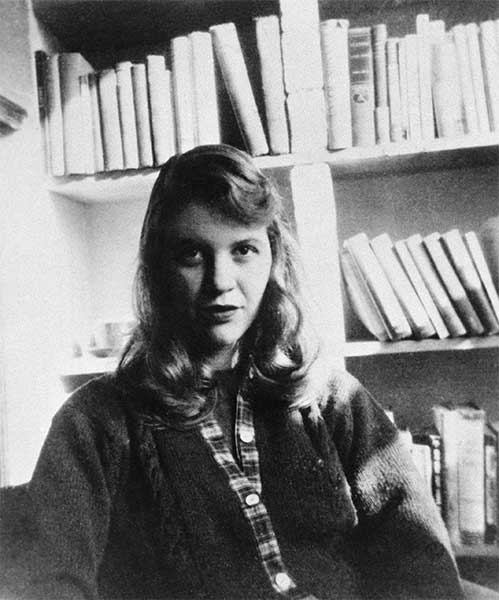
Sylvia Plath did not enter Ted Hughes’s life like a calm woman. She arrived like a collision. Cambridge, 1956. A crowded literary party, cigarette smoke hanging in the air, young poets pretending not to notice each other while secretly wanting to be seen. And then Sylvia saw Ted. Tall, dark, almost animal-like in presence. Ted saw her too — not as another girl in the room, but as a force.
Their first meeting already carried violence disguised as passion. Sylvia later wrote that she bit his cheek hard enough to leave marks, and he tore her headband. Who begins a love story like that? Not ordinary people. Only two people already burning from inside.
People always try to simplify their story. They want one villain and one victim. I cannot fully do that with Ted Hughes. Maybe because in the beginning, his love for Sylvia looked frighteningly real. Men do not marry women like Sylvia out of convenience. She was too intense, too intelligent, too emotionally sharp to be loved halfway. Ted admired her mind before the world did. He read her poems seriously. He treated her like a writer. And for a woman in the 1950s, that kind of recognition itself becomes seduction.
Sometimes I think Ted did love her. Truly. But love and loyalty are not twins. People confuse them all the time.
The tragedy of Sylvia Plath is not that she loved the wrong man. The tragedy is that she loved with her entire existence. Some women know how to leave pieces of themselves untouched. Sylvia did not. She poured everything into love — her body, her poems, her jealousy, her devotion, her hunger to be chosen every single day.
And maybe that is why betrayal destroyed her the way it did.
People say, “Once a cheater, always a cheater.” I do not know if that sentence is philosophically true, but emotionally it exists because betrayal repeats itself in patterns. A man may change his actions, but the wound he creates inside someone else never changes. Every woman who gets cheated on starts questioning herself before questioning him. Was I not enough? Was my love too heavy? Too loud? Too demanding?
But Sylvia’s story proves something terrifying: even being extraordinary cannot save a woman from abandonment.
Ted later became involved with Assia Wevill. Beautiful, intelligent, magnetic Assia. Another woman entering the same fire Sylvia once entered. And suddenly Sylvia was no longer the center of Ted’s emotional universe. Imagine the humiliation of that realization. Imagine being Sylvia Plath — Sylvia Plath — and still getting replaced.
That is what breaks my heart the most.
Not because Ted left. But because Sylvia stayed emotionally long after the relationship had already started dying.
London became almost gothic around her final days. Winter freezing the city. Two small children sleeping in the flat. Silence pressing against the walls. Her marriage collapsing. Her mind turning against her. And somewhere in another part of life, Ted Hughes existing beyond her reach.
11 February 1963.
That date no longer feels like history when you read Sylvia closely. It feels like tension slowly tightening until there is no oxygen left. She sealed the kitchen, prepared milk and bread for her children, and then ended her life before morning fully arrived. There is something unbearably heartbreaking about the ordinary details of death. Not drama from cinema. Just coldness. Exhaustion. Silence.
And still, even after death, Sylvia remained louder than everybody else.
That is the irony.
Ted Hughes continued living. Sylvia Plath became immortal.
Her pain turned into literature people still underline decades later at 2 a.m. after heartbreaks of their own. Her confessions became other women’s confessions. That is power. That is why people still feel her breathing between lines of poetry.
And Ted?
I think Ted spent the rest of his life haunted by her presence — not only by guilt, but by the impossible reality that sometimes the person you fail becomes greater than you after destruction. He wrote Birthday Letters years later, almost like a man finally speaking to a ghost he could never escape.
Maybe he loved Sylvia. Maybe he betrayed Sylvia. Both can be true at the same time.
But Sylvia loved in a way that consumed her completely. And people remember that kind of love forever because most of us are terrified of feeling that deeply ourselves..
By – Tiyasha Khanra
.
I like your willingness to speculate on this terrible event. I taught a few years where David Wevill taught. He is retired and still in the area. The man continued, although I don’t think he recovered from Asa’s killing of his children. He was very withdrawn.
I once watched a man put his arm over next to a woman’s head and lean in close as she was against a wall in a movie theatre. It seemed French romantic, but I didn’t like his behaviour. After the man left, she said, “He was magnetic. I liked his poetry, but I know better to get involved with a man so intense.”
Some people, be they man or women, have intense sex drives. Sometimes the reason and women or man cheat can be quite simple. They need more sex that the partner wants to provide. Some can see sex as the highest sacred ritual act. The Hindus have sects that believed that, thus tantric sex. Sex is the way they talk to the divine. Others may just be great hedonists. Either way, the drive is very powerful and almost impossible to control, be they man or woman.
Comment by Charles Taylor on 13 August, 2026 at 9:43 pm