
British Progressive Rock, which was prominent in British rock culture between the late 1960s and the early 70s, seems despite the odds to live on. As passionately loved by audiences as it was sneered at by critics, it should have sunk below the horizon in the mid 70s as new forms of popular music dawned – disco, punk, hip-hop, new wave. Grandiose, overblown, preposterous – the derision frequently lobbed at Prog was arguably justified. It seldom settled into a groove, you couldn’t dance to it, it wasn’t rock and roll, it only appealed to men, and so on. Yet it had a quality that has become over the years since its initial decline distinctly lacking in popular music in our driven-to-the-edge-of-madness consumerist culture: ambition. Largely confined to albums, Prog tracks were frequently long, complex, lyrically obscure, occasionally infuriating, often just plain baffling. Tricky time signatures, continually shifting motifs and progressions, impenetrable lyrical themes – prog didn’t do the conventional three-and-a-half-minute pop music thing. Prog was Concepts. It was philosophical. It was Deep. It did warp drive. It did strange new worlds. Occasionally it threatened to unhinge your mind. Sometimes you had to rip the stylus off Topographic Oceans and slap on Iggy singing I Wanna Be Your Dog to reset your sanity. It was absurdly pretentious and yet ostentatiously glorious all at once. And it knew that.
And so, despite – or because – of all this, it seems prog refuses to entirely go away. If you dig deep enough you will find prog living on in music being made by younger performers – a healthy subculture championed by vintage prog remix supremo Steven Wilson with his band Porcupine Tree, along with Opeth, Wobbler, Big Big Train and many others. In current mainstream media pop music is generally understood to be the preserve of solo artists, and when female most often singing about men and what twonks they invariably turn out to be should you be so foolish as to get involved with one. All well and good if that’s what you want. In the meantime, if the whole vacuous chart pop thing bores you to distraction, you can go to the BBC iPlayer and watch Prog Rock, A Fanfare for the Common Man, a lurid spectacular in which bourgeois culture at its tawdry height bravely battles with a genre of popular music it could only ever struggle to understand.
The core problem for orchestral players tasked with playing pop is deceptively simple: swing. Pop and rock of the 60s and 70s took its cues from Black music – blues, jazz, the original R&B. Swing – where players deliberately bend notes and phrases so they swerve around the beat, sitting just behind or sneaking in ahead, not enough in either case for you to consciously notice, but enough to create that essential groove that gets the toes tapping. Orchestral players spend their 10,000 hours studying precision, recreating as faithfully as is possible the marks written on the staves by those (mainly) long-dead classical composers. And therein lies the problem for Prog at the Proms. Music written for what used to be known as beat combos – guitar, bass, keyboard and drums – the essential heart of even the most florid Prog outfit – doesn’t translate well when transcribed for 80 people trained to slavishly replicate in every attention to detail Rachmaninov’s second piano concerto. Add in notions of cultural superiority and the fact that groove and swing began life in bars, gambling dens and flop houses and you’re off to a tricky start. No-one would accuse prog of being overtly sexualised – overtly cerebral perhaps – but the stigma remains.
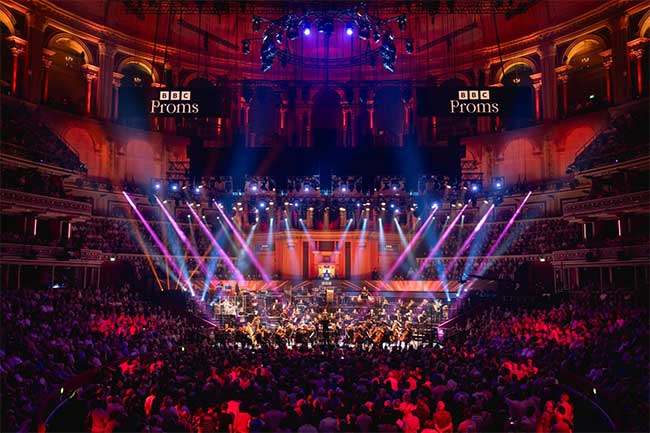
The evening started out OK with Emerson, Lake and Palmer’s interpretation of Aaron Copeland’s Fanfare for the Common Man. A few days previously, Carl Palmer had gone on the radio to tell the story of ELP being invited to go to see Copeland and play him the tape of their version of Fanfare. They initially thought it wise to give the great man the low-key, more respectful take. But when Copeland was seemingly underwhelmed they played him the prog banger they felt truly at home with. Copeland loved it. ELP released it and it became a staple of their live sets. The BBC Symphony Orchestra made a fair crack at it and all seemed well. But then, not long later, came the oh dear moment: Gruff Rhys from Super Furry Animals singing Jethro Tull’s Living in the Past. Sadly, the Beeb has excised this horror from both the iPlayer version of the gig, so you can’t see what a butt-clenching calamity it was, though you can still hear it on BBC Sounds. The warning sign was there from the start: the 5/4 bass line cunningly played with no hint of swing whatever, the orchestra stiff and stilted. It went rapidly downhill from there. Gruff Rhys was clearly out of his depth – under-rehearsed, reading the lyrics from an auto-cue. Cringe deluxe. Bemusement on all sides ensued.
Happily, things picked up soon after with Soft Machine’s Out-Bloody-Rageous Part 1, written by Mike Ratledge. This featured a stand-out sax solo by veteran flautist Andy Findon. Having played with such heavyweight figures as Paul McCartney, Stevie Wonder and Joni Mitchell, and despite having had a stellar orchestral career behind him, Findon knew about swing. The result was one of the evening’s winning moments.
To their credit, the organisers of Prog at the Proms had addressed the ancestral male-centric nature of prog by including four female singers. Jane Weaver made a fair stab at Renaissance’s anthem Northern Lights and the Moody Blues’ Nights in White Satin, though on the whole her performances were weak, and she too seemed to rely on auto-cue for the songs’ lyrics. Female folk duo the Staves breathed a bit of welcome life into Yes’s And You and I, but it was Pink Floyd’s The Great Gig in the Sky that featured the evening’s most stellar performance by a female vocal artist: Vanessa Haynes nailed it. The critical response has been effusive.
Throughout all this, despite the occasional high point and what one hopes were best efforts all round, the general impression given was that too much was under-rehearsed and that almost everyone involved seemed at times baffled ir mildly alarmed by their involvement Confidence in the assembled ranks was palpably not high. Such attempts by the Proms to appeal to wider audiences than their core classical music buffs often seem weak. They should stick to what they know, and excel at.
As the evening progressed Guy Garvey went on to do credit to a King Crimson mash-up, with Gruff Rhys back on stage looking like he’d rather have got the bus home following his Tull debacle, and the prize for most eccentric vocal performance of the evening should go to Peter Hammil of Van Der Graaf Generator. His tone-deaf man-shouting-in-a-bar rendition of their track Refugees seemed to be enjoyed by the singer and the audience both. There’s no accounting for taste. Credit should go to those responsible for the arrangements – for attempting the essentially impossible – making rock music intelligible to a middle class Radio 3 audience. Gentle Giant, Mike Oldfield, Supertramp and the Incredible String Band all got a look-in. Several notable others, including Camel, Marillion and Barclay James Hervest didn’t. Stuart Maconie did a brave job as MC. An attempt at recognising that prog wasn’t exclusively a British thing came via a somewhat lame Focus/Osibisa/Frank Zappa mash up. Elsewhere it became clear what great tunes Genesis’s Entangled and I Know What I Like are, and towards the end we heard a snippet of the late Greg Lake belting out the intro to Karn Evil 9 from ELP’s Brain Salad Surgery. His delivery showed what all the vocal performers except Vanessa Haynes and Peter Hamill had failed to achieve – unswerving commitment to the improbable via bat-shit craziness. The essence of British Progressive Rock.
Prog at the Proms is available for catch-up on the BBC iPlayer and BBC Sounds. If you want to hear a Proms-related, far more successful partnering of popular and orchestral music, check out Nadine Shah’s excellent performance at The Glasshouse International Centre for Music in Gateshead, in collaboration with the Royal Northern Symphonia. Available on BBC Sounds.
.
Keith Rodway
.
Keith, this sentence is the wrong way round: ‘Sometimes you had to rip the stylus off Topographic Oceans and slap on Iggy singing I Wanna Be Your Dog to reset your sanity.’ Sometimes you have to play Tales From Topographic Oceans all the way through to reset your sanity.
Comment by Rupert on 8 August, 2026 at 11:22 am‘the prize for most eccentric vocal performance of the evening should go to Peter Hammil of Van Der Graaf Generator. His tone-deaf man-shouting-in-a-bar rendition of their track Refugees seemed to be enjoyed by the singer and the audience both. There’s no accounting for taste.’
Comment by Rupert on 8 August, 2026 at 11:26 amAlthough i totally disagree, this made me laugh out loud.
Utterly loved this darling. Am so self-obsessed as to think my reactionary old git routine about the very (BBC) idea of Prog at the Proms may have part prompted your glorious unsheathing of the word processor. More importantly you’ve helped me not to be ashamed of love of certain totemic items of the Prog oeuvre.
Comment by Neil Partrick on 9 August, 2026 at 7:47 amVery eloquently nailed. For me, prog from Genesis to King Crimson entertained countless stunning classical passages of extraordinary beauty. The King Crimson versions of this RAH performance was for the geriatric KC fans now on Valium. My personal take is that classical artists have the soul ripped out of them, when it comes to orchestral performance, (outside of the orchestra, many are very capable and relieved to express themselves freely without guidance). i think this lack of swing is due to the limitations of conductors to assimilate every nuance within the time frame open to them and between however many musicians, but also an imbedded rigidity of interpretating written scores. None of the intuitive fluidity of crafted play-by-ear/feel musicians. Stravinsky’s ‘Rite of Spring’ gets very Crimsony in passages, (and there is a Scandinavian composer i heard on the proms once that was even more Crimson/Soft Machine, i have not been able to find in over a decade now). so it is there in some pieces, but they are already stringently included in the score. Despite her success, Gary Barlow’s mixing room floor must have resembled a lazy hairdressers salon trying to ‘transform’ Charlotte Church from her classical competency to pop; and imho, Church – who i like and respect as a person – had the good grace to divert to other priorities after a short tenure in that industry. Success? What measures it these days, when most popular music is formulaic and much of it even created for ‘musicians / artists’ – definitely a different beast to what preceded it.
Comment by Kendal on 9 August, 2026 at 10:03 amOn a good day Prog is glorious! I think the processor would have remained dormant in its sheath had not i been dismayed by the Beeb’s bizarre decision to invite singers from insipid indie bands to tackle such riches.
As to Iggy vs Topographic Oceans, at least it’s clear what Iggy is singing about. I have no idea what Jon is banging on about and I’m not entirely sure he does either.
Comment by Keith Rodway on 4 September, 2026 at 9:32 am