
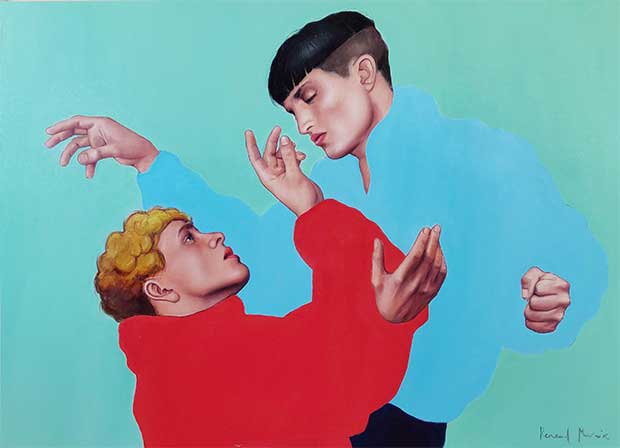
Cain and Abel – Oil on canvas by Renaud Muraire from Sacred Resonance by Renaud Mauraire, 21 May – 8 September 2026, Canterbury Cathedral.
This is the most recent exhibition curated by Jacquiline Creswell.
From 2009-2021, Jacquiline Creswell was responsible for leading Salisbury Cathedral’s pioneering arts programme. Since then, she has worked with a number of Cathedrals in England and in that time has commissioned, curated and installed more than 80 exhibitions. ‘Hear Us’, a recent exhibition at Canterbury Cathedral, attracted criticism from the likes of JD Vance and Elon Musk (a badge of honour!) for using temporarily installed questions in the style of graffiti to explore the big questions that people in the local community were asking about life and faith.
I spoke with Jacquiline about some of the key exhibitions she has curated in order to explore the way in which art in sacred spaces can open up conversations about life’s big questions in new and surprising ways. We began with her curation of Wells Contemporary in 2022/23 and Nicola Turner’s ‘The Uninvited Guest from the Unremembered Past’ which also proved controversial.
JC: It’s made from sheep’s wool and the installation not only had presence in the space but also had quite a strong smell. So, as people were walking up the stairs, immediately they were confronted with something that’s quite disturbing. I think people felt a little bit threatened by that but because Wells Contemporary was not linked with the church itself – they are linking now, which is really good – I felt that the discussion around this piece was an opportunity missed.
I placed an Antony Gormley piece in Salisbury Cathedral in 2020 for the ‘Spirit and Endeavour’ exhibition. It talks about absence and presence. In 2020, when the cathedral was actually used as a place for immunization against COVID, it became quite profound. You can only view it from certain areas. I remember going to Antony’s studio and talking to them about which figure would work best in there. They suggested one that was bent down and I suggested a figure that related to an image in a window near the space showing a man standing up to his highest height. There was then a conversation between the sculpture and this image. The sculpture’s still there. I think it’s on long-term loan. I really think that works.
I worked with Anna Maria Pacheco in Chichester and did two exhibitions with her in Salisbury. One was ‘The Longest Journey’ and also ‘Dispersing the Night’. I think at that stage we’d got to the point where I was working quite closely with the education department, which is so important. We were talking about refugee migrations because this was just around the time of the Syrian refugee crisis. So, we were using the art to say things, to do things, to express things, and allow people to express their views and, therefore, to be part of the community in a very different way.
JE: Can you say more from your own experiences about how art in cathedrals or churches can open up conversation and dialogue?
JC: I know quite a lot about Christian faith now because I’ve spent nearly 20 years in churches and cathedrals. It’s kind of like there is ‘the Word’ and there’s no discussion about the faith and about interpretation. This is very different to Judaism, where everybody has a different view about what something means. Art offers an opportunity for enabling these discussions to take place in these spaces. It can be used in such a positive way if it’s used in the right way.
My son’s bar mitzvah piece was on Cain and Abel. When you have a bar mitzvah, you have to spend two or three years learning Hebrew and, in that time, you have this strong relationship with a rabbi. My two sons had a really good relationship with their rabbi. It’s a big commitment. My son obviously learned his portion and then, when he was 18, he had “Am I my brother’s keeper?” tattooed in Hebrew on his arm, because it had such a profound impact on him. That always stayed with me; his social conscience. Our children become their own people and they always amaze us. I always think, “I wish I was more like my children.”
My last project at Ely Cathedral with Mark Bonney, their dean, was with Sean Henry and was called ‘Am I My Brother’s Keeper?’ I’d worked with Sean at Salisbury in 2010, I think. I spoke with him and we connected. Ely Cathedral originally had plinths that were full of angels and saints and people from scripture. They had all been removed and so we replaced them with Sean’s figure to talk about whether I am my brother’s keeper and about compassion for one another. Sean’s figures are just ordinary people. Two of them were homeless people placed on empty plinths.
One of the figures we had also had at Salisbury. The facade of Salisbury Cathedral is populated with saints and Christian figures and people of historical importance holding orbs et cetera. We just placed this Black gentleman with his coffee cup on the side to begin an interaction and conversation. It’s so exciting when you hear the feedback and the stories as other people interpret it in their way. That’s all we can do. We can only interpret from our perspectives. But those perspectives are so meaningful, and, for people to be given that voice within a church or cathedral, I think is so important. And that’s what the art does. For the church that is actually the most amazing opportunity – in today’s world to engage with subjects like Nicola Turner’s dark piece. There is not just light in the world, there is a lot of dark in the world, and the fact that we don’t want to look at it means we really need to have that discussion.
Such discussions were also part of the 2020 ‘Spirit and Endeavour’ exhibition at Salisbury Cathedral, particularly in relation to Subodh Gupta’s ‘When Soak Becomes Spill’, which has utensils spilling out of a huge bucket.
JE: How have you dealt with the controversial elements of the projects you have curated? One of the things with ‘Hear Us’ was that a lot of the criticism was based on a misunderstanding of the exhibition, wasn’t it? People thought that it was actual graffiti on the walls. So much criticism when controversial works are shown is to do with a lack of understanding of the work itself and what it’s doing in the space. How do you counter that?
JC: In my reply to Vance and Musk, I said I was delighted that these very important men that had so many more important world things to deal with had taken the time out to research the exhibition before it had opened. Because they’d actually made their comments before we’d put any information up there.
I learned so much last year. It was pretty horrific, the whole ‘Hear Us’ controversy, in terms of how personal it became. What it did make me realize, and what did open my eyes, was the passion people still have for either the buildings or the faith. We need to try and understand the difference. I do think though that, if people have that passion for the building, in a time where we really need to believe in something other than ourselves, one can actually use that. I sound very evangelical but I actually do believe that. It is a tool and one that Christians have used forever in the past. Christianity is so popular because you had this figure and these stories that people who couldn’t read could actually be part of and take away with them. We’ve kind of forgotten that.
I learned early on that one thing about art in cathedrals or in any sacred places is how it brings everybody together. It’s not just the art and the space. The works department get involved. The cleaners get involved. The vestry get involved. And if you can make them all own it, then, you are a winner. I spend a lot of my time trying to make everybody part of it and to own it.
‘Hear Us’ was a real challenge. I remember engaging with the community because we’d done the ‘Cross Currents’ one previously. We’d done this one with them. It was brilliant because it was a pilgrimage and people made their own boats, so we brought everybody into it and that really, really worked. When we tried to do that again with ‘Hear Us’, it was quite difficult to get people to engage because they felt threatened by the images in their cathedral. I remember having a conversation with one of the women, and I said to them, “You know, this is your cathedral, and I really respect that. You know, these people who have these questions are visiting here for just a matter of nine or 10 weeks. I know you’re Christian because you worship here. Do you think you can find it in your hearts to give them eight or nine weeks to make the space theirs for a very short period of time so they can have their voice? I think that persuaded them a little bit and it wasn’t something permanent. I don’t really do any permanent commissions, although one or two of the works I commissioned have remained after exhibitions.
I think the problem is the negative noise is so much louder than the positive. All the people who love the work, you don’t really hear their voices. It’s only the noise of people who hate it. The positive views don’t get amplified by the media because that wouldn’t sell newspapers. It’s strange the world we’re living in. It’s like learning another language. Learning how to work in this media, around the media, and around AI and all of that.
JE: Tell me about some exhibitions where engagement has been easier and even revelatory?
JC: Last year, I was called in by the Chapter of Durham Cathedral and asked if I could visually explain Magna Carta to people. I went, “Okay. This is going to be a challenge.” I found an art collective called Squidsoup and commissioned them to do a piece. They made a light installation, which we put in the North Porch and which had an ambient soundscape to it. But the really interesting thing about this installation was that when you walked through it, your actions changed the light. So, the whole idea was that we wanted to show people the magnitude, the importance of Magna Carta. The fact that the lights change when you walked through them equated to being responsible for your actions when you have rights. So, visually, we explained that to people, which really worked well.
But my favourite bit was to do with the articles of Magna Carta. The other piece that I commissioned from them was a beautiful tree projected on the wall of the Morning Chapel. The installation consisted of a tree like wall projection, with branches of words. Children would move their hand across the wall and the words would tumble to the ground like scattered leaves, to be replaced by another branch showing a different article of Magna Carta. So, the children were reading the articles of Magna Carta. This is what art can do in these places. Magna Carta came alive for young children. It’s no longer this piece of paper that they can’t read.
A project with Earlstown Prison was a very rewarding project. I worked with Sarah Mullally and Sarah Rickett, who was education outreach. We wanted to talk about justice and freedom from the perspective of people who’ve had their freedom curtailed for something they’ve done. We spent 10 weeks with the inmates. The first two weeks we gave each inmate a book and we would sit there and they’d have pencils and pens and we would say to them, “Power, you have three minutes. What does that mean to you?” Some would draw a gun and some would draw a light bulb. Some would draw money. Some would draw the cross. The next thing we’d say, “What does faith mean to you?” “What does right mean to you?” And they’d have three minutes again to draw these things, and then we spent the next couple of weeks working with them to create beautiful ceramic tiles. And we made books and people were able to write in the books what they thought of what they saw. We then went back to the prison and put the two montages in the visitor centre there. We gave the inmates a presentation on what people said of their work and they felt that it was the first time they’d ever had a voice outside of the walls.
Bruce Munro was an artist who just gave freely of his time and creativity. I went to him and said, “I want to do a star of Bethlehem.” He said, “Right, well, we’ll put it on the screen in the spire crossing and we’ll shine the light, the projection onto that.” I thought, “No, that doesn’t work. It’s too forced”. And so, I said, “Let’s see if we can do it over the font.” We set the whole thing up. This was beautiful. This was a really special installation. It’s on Bill Pye’s font and it starts as a tiny dot of light. It grows and has these striations, which are dots and dashes, and they fall over the font and onto people who are standing by. These dots and dashes are actually Morse code telling the story of the three wise men following the star of Bethlehem to the baby Jesus. We have a lot of people in the army in Salisbury. School children would come in and be bathed in light and they could say, “That word says that, and that word says that.” The children were just immediately engaged.
I also found an artist, Jayson Haebich, who was still a student at Goldsmiths. He was a laser artist and I used his work in three different cathedrals where we made another ‘Star of Bethlehem’. The beauty of this ‘Star of Bethlehem’ was that you had an iPad in the nave where people could come and change the shape and colour of the star. They have that participation and then they become involved in the story.
‘Les Colombes’ was for the commemoration of the end of the First World War, to commemorate peace. But, of course, we had the Novichok incident in Salisbury and the doves in the installation took on a whole new meaning. The whole of Salisbury was closed. We had men in hazmat suits around. It was pretty scary. I think that that happened in February. We put the installation up in March or April and the cathedral opened its doors to people to come and put their prayers and hopes on a piece of paper and fold it, and then it would join the flock- The installation had already been to Bethlehem but it took on a whole new meaning here. In the evenings we would have the cathedral open and have a lightscape but it just became completely different because every shop in Salisbury, every office, even Ostow Prison, had doves. Everybody had doves. The whole city became a dove city, which was wonderful. See how art can do that! The police couldn’t do that. Our MP couldn’t do that. Nobody could bring people together. But this installation brought people together. That is what I want people to write about because it makes a difference.
‘Cross-Currents / Life as Journey’ by Frances Carlile was my first exhibition at Canterbury and it was talking about life as journey, but also about refugees; the little boats that come over. So, you have these beautiful, fragile boats that climb up the staircase and in the Corona Chapel. But the best part of it really was the workshops where people got to make their own boats. Emma Pennington took people on a pilgrimage where they collected leaves and fallen bits and then did a workshop with the artist making their own boats which then joined the fleet of boats in the cathedral. Amazing!
JE: As you describe your role, it seems you’re working as a bit of a translator or a mediator between the artist and their expression of their art, and the cathedral staff and their expression of their faith.
JC: I think that’s what I try to do. It’s so interesting, as it usually takes about two or three years to do an exhibition, and what’s really amazing and fascinating is how the artist sees their work and themselves differently in that time. Somehow, they’ve actually embraced faith. I don’t necessarily mean in a Christian way but they have a new and different spirituality by that engagement. They talk to the Cathedral’s communities and there’s these backwards and forwards conversations, from which everybody’s learning. Everybody’s getting something from it. It’s bringing light to everybody.
Working with the Association of English Cathedrals has also been very rewarding. We’re putting best practice in place. We’re helping people with arts policies. People like Durham Cathedral call me. I can say, “Look, this is how you can animate certain spaces. These are the conversations you can have.” And then I put them in touch with the artists and then it grows. It’s pairing the right people with the right projects.
I have had to learn my language. I’ve had to hone my skills. It’s been a give and take in many ways. I’m a great believer in faith and I do believe that we are guided. I have been guided to do what I do. It’s really difficult for me to say that to just anybody, because not a lot of people understand that.
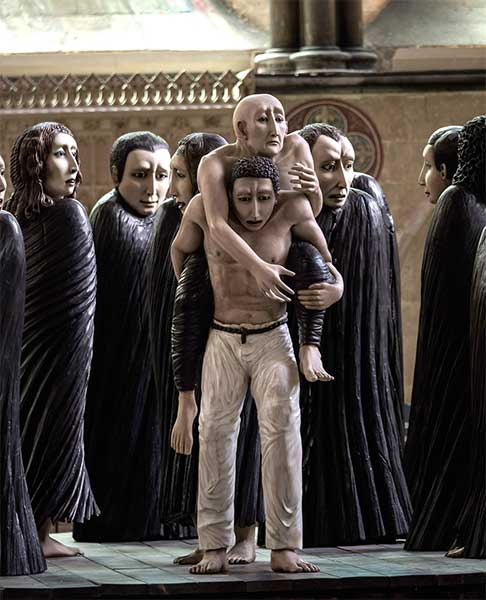
Shadows of the Wanderer, 2008, by Ana Maria Pacheco. Polychrome wood,260 x 390 x 605 cm. Photo: Ash Mills Photography.
.
Jonathan Evens