
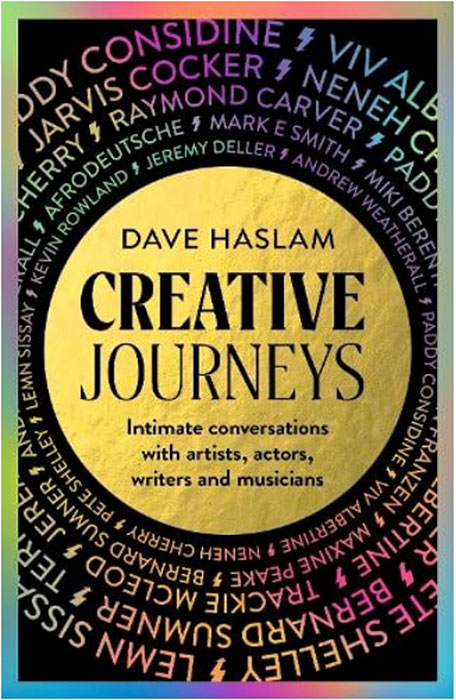
Let me be clear from the start: I’ve been a fan of Dave Haslam’s work for over forty years. From the mid-1980’s when I came across his ‘Debris’ fanzine to the more recent ‘Art Decades’ micro-books, I have read most and enjoyed all of his written output. But what do I not enjoy? Transcribed interviews. I blame it on the contents of too many other, shoddier, fanzines read in my youth. These consisted of vacuous questions sent through the post (with an SAE, obviously) to the members of some obscure Indiepop band who would then scrawl equally vacuous responses (in crayon, if they were parading C86 twee pop credentials). Such fanzines were proof that the hazards of overabundance must never to be underestimated and that the old DIY (the ‘Underground’ or ‘Punk Rock’, if you choose to use such terms) dictum of ‘Anyone Can Do It’ ought really to be caveated with ‘But Most People Shouldn’t Bother (Because It Will Be Shit)’.
The interviews contained in Dave Haslam’s ‘Creative Journeys’ book (due for publication by Manchester University Press, October 13th 2026) are not shit. It’s just the collected form that irritates me. In his introduction to the book Haslam points out that: “The interviews are all transcribed in a question-and-answer style. I took this decision because that’s a format which I think gives a little more agency to the interviewee: their words are unfiltered, rather than being wrapped up in a context created by me.” Yet having finished the book I cannot help but think that those very words struggle to escape from the original contexts in which they were spoken. These were often face to face interviews carried out in front of A Live Studio Audience or, as in the case of Bernard Sumner, recorded for a radio programme (about Ian Curtis) where the majority of the interview was never used. This last context is interesting because one assumes that small sections of Sumner’s dialogue were edited into the programme in question. The key word there being ‘edited’, as in teased out and woven into a cohesive narrative.
That sense of cohesion is largely missing in ‘Creative Journeys’, for whilst the title suggests that the interviews are all connected by a common theme of the creative process, this really feels like something of a stretch. Certainly there are themes linking some of the interviews such as loss, trauma, abuse, redemption and the unglamorous reality of Hard Work, but it is largely down to the reader to put these together into something even vaguely unifying. Not that I don’t believe in making the reader Do Some Work, but there are limits, particularly when one accepts that many readers are lazy beggars, not least of all me.
Again, let me stress that my dissatisfaction is more about the published form than anything else. Haslam is a good writer and a very fine interviewer, this latter being due in no small part to the fact that he seems to be a good listener and that, crucially, he puts in the hard work. He makes reference to this in his introduction, outlining the hours, days, weeks spent immersing himself in the subject he is to interview. This results in interviews that feel a lot like natural conversations, yet the reason they feel such is because of all the ground work that has been laid. There is a point in the interview with Andrew Weatherall where, when asked if his approach to DJing has evolved, Weatherall replies that: “I had to get my act together… it dawned on me that this was my job, and I better pull myself together a little bit.” This point of doing something that one loves, yet also realising that one has to put in the hard yards in order to keep doing that thing which one loves is, for me, one of the more interesting threads of the book. That it is underplayed, even largely ignored in the face of ‘sexier’ themes of abuse, trauma, disconnection from the school system etc says much about how we are encouraged to view creativity as being Other and how the reality of the hard work of process is kept hidden behind the curtain lest the illusion of magic be lost.
One thing that does lend a degree of cohesion to the book is the selection of artists interviewed. Few could be thought of as being Part Of Mainstream Culture, despite some (say, Terry Hall, Kevin Rowland, Pete Shelley, Neneh Cherry, Jarvis) having made some instantly recognisable artefacts that to some extent help define a certain point in time. All are from what one might call a position of being culturally (and, largely, socially and politically) left of centre, yet if this lends a degree of cohesion, it also makes for a peculiarly frustrating ‘safe space’. There is little, if anything, that challenges the orthodoxy of the 21st Century socially liberal perspective and whilst there is much reflecting on The Past by Haslam and the interviewees alike there is, for me, not enough challenging of that past. The unfolding narrative of an artistic space rooted in counter-cultural as a socially liberal (and liberating) positive force of the past forty/fifty years is for the most part protected and reinforced. The audience for this book then will largely be fans of some, or all of those interviewees, and of their world views. They will be the same audience who queued to watch Haslam conduct the interviews on stage in their original contexts. They will know what they are getting and they will get what they want. It’s all oddly cosy.
As it stands then ‘Creative Journeys’ seems more than anything like a collection of source material that future writers might reference and pull what they require for their own purposes. It feels like a possibility (or even a range of possibilities) missed. Perhaps one day someone (possibly even Haslam himself) will create an interesting narrative where similarities and differences are investigated, challenged and illuminated by selected quotes from the cast of characters. Someone, obviously, less lazy than me.
.
Alistair Fitchett. 2026.
.