
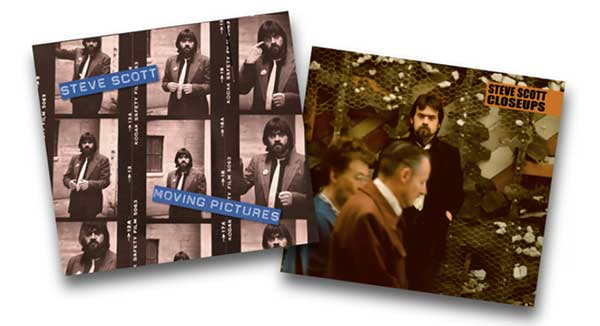
Moving Pictures and Closeups by Steve Scott (Solid Rock Records)
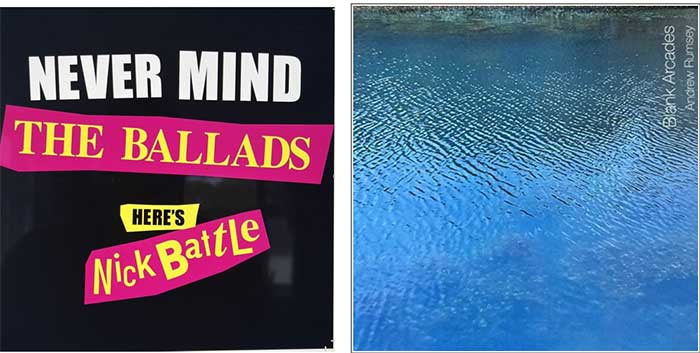
Never Mind the Ballads Here’s Nick Battle by Nick Battle (Star Street Music Ltd)
Blank Arcades by Andrew Rumsey (Gare Du Nord Records)
In 1977, an art student from Croydon moved to America, signed a record contract with a US label, and began recording Moving Pictures and Closeups. In 2026, following a Kickstarter campaign by the brother of the albums’ producer and impresario, the two albums were finally released. Between times, the art student, Steve Scott, spread his wings as artist, author, musician, pastor and speaker recording 11 albums, including a retrospective, plus the writing of two books on the Arts and several collections of poetry. Scott is a cult musician whose songs, poems, and books, all reward discovery or rediscovery. What does the eventual release of his first two albums nearly fifty years after they were recorded add to his legacy?
Scott found a melodic but edgy post-punk signature sound on later recordings before, later still, compellingly combining poetry with ethno-electronic soundscapes. By contrast, these albums span musical genres with Scott wearing his musical influences – David Bowie, The Sex Pistols, Bob Marley, Neil Young – on his sleeve, yet without resorting to paint-by-number copies of his heroes. The diversity of styles found on these albums is not simply indicative of an artist finding his way but instead delivers a consistently creative early vision through a pot-pourri of styles.
At this early stage in his career, the songs are ones that accurately skewer modern life in terms of the God-shaped gaps found in lives that are filled with celebrity or ambition (‘My Name in Lights’), the increasing propensity for danger found in the ‘Wild Boys’, the ‘Pilots without Parachutes’ who have ‘forgotten where they stand’ and who ‘fall away like leaves’, together with those lonely, isolated people who play at being ‘King for a Day’. Alongside these are songs that ask valid questions of those who believe (questions that caused jitters among the corporates in Solid Rock’s distribution company Word Records leading to the initial delays in release) such as ‘Never mind your means of travel’ in ‘The Raft is Not the Shore’ because ‘Epistemology is not Ontology’. In between are songs in which the central characters are starting to see a ‘different kind of reality’ (‘Thief’s Song’) because these are songs that refuse ‘the usual merchandise recycled in a new disguise’ and, instead, are captivated by ‘a better way’ and ‘A Different Kind of Light’.
Gratitude is due to Charles Norman (formerly of Executioner, The Merchants of Venus, The Guards of Metropolis, Thriftstore Masterpiece) for releasing Moving Pictures and its intended follow-up Closeups on the revitalised Solid Rock Records. Both stand up well against the classic Solid Rock albums of the period, possessing a potent combination of accurate social commentary, poetic spiritual insight and powerful appeals for change.
Nick Battle’s career in music began in late 70s/early 80s bands like After the Fire and Writz before moving into A&R with IRS records. He was a record plugger from 1988-1993 with clients including George Benson, Sir Cliff Richard, Ronnie Wood, Take That, Clannad, and Paul Hardcastle, among many others. In 1993 he helped start the music publisher Windswept Pacific Music Ltd and introduced Simon Fuller (his former client) and the Spice Girls to the company. He’s written songs with a whole host of people, including Tony Swain, Chaz Jankel, Anthony Phillips, The Nelson Bros, Richard Kerr, and even briefly Gary Barlow, and has had his songs recorded, among others, by Sir Cliff Richard, Michael Ball, Engelbert Humperdinck, Karel Fialka, and Jonathan Veira, while his music has also been used in film and television series.
Alongside all this have been solo albums where, as he says, the songs come ‘from my heart and soul’. His recent albums – Big Heart, The Finish Line, Dark Passenger – have become particularly personal responding to health crises and the Covid-19 pandemic while charting his life as he has wrestled with time. The latest, with the great title of Never Mind the Ballads Here’s Nick Battle, is an album of the best ballads culled from all his solo albums to date.
These are exquisite soft rock songs with country or americana flavours that provide wry reflections on life. Battle recognises that life sometimes ‘just throws shit at you’. As he wrestles in these songs with the effects of time passing – health challenges, the loss of loved ones – we encounter an impetuous person slowing learning to take time; time to think, time to reflect, time to respond. These are songs ‘born out of pain’ but with a ‘clear eye on the future’. They explore questions such as ‘How do you want to live?’ ‘How do you want to love?’ and ‘What is most important?’ Emotional and spiritual, these are songs that encourage us to ‘find joy in the moment’ as they see that better days are ahead. Battle wishes us happy trails, believing that one day all will be well because ‘kindness and grace are great bedfellows.’
There are songs in memory of lost loved ones, songs about might have beens and commitments, songs about living with ghosts, plus songs about renewed relationships and songs to children. Along the way we see that ‘love is a dance with suffering’ in which ‘we twist and turn, we move and sway and in the lonely night we pray’ (‘Dance of Suffering’). We try to lay our anger down ‘inside a shallow grave’ (‘Can I Please Have That Dance Again’) and see both that ‘every little kindness is written on his heart’ (‘Lucky’) and that ‘for every single joy that passes, someone sings a quiet refrain’ (‘The Finish Line’). ‘As we approach the finish line’, ‘every moment you are near, these are just the sweetest time’ (‘The Finish Line’). Rich in melody and emotion, wrapped in timeless sounds, these songs echo the heartfelt storytelling of Battle’s life.
Andrew Rumsey is an outlier as a folk musician being a cleric in his primary vocation – newly appointed as Bishop of St Albans – yet, from The Effras to three recent solo albums, music has intriguingly always been intertwined with ministry. Reviewers note that he ‘isn’t a typical Anglican bishop’ and that his ‘acoustic textures, melancholy melodies, and haunted vocals suggest what Nick Drake might’ve achieved if he’d overcome his inner vortex’.
Blank Arcades is the third in his acclaimed triptych of albums-in-a-day recorded in historic Wiltshire churches. Pragmatically, this has been a means of fitting recording into a busy schedule, yet the approach allows for something of the ambience of these sacred spaces to infiltrate the sound that is captured. Known for songs with a pastoral focus that possess a deep awareness of the significance of place, Rumsey immerses his listeners in the places he visits and the feelings they engender. Jokingly described as jangle folk for Pentanglicans, the psych-folk of his albums provides an exploration of faith, place and identity.
Singing of lost places and the hope of return, Blank Arcades draws on themes of impeded progress and the ‘entrances to nowhere’ implied by the album’s title in order to pray that we find a better route from where we now are. The image was inspired by a visit to Salisbury Cathedral and the sight of its north porch carved with blank arcades; a ‘series of gothic arches that are essentially openings to nowhere’. These blank arcades are a ‘decorative façade and nothing more’. It’s been a resonant phrase for Rumsey and one that carries his theme of impeded progress which, in terms of the Church of England, reflects the stalling of the Living in Love and Faith process that had been opening up space within the Church of England for those in same-sex relationships. Despite this thematic focus, the music he conjures up with his compatriots in Yatesbury Church draws primarily on the Byrdsian jangle-folk of Sixties folk-pop bands.
Sixteen songs were recorded by David Perry (guitars and church organ), Cameron Saint (double bass) and Louis Spanton (percussion) on a single summer’s day in atmospheric Yatesbury Church, close to the Avebury stone circle. One commentator has suggested that most of the songs on Blank Arcades barely touch directly on faith at all. That comment demonstrates a lack of religious literacy as ‘Place of Dragons’ opens with a quote from Psalm 44, ‘Pilot Light’ is about the creative flame of the Holy Spirit, and ‘O Lazarus’ states that the title character still ‘dazzles us’ with a ‘heavenly glow’, but Rumsey also writes about delays on the A303, prevarication on diving boards, swimming in the slow lane, and late arrivals at meetings (‘Chapeau’ and ‘Fastest in the Slow Lane’). His spirituality is essentially one of both ‘heaven in ordinarie’, as the poet George Herbert termed it, and also of place. He conjures up for us not only the experience in the place it occurred but also the spiritual significance of these everyday happenings and locations.
While spirituality is undeniably a shared inspiration for Scott, Battle and Rumsey, their music engages with the world through humanitarian concerns, interests and insights that are broad and open. Whether singing songs of celebration or critique, they offer us insightful and moving perspectives as troubadours accompanying us along the twists and turns of the rich but challenging journey we all make in life. Their other lives – at times, pastor, funeral celebrant, bishop – inform their ability to fashion songs that accompany us in our life experience, as opposed to simply documenting or describing.
.
.
Jonathan Evens
.