
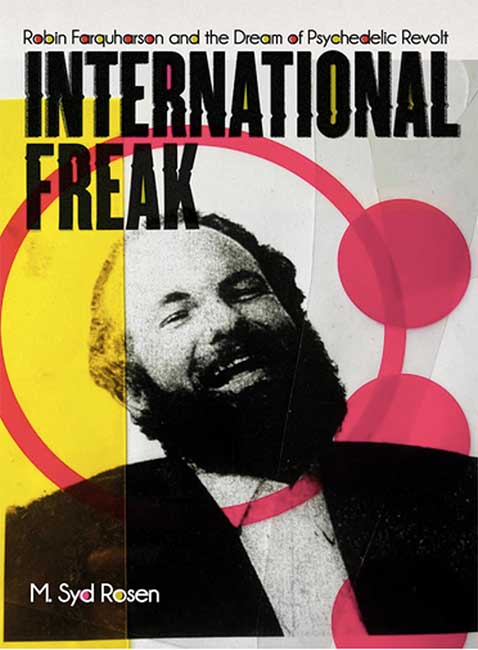
International Freak: Robin Farquharson and the Dream of Psychedelic Revolt, M. Syd Rosen (352pp, £17.99, Strange Attractor)
Unless the eye catch fire,
The God will not be seen.
Unless the ear catch fire
The God will not be heard.
Unless the tongue catch fire
The God will not be named.
Unless the heart catch fire,
The God will not be loved.
Unless the mind catch fire,
The God will not be known.*
Robin Farquharson was, is, a legend of the British Sixties counterculture. Born in 1930s South Africa, he was a man who embraced, and in his greatest moments, became the zeitgeist of the Sixties utopian dream. This occurred all while struggling through mental illness, embracing his homosexual identity, a brilliant academic career cut short, and an urgent need to get at the centre of things; the epochal moments of change of the era, a drive which became his mission and his living curse.
M. Syd Rosen’s excellent, searching biography is both kind and keenly objective about its subject, painting a picture of a man lost from the centre of his own life. When half the time Farquharson’s attempts to change the world backfire, he nonetheless makes startling new connections between other notorious, disparate and sometimes lost figures of the time.
International Freak is ostensibly a book about (a) nobody. At first glance Rosen presents the image of another hippy drop out, subsumed by drugs, the wayward philosophies of the time and the crashed out clichés of free love, squatting, and a better future. Whilst on the one hand this is true, Farquharson is perhaps both victim and hero of the ‘out there’ milieu he was drawn towards and willingly inserted himself into. Gay, living in exile from apartheid South Africa which continued to vilify him in the press, he was a natural outsider and found a way to live alongside people who, like himself, didn’t fit into the square holes of straight society. While it is easy to write-off Farquharson as a failed academic, he produced the influential short book, Theory Of Voting, which highlighted the logical value of tactical voting, which has since become much more prominent in political discourse, and began to make further inroads towards the cybernetic futurism promised by Richard Brautigan’s 1967 poetry pamphlet, all watched over by machines of loving grace, later inspiring the Adam Curtis series of the same name, a further example of how one small idea can mutate and bloom into a whole new realm of much greater concepts.
M. Syd Rosen gives us a portrait of a zeitgeist figure who, like Larkin, arrived too late and was already too old to be a fully-fledged hippy, but nonetheless threw himself into the fray, full-hearted, as with all his endeavours. Certainly the Robin Farquharson portrayed in the book was a friend to some and an abiding nuisance to others. Rosen offers vivid sections of prose to portray the tragi-comedy of man who was born to self-sabotage, such as being kicked out of a squatting and advice line co-op he helped to establish for hitting his colleagues over the head with a phone. These are set in contrast to anecdotes from friends, allies and enemies, including an abiding university friendship with a young Rupert Murdoch, an ongoing correspondence with the philosopher Michael Dummett, south African secret service BOSS informant, Gordon Winter, the occult mystic, Frater Choronzon, legendary bookseller and author Barry Miles, and the revolutionary psychologist, R. D. Laing – to name but a few.
Farquharson was certainly a lightning rod for the age, despite his wayward passage through a troubled and troublesome life. Perhaps the greatest testimony to this would be his slender 1968 book, Drop Out!, the literary antidote to the worthiness of Orwell’s Down And Out In Paris And London. Where the latter praises the bracing abilities of a fellow hobo to remain clean shaven and walk from London to Kent to go hop-picking, in spite of his many hardships, Farquharson takes his own more Gonzo journalistic approach to abject poverty and social exclusion.
His journey begins by marching into the offices of publisher Antony Blond with a sleeping bag under his arm, demanding a minor cash advance to go out among the splintering sub-cultures of London and report back to the straights of mainstream society what was really going on with ‘the kids’. That Farquharson returned a wild sheaf of papers including excerpts of toilet graffiti, accounts of random street violence as he tried to pick up young men, and the open hearted wonder of being given free food from a homeless shelter when he was at his hungriest alongside some casual LSD use, suggests the jagged path that many of his adventures took.
Rosen gives us a vivid and resoundingly alive figure of a man who went to the limit of his given ability, doing the best with what he could, both obstructive and thwarted by turns, his story is often wryly amusing, at other times punishingly sad, as with his death from a sudden housefire in 1973. The author balances both sides of this experience and interjects his own highly-researched thoughts with moments of oral history from the people who were there alongside Farquharson.
International Freak shows us that the real Sixties was not just Carnaby Street media slop, the Rolling Stones’ self-obsession and the technicolour daydream that would later be swallowed up whole, real people with real lives were happening and making things happen. Robin Farquharson’s story was but one of them but, as shown by the many lives he touched, both for good and ill, it was a hell of a trip.
(Credit should also be given to the book’s publisher Strange Attractor press for again venturing further into brilliant and strange new places, and to designer Louise Mason; this collaboration has continued alongside M. Syd Rosen in reissuing a new updated edition of Farquharson’s Drop Out! )
.
Adam Steiner
Find out more about International Freak at https://www.strangeattractor.co.uk/publications/international-freak
and more about M. Syd Rosen at https://https//msydrosen.neocities.org/
*This poem appears in Where the Wasteland Ends: Politics and Transcendence in Postindustrial Society by Theodore Roszak (Doubleday, 1972) and is also referred to in his seminal The Making of a Counter Culture: Reflections on the Technocratic Society and Its Youthful Opposition where Roszak discusses the cosmic vision of Blake, channeling much of his stylistic verve into the discussion, causing many to misattribute the lines to Blake himself.
.