
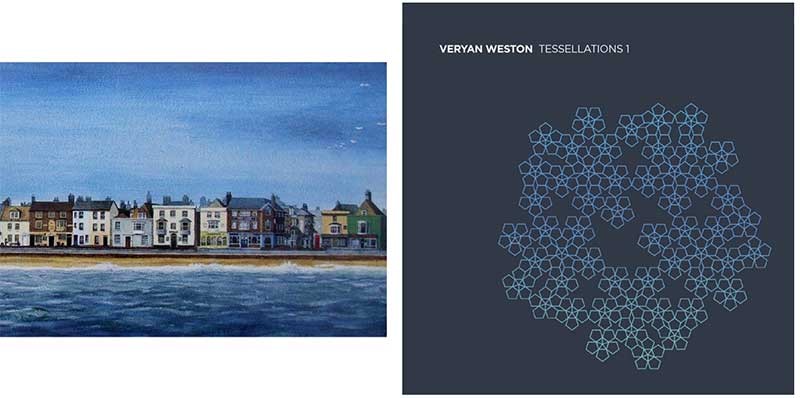
At home, John Tilbury (Another Timbre)
Tessellations 1, Veryan Weston (Shrike Records)
Pianist John Tilbury, who was ninety this year, has been a hugely significant presence in the world of experimental, improvised and contemporary music all his adult life. He became perhaps the leading interpreter of Morton Feldman’s music and was, from 1980 onwards, a member of the improvisation group AMM (the initials of which, incidentally, are famously secret and have long puzzled people. My theory is that it stands for ‘AutoMatic Music’, after the Surrealist practice of automatic writing, but that’s by the way). Tilbury officially retired in 2018, but, over the following eight years, Simon Reynell (founder of the Sheffield-based Another Timbre label), visited him on a number of occasions. As he explains in the album notes: ‘we recorded whatever John wanted to play at the time, and so assembled an unusual and varied collection of recordings ranging from pieces from Elizabethan songbooks to new compositions sent by old friends from Scratch Orchestra days. Sometimes … the visits became as much a social thing as a recording session – and it was always very enjoyable to talk with John and Janice about music and politics, and hear stories about John’s past and his many musical friends.’ The end result – with the addition of a few archive recordings – was this 4-CD set, At home.
There is, obviously, a lot to listen to. Some of it is what you’d expect: there’s a spell-binding performance of Morton Feldman’s ‘Madame Press Died at Ninety’. There are works, also, by Cornelius Cardew (including ‘Volo Solo’) Christian Wolff and a selection of Howard Skempton pieces. But then there are arrangements of Machaut, too. (I understand the attraction: Machaut’s Messe de Nostre Dame may be over seven hundred years old, but, in a way, it sounds very modern). And Tilbury doesn’t just confine himself to the piano: we also hear him playing the organ and the clavichord. Christopher Hobbs’ Five Pieces for Clavichord (2023) were specially written for him and, on one of the bonus tracks, we hear him play Skempton’s gnomic ’24 Preludes and Fugues’ arranged by himself for the clavichord, which is a real eye-opener.
As one who tinkles about on the clavichord myself, I warm to any pianist who champions it. (And I keep coming across them – clavichords – popping up all over the place: the instrument might even be in danger of becoming trendy). It’s one good reason to explore this set. The main, overriding reason, though, is that it gives us an insight into over half a century of contemporary and experimental music, performed by one of the key players who helped make it all happen.
Pianist Veryan Weston has been active for around half a century (he was awarded Young Jazz Musician of the Year’ in 1979). Back in the day, he was a member of the Eddie Prévost Quartet and has worked with a range of jazz and improvising musicians including Lol Coxhill, Phil Minton and Steve Beresford. Tesselations 1, originally recorded in 2001 and recently released by Shrike Records, is one of a series of pieces he’s created that centre around his research into pentatonic scales (others include a choral piece and a string quartet). As he says in the album notes, the piece ‘is an autobiography or a journey that started on an old upright piano in a garage soon after I reached double figures’ (so, some time in the early 1970s). It explores the possibilities of a sequence of fifty-two different pentatonic scales, each one one note different to the one that preceded it.
What becomes clear as you listen to the music is how the different characteristics of the scales he uses nudge Weston in various creative directions: one set of intervals might suggest a tight, nervous music, another, the sort of brightly-lit textures you find in Debussy. There exists a whole gamut of possibilities in between and Weston explores them thoroughly. I could say I detected a wide range of influences – here and there, I was reminded of Nancarrow’s player-piano pieces and there are occasional suggestions of minimalism, although ideas never outstay their welcome – but to what extent we’re talking here of influences as such, I’m not sure. It could simply be all down to the way the scales lead Weston to shape the music. And the different colours and possibilities the scales suggest ensure that even though the music comprises a single track, just over an hour in length, it never flags. It’s as if Weston has embarked on a journey of exploration – into the world of pentatonic scales – and invited us to go along with him. He keeps us engaged right up to the end.
.
Dominic Rivron
LINKS
At home: https://anothertimbre.bandcamp.com/album/at-home
Tessellations 1: https://shrikerecords.bandcamp.com/album/tessellations-1