
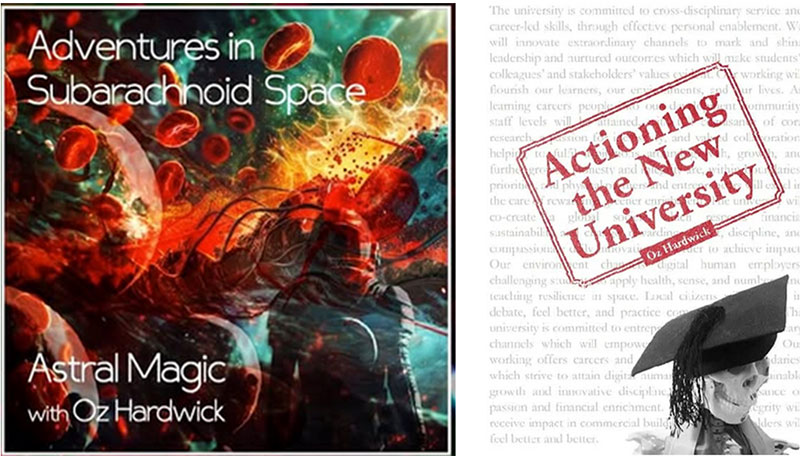
Adventures in Subarachnoid Space, Oz Hardwick / Astral Magic (Astral Magic)
Actioning the New University, Oz Hardwick (Yaffle Press)
For those who are unfamiliar with it, the psychedelic space rock project Astral Magic is the creation of Finnish multi-instrumentalist Santtu Laakso (aka DJ Astro), one-time Moog and bass player with the Finnish band, Dark Sun and the Rising Telepaths. He frequently collaborates with other artists and recently approached poet Oz Hardwick. The result was the monumental Adventures in Subarachnoid Space. I say monumental, as not only is it not short (it lasts around an hour) and packs a punch, but, taken together, the poems have an encyclopedic quality, taking in, as they do the nature of space, time, society, human psychology and perception, among other things. We’re talking about poetry with a broad vision, in which you sense there’s a constant movement between outer and inner space going on. As for the music, my benchmark for albums that combine poetry and music is Lawrence Ferlinghetti’s collaboration with saxophonist Dana Colley, A Coney Island of the Mind, based on the poetry collection of the same name. It just strikes the right balance between the poetry and the music, to my mind. It’s a trick Laakso and Hardwick pull off, too. Indeed, I’d say they go one further. The character of the music really fits with the poetry: what we get is more than the classic space rock mixture of spoken word and ambient sound. Instead, as Hardwick has said of it, what we have here ‘is proper psych/prog/space rock, in which the voice is another sonic element.’ Nevertheless, the album is mixed in such a way that we can make out the words of the poetry almost all of the time, which is essential, I think. I would say, though, it really helps to listen to the album while having the printed poems in front of you. It gives you a chance to ruminate on the words and, if you get carried away, you can even join in!
The first track is an examination of our place in space: we compare notes with the greys and – forget screaming – in a typical twist, Hardwick tells us ‘in space, no-one can hear you ask fundamental questions’. We have no reason to suppose those questions exist without us being there to ask them and, as for the greys, we’re all ‘shades of grey’. There is a whiff (only a whiff, mind) of Douglas Adams: ‘close up, the Earth is just earth, with diminishing water and occasional parking places.’ The second track is a paean on the nature of time. The things we’re dealing with here are anything but cosy (the last poem on the album ends, ‘It is cold. It is beautiful’) but, somehow, Hardwick and Laakso create a kind of musical comfort zone out of the material, which draws us in. The third track addresses the issue of human versus machine intelligence. The poet asks the machine to suggest new superstitions; the machine suggests ‘[he] tie [his] left shoelace in a single bow and the right in a double, in order to ensure that [his] transport arrives on time.’ Pitted against the machine and universe, human ways of thinking are exposed as absurd. The depiction of machine intelligence here put me in mind of the ramblings of the artefact in M John Harrison’s latest novel, The End of Everything. The next track gives us a memorable, humorous conceit: ‘On account of my numb thumbs and autocorrect, the future I thought I’d ordered arrived as furniture, flat packed and primed to exasperate.’ In the next track we metamorphose into trees and, travelling back to a time before people got round to categorising everything, ’embrace our absence of names’.
What follows resembles a Richard Hamilton collage of family life in the 1970s, right down to the Keracolour Globe TV, with its pigeon-hole expectations, fantasy flying saucers and the broken promise of a space-age future. It carries the key, I think, to the ‘comfort zone’ Hardwick and Laakso create that I mentioned earlier. There is a sense of history running through it all. It doesn’t just deal with the cold emptiness of space, it takes us to places we feel safe revisiting, even though, as with the self-assembly furniture, things don’t necessarily turn out the way we hoped they would.
The next track, ‘Field Notes for the Urban Coleopterist’, is one helluva trip, an apocalyptic vision in which everything – cities, genders, insects, even basic shapes – refuse to ‘conform to usual parameters’. What follows, after we’ve taken a voyage on an impossible ship, over an impossible sea under an impossible sky, is a consideration of the limitations of language. In the end, ‘everything looks like magic and, come the evening … there’s nothing to see but whole galaxies and stacked images of parallel worlds…’ And if you try to force the emergency exit, you find yourself on a fire-escape designed by Escher, ‘where demons and quack doctors are sharing a spliff that’s rolled from societal taboos, inhaling the edgy relief which can only come from burning poetry.’
So far, I’ve concentrated very much on the poetry. As for the music, it’s hard to imagine anything more appropriate to fit with Hardwick’s poems. It follows their twists and turns and the fact that space rock has been around for as long as it has means that it easily navigates the poetry’s time-shifts, at home, as it is, as much in the present day as in the 1970s. It often seems to grow from the poetry, as when it mimics the imponderability of flat-packed furniture or, as when in track seven – ‘Field Notes for the Urban Coleopterist’ – the music becomes beetle-like (I can’t explain how, but it does). Not only that but there are some great set-pieces, too (the aforementioned track, ‘The Scintillation Effect’ and ‘The Glass Man’s Last Aria’ spring to mind). Listening to the album, it occurred to me more than once that it would make a great animated film (with subtitles, of course). In one of the poems, ‘The New Age of Signs’, it talks about things ‘that don’t make the papers because they disrupt the ads, don’t make the news because they are impossible to squeeze into a headline and two minutes of soundbites.’ In a more enlightened world, Adventures in Subarachnoid Space would be headline arts news.
Every time I see the cover of Oz Hardwick’s latest pamphlet, Actioning the New University, I think of my favourite joke: did you hear the one about the skeleton that walked into a bar and ordered a pint and a mop and bucket? It seems apposite: perhaps it’s because, in the new university of the title, education is merely information you pour in, something that’s sold to you like a pint of beer. But it’s unlikely to intoxicate you and digestion and growth have nothing to do with it. Someone, we can’t help but think, will have to clean up afterwards.
What we have is a polemic written by a poet who, as we’ve seen, is a master of the bizarre, whimsical surrealist mashup. And it’s obvious from the word go. The first thing we learn in the first poem, ‘Arts Education for the Working Class’ is that Hardwick was ‘blasted to school in a cannon’, back in the days when cannons ‘were common as hand-knitted jumpers.’ It doesn’t seem to have done him any harm, but we should not let the intimate, almost Wallace and Gromit-like tone deceive us. What follows is a savage indictment of a hollowing out of further education by neoliberal ideologues. They have, of course, been at it for decades, but these days it’s proceeding apace.
A few pages further in, ‘A Strategic Plan for the Digital Age’ left me wondering if there weren’t career academics out there who, on reading it, would nod vigorously in approval, blind to the irony and trademark oddness, while inwardly eating their hearts out wishing they’d come up with it to pad out their latest mission statement or funding application. For everyone else reading it, though, the anger and urgency behind this call to recognise the debasement of higher education for what it is, will be all too apparent. Speaking for myself, what appals me is not just the way that debasement undermines everything about human culture that is rich, creative and life-affirming, but the all-pervasive positive spin, the enthusiasm with which those managing academe have set about dismantling what it is surely their role to protect. But then, I guess it doesn’t do to think too much: too much consciousness of what you’re doing gets in the way. As Hardwick says, in the poem ‘A New Strategy for Inclusivity’, ‘in such a positive working environment, even the biros and blotters achieve self-awareness.’ And I guess everyone who has worked in the public sector during the past half-century has similar kapo syndrome horror stories to tell. Many, one might argue, are worse, as they involve services people rely on to stay alive and maintain their dignity. Nevertheless, what is at stake here is the vibrancy of a culture that helps make life the rich, wonderful thing it can – and should – be. And what can be done about it? I know it’s easy to say one should resist, and one should (Hardwick calls this pamphlet ‘one of my own small acts of resistance’). One should also consider the possibility though – thinking of the ‘free universities’ of 1968, for example – of developing education beyond the established institutional sphere. The existence of cyberspace throws up all sorts of possibilities in this regard that were not available before, many of which are already happening and have, indeed been happening for decades.
Don’t go away, however, thinking this is just a polemic. In one of my favourite poems in the book, 364.1523 (the Dewey Decimal code for books about murder and true crime) the ‘body in the library’ becomes a metaphor for the library and all it stands for, as the library itself inexplicably shrinks and the librarian is ‘transcended to the digital realm.’ It’s a small-scale masterpiece of strangeness. Actioning the New University, is both a polemic and a book of poetry. It’s very well worth a read on both counts.
.
Dominic Rivron
LINKS
Adventures in Subarachnoid Space can be found at: https://astralmagic.bandcamp.com/
Actioning the New University can be bought from: https://www.yafflepress.co.uk/shop
.