
Anish Kapoor, Hayward Gallery, 16 June – 18 October 2026
I first saw a selection of Anish Kapoor’s sculptures in Liverpool Cathedral in 2024. The selection and positioning of sculptures then related thrillingly to the building in which they were set and for key works enabled and invited the interaction of viewers.
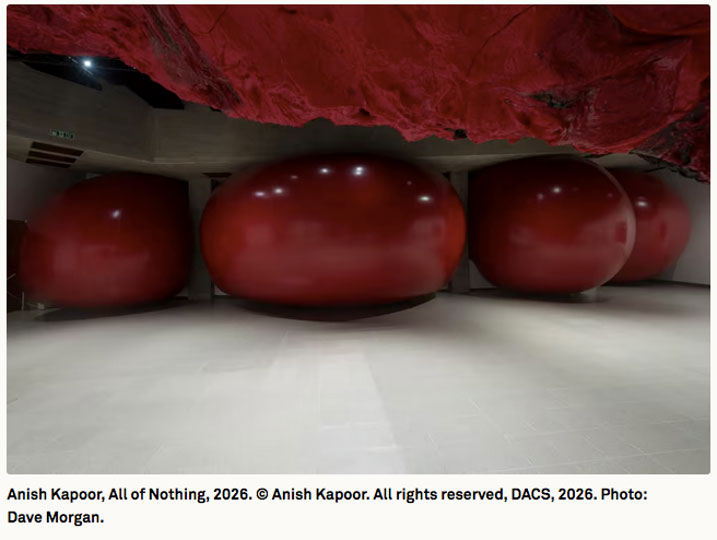
By contrast, the opening rooms of Kapoor’s exhibition at Hayward Gallery are a deflation of expectations, particularly in view of the laudatory reviews given when this show opened. The first room has a large blood-red oval inflatable that fills this expansive space. All of Nothing is a confrontational piece blocking our every move with a rubber wall, in stark contrast to the more invitational pieces I encountered in Liverpool. On entering this exhibition, our experience is of an immediate blockage, a structure that shuts us out with no way through and around which we have to pass. Its uniformity and bland substance may, perhaps, suggest that this is the natural form that exclusion takes, as with the serried ranks of identically dressed and anonymous protestors seen at Dover recently.
Unlike some of Kapoor’s exhibitions, this is a series of installations that explore the darker strands of human existence, although the works, themselves, do get more interesting and engaging as we progress.
The second room predominantly makes use of Vantablack paint, the black paint that absorbs 99.8 percent of all light and of which Kapoor has exclusive use as an artist. It has been claimed that this is ‘the blackest material in the universe’ but this claim is disputed by the artist’s Stuart Semple and Diemut Strebe, who each claim to work with different and darker paints. Kapoor uses Vantablack here in a range of works, each of which involve a degree of optical illusion.
The search for the blackest black and its use with squares, ovals, circles and cracks (Kapoor) or diamonds (Strebe) would seem to be an extension of the experiments with black paintings made by the likes of Kasimir Malevich, Ad Reinhardt, Frank Stella, Pierre Soulanges, and Robert Rauschenberg. Reinhardt, in particular, with his series of ‘late’ Black paintings was seeking a painting that absorbed light and that had no reference to the means of its making. As a result, as David Miller has noted, absolute attention is needed to see the cross-like structure of each work in the subtle differences derived from different colours in extremely dark tones.
The optical illusions found in Kapoor’s works here include the sense of a work hovering over a plane that we can glimpse or sense but not fully see or of an infinite recession into a void. In the Hayward’s spaces, some of these effects are diminished by the curatorial decision to protect the work from the viewer with bars or vitrines that mean they can only be viewed from a distance and can’t be touched. Kapoor’s works are supremely tactile and are, in my view, only enhanced by being seen close-up or felt.
Strebe, with The Redemption of Vanity, eliminated all reflections from the diamond he painted black (diamonds are, naturally, the most reflective of surfaces) enabling the diamond itself (although present) to disappear from sight. Kapoor achieves a similar effect with his Non-Object Black works that make three-dimensional forms appear entirely flat when seen head-on.
Reinhardt’s intent with his Black Paintings was to demystify paintings. Although also concerned with paint’s absorption of light, Kapoor’s works seem to move in the opposite direction in wanting to suggest something more, something beyond, another dimension that can only be sensed not seen.
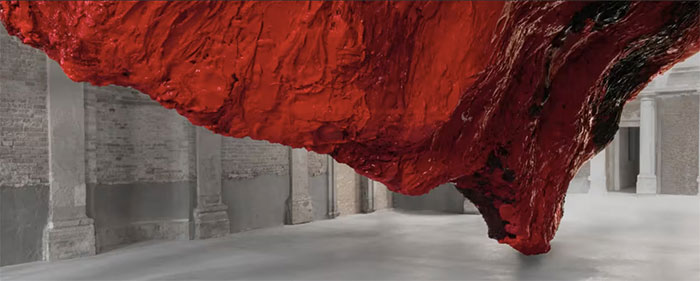
From here, we move to the more visceral works in the exhibition, including those that seem to bear the weight of the world’s sorrow and the concerns of the artist’s heart. The most dramatic of these is Mount Moriah at the Gate of the Ghetto, a massive inverted replica of Mount Moriah in volcanic reds and blacks that hangs from the ceiling above our heads, the peak of the mountain nearly touching the floor. Ominous and overwhelming, like the guilt – ‘the darker aspects of our collective consciousness’ – that clings to us through our human tendency towards violence, Mount Moriah is the place where God asked Abraham to sacrifice his firstborn son Isaac. Kapoor writes that we are ‘religious beings’ involved in the ‘ancient practice of ritual sacrifice’ and that ‘we carry within ourselves the mystery, the masked feat that sits behind the ritual act ─ the fear of death’.
This theme is carried on in the three Plastic Sacrifice works in which ‘bloodied masses of body tissue’ have been shrink-wrapped in plastic, as though for sale; something we, as carnivores, accept as normal, but which here is rendered objectionable through the graphic nature of the wrapped contents.
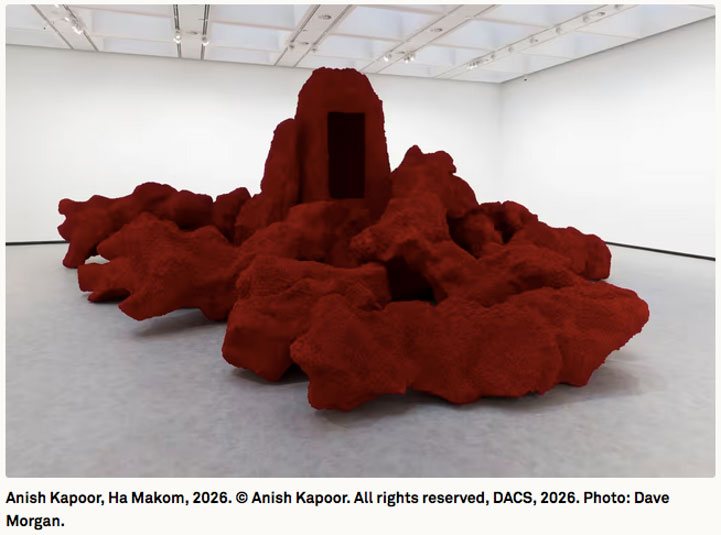
Then, we encounter the Ritual Expiation sculptures and paintings. The sculptures are dead or diseased organic, often octopus-like, shapes – reminders of hearts and guts – placed on abattoir-type trays with run-off channels from which the blood can drain. They are stark reminders of the pain and anguish that sacrifice in any form causes. Several contain black voids – reminders of the earlier Vantablack voids – but here acting as voids of eternal angst – reminders, too, of the screaming figure in Francis Bacon’s Three Studies for Figures at the Base of a Crucifixion and carrying the same intensity of pain. Kapoor’s paintings, by contrast, offer a more transcendent response to sacrifice; the sense of expiation that is found in the light that emerges from wound-like shapes.
These works, it seems to me, are a visceral cry protesting our human tendency to scapegoat and sacrifice others in order to experience expiation. This is the tendency that has been most clearly articulated by René Girard through his theory of mimetic desire. Girard argues that the story of Abraham and Isaac at Mount Moriah is a subversion of the ritual practice of child sacrifice and the first stage in human beings developing an understanding that God does not require (even abhors) sacrifice; an understanding that reaches its ultimate conclusion in the Christian tradition with the realisation that God becomes scapegoat and sacrifice through the crucifixion of Jesus Christ. Such subversion of our tendency towards ritual sacrifice is what Kapoor seeks to express through the visceral cry of pain found in these works relating to sacrifice.
.
Jonathan Evens
.