
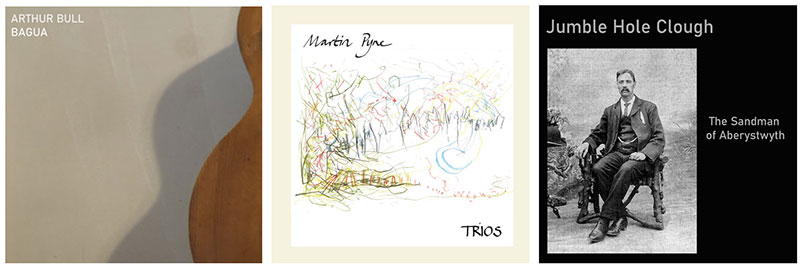
Bagua, Arthur Bull (Scatter Archive)
Trios (2026), Martin Pyne (Discus Music)
The Sandman of Aberystwyth, Jumble Hole Clough (Jumble Hole Clough)
Canadian improvising guitarist Arthur Bull says of his recent Scatter Archive release, Bagua: ‘In recent years, much of my music has focused on an exploration of my musical language. This has led to a daily practice of shooting short videos of natural movement and light, improvising acoustic guitar scores, then posting the completed pieces on Instagram [see links, below]. Doing this work, I started to see patterns in my playing that seemed to correspond to patterns in nature: rushing waterfalls, still lakes, sudden bursts of thunder, ripples caused by gentle breezes. These modalities also seemed to correspond with the trigrams of the bagua, like baskets for sorting the different aspects of my musical language, not as some musicological theory, but as a way of participating in the essential spontaneous self-creation of all things.’ For those who don’t know, the bagua (‘eight symbols’) is a Taoist representation of the principles of life and existence that takes the form of an octagonal diagram showing eight trigrams arranged around a yin-yang symbol. The trigrams – groups of three lines, some broken (yin), some unbroken (yang) – are what go to make up the sixty-four hexagrams of the ancient Chinese divination text, the I Ching. Each trigram represents a different aspect of experience: thunder, lake, mountain, earth, sky, water, wind and fire.
The album Bagua presents us with a track for each of the eight trigrams, the music of each rooted in (but not crudely descriptive of) the meaning of the trigram. There are actually ten tracks, as two of the trigrams take up two tracks each. You could say Bull has found, through his practice and the way he thinks about it, a way of using the whole of creation as a ‘score’ – and not simply by looking at it, but by feeling his way into it. And just as you don’t have to understand Taoism – or any other particular way of seeing it – to appreciate the world, one doesn’t have to unpick the way Bull puts his music together to respond to it. Once I’d figured it out, I found it best to put all the background information, important though it is, to the back of my mind and let the music – as the world it’s based on does – speak for itself. The end result is sometimes dense, sometimes spacious, always imaginative. Do have a listen. And if it starts to get under your skin, start following Arthur Bull on Instagram.
Martin Pyne is an improviser and composer whose work centres on vibraphone, drums and mallet percussion. He has received much critical acclaim for his work as a vibraphone player. His trademark style could be described as being cool, expressive, transparent and economical while paying close attention to timbre. His work embraces both contemporary jazz and free improvisation. He has worked with various ensembles as bandleader and is also known for his work with contemporary dance and for providing music for silent film.
His recent double album, Trios, now out on Discus Music, has him working with two contrasting trio line-ups. In the first, he’s working with drummer Johnny Hunter and double bass player Michael Bardon. What they come up with is a set comprising largely quiet, non-showy chamber jazz, the sort of open texture that allows all three players to showcase their creativity. That’s not to say they don’t come up with surprises – Michael Bardon’s tremolo and double-stopped bowed section in ‘Blackwell Tart’, for example, and the surprisingly idiosyncratic ‘Spinning Yarns’. And there are two solo pieces from Pyne: ‘Cooking for One’, for balafon (an African xylophone) and temple bowls and a ruminative homage to vibraphone player Walt Dickerson.
For the second trio, Pyne has teamed up with one of his regular groupings, the Chalk Horse Trio, which comprises Pyne, keyboard player David Beebee and drummer Angus Bishop. The vibe here is slightly different, partly on account of the changed instrumentation and partly due to the preoccupations of the players. There’s more forward drive and, as the album notes point out, an air of mystery. I particularly liked the restless, shifting textures in The Ghosts of Wharam Percy’ and the slow-motion unfurling of ‘And Then A Poppy Blooms.’
The combination of the two trio line-ups on this album was an inspired move. Both are wide-ranging and interesting in what they do, in different ways, and the fact that they’re both brought together in one place makes the music even more so.
Colin Robinson (aka Jumble Hole Clough) is a fast worker. He’s just released The Sandman of Aberystwyth – his fifty-third album – a mere six weeks after releasing his last.
You could say the opening track, ‘Standing in Aberystwyth’, is song about memory although, on a deeper level, it feels more like a tragic reflection on our urge to do things – however absurd – in our quest – however doomed – to acquire memories that bring us comfort and allow us to feel we did something with our lives:
From Morecambe to Llandudno
it was all the bloody same
we were the only people on the beach
then it started to rain.
An hour on the bus
four hours on the train
just to stand in Aberystwyth
in the rain.
Do click on the tracks: that way you get to see the photos that go with each one. Occasionally there are other goodies to be found: in this case, a pic of a youthful Robinson and a poem about the song and how his parents used to take their cat to the vet. A JHC album is very much a mixed media experience these days. You never know what’ll pop up next on one either, so I’ll leave you to discover what else is on this one for yourself (including figuring out Robinson’s anagram, which you’ll find, if you pay close attention). I can’t resist highlighting a couple of tracks, though. ‘Where Have All the Little People Gone?’, at barely over a minute, is a miniature masterpiece. Then there’s ‘UXB at the Chip Shop’, which owes its inception to a recent news story about an unexploded bomb in Prestwich that turned out to be a false alarm. Prestwich is perhaps most famous these days for its mural, documented here by Robinson, of Mark E Smith on a wall next to a fish and chip shop.
Robinson, as I said, might be a fast worker, but don’t go thinking there’s any fall-off of intensity or quality as a result, though: there isn’t. There might be fifty-two other JHC albums, but The Sandman of Aberystwyth is up there with the best.
.
Dominic Rivron
LINKS
Bagua: https://scatterarchive.bandcamp.com/album/bagua
Arthur Bull on Instagram: https://www.instagram.com/arthurbull5/
Trios (2026): https://discusmusic.bandcamp.com/album/trios-218cd-2026
The Sandman of Aberystwyth: https://jumbleholeclough.bandcamp.com/album/the-sandman-of-aberystwyth