
by Ade Rowe
The history of British punk rock is populated by musicians whose contributions have become inseparable from the cultural upheaval of the late 1970s. Yet, among the multitude of performers who emerged during this period, comparatively few developed an artistic identity as distinctive, intellectually provocative and aesthetically unconventional as Poly Styrene. As the charismatic frontwoman and principal songwriter of X Ray Spex, Styrene occupied an unusual position within a movement frequently associated with aggression, masculine posturing and deliberately rudimentary musicianship. Her approach was altogether more intricate. Beneath the explosive arrangements, abrasive guitar work and seemingly anarchic performances existed an unusually perceptive songwriter whose observations encompassed consumerism, environmental destruction, female identity, racial prejudice, social conformity and the increasingly artificial nature of modern existence. Her work possessed an almost prophetic quality, anticipating cultural anxieties that would become considerably more prominent in subsequent decades.
X Ray Spex emerged in London during 1976, a period in which British popular music was experiencing a profound transformation. The economic difficulties, unemployment and social disillusionment of the decade had created fertile circumstances for the emergence of punk, although its cultural significance extended beyond straightforward political dissatisfaction. Punk offered a means of rejecting established expectations concerning musical ability, personal appearance, class identity and artistic legitimacy. For young musicians who felt excluded from the increasingly elaborate conventions of mainstream rock, the movement presented an opportunity to create something independently of established institutions. Poly Styrene understood this possibility instinctively, although her artistic temperament was never entirely confined to the confrontational attitudes generally associated with punk.
Born Marianne Joan Elliott Said on 3 July 1957 in Bromley, Kent, Styrene was the daughter of a British mother and a Somali father. Raised principally by her mother, she experienced the complexities of growing up as a mixed race girl in Britain during a period when racial discrimination remained deeply embedded within everyday social life. Her childhood and adolescence were formative in shaping her subsequent understanding of identity and belonging. The experience of being perceived as different, combined with her refusal to accommodate conventional expectations of femininity, contributed to an artistic personality that would eventually challenge several prevailing assumptions within popular music.
Her early interests were not restricted to punk or even rock music. Styrene was attracted to the countercultural atmosphere of the late 1960s and early 1970s, and spent time travelling independently, attending festivals and exploring alternative lifestyles. At fifteen, she left home and travelled around the country, hitchhiking between music festivals and experiencing the alternative communities that existed outside conventional society. She also developed an interest in fashion and design, talents that would later become apparent in the construction of her stage costumes and the visual presentation of X Ray Spex. Her relationship with music developed at an early age, and she had already begun writing songs before the emergence of the band that would establish her reputation.
An important, although sometimes overlooked, element of her musical history occurred before X Ray Spex existed. In 1976, performing under the name Mari Elliott, she released a reggae influenced single entitled Silly Billy, with What a Way on the reverse. The record represented her first commercial recording and demonstrated that her musical interests were considerably broader than the punk vocabulary with which she would subsequently become associated. Its rhythmic character and lighter musical presentation provide an intriguing contrast with the confrontational material that followed. The single did not achieve significant commercial success, but it remains an important document of her development as a songwriter and recording artist. It also establishes that Styrene had begun pursuing an independent musical identity before the formation of X Ray Spex.
The decisive moment arrived when she attended a Sex Pistols performance at Hastings Pier in July 1976. The experience encouraged her to establish a band of her own, not because she wished to imitate the existing punk establishment, but because she recognised that the movement offered an opportunity for individuals without conventional musical credentials to create something meaningful. She subsequently placed an advertisement in the British music press seeking young musicians who wanted to form a group. The advertisement, famously headed with the words Young Punx Who Want to Stick It Together, attracted several young performers who would become central to the band’s original identity.
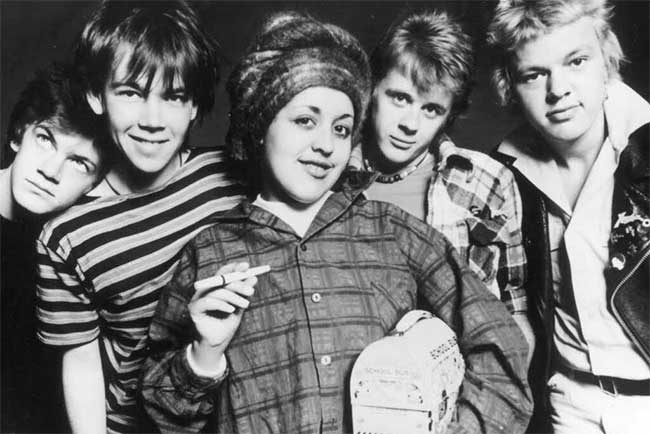
The initial formation brought together Styrene, guitarist Jak Airport, bassist Paul Dean, drummer B P Hurding and saxophonist Lora Logic. Airport, whose real name was Jack Stafford, supplied the group’s angular guitar work, while Dean provided the bass foundation and Hurding established the rhythmic framework. Logic, born Susan Whitby, was particularly significant. Having developed an interest in jazz saxophone, she introduced an instrumental element that distinguished X Ray Spex from many of their contemporaries. Her playing was neither ornamental nor restrained. The saxophone frequently occupied a position of equal importance to the guitar, producing an abrasive, almost unruly musical texture that became fundamental to the group’s identity.
Logic was still a teenager when she joined the band, and her musical relationship with Styrene formed an important part of the original creative dynamic. However, she departed during the band’s early development and was subsequently replaced by Rudi Thompson, who continued the saxophone tradition within the group. The precise contribution of the saxophone was crucial. Rather than functioning as a conventional melodic embellishment, it became an instrument of disruption, punctuating the arrangements with sharp, discordant phrases and providing an additional source of musical tension.
The band’s early performances were characterised by extraordinary energy, although their musicianship was initially imperfect. Their appearance at London’s Roxy club, following only a handful of rehearsals, demonstrated both the limitations and possibilities of their approach. X Ray Spex did not possess the polished technical ability of established rock musicians, but their performances communicated an immediacy that was particularly appropriate to the emerging punk environment. Their music seemed to exist in a state of permanent agitation, with Styrene’s vocal delivery providing its principal expressive force.
Their debut single, Oh Bondage, Up Yours!, released in 1977, established the band as one of the most distinctive groups within British punk. The opening declaration, concerning the expectation that little girls should remain silent, was transformed into an explosive statement of resistance. Styrene’s delivery was deliberately theatrical, moving between speech, shrieking and melody, while the guitars and saxophone created an unusually dense musical backdrop. The record was not simply an exercise in youthful aggression. Its lyrical content challenged the relationship between power, gender and submission, while its provocative title invited several interpretations concerning the structures that restrict individual freedom.
The production of Oh Bondage, Up Yours! was associated with producer Falcon Stuart, who would subsequently become closely involved with the recording of the band’s debut album. The single’s comparatively raw presentation suited its subject matter. Rather than attempting to soften the band’s sound, the recording preserved its abrasive character and allowed the competing instrumental elements to retain their individual force. It was an important statement of artistic independence, establishing the musical vocabulary that would be developed more fully on the group’s subsequent recordings.
Styrene’s songwriting was particularly unusual because it combined the directness of punk with an almost analytical interest in the language and imagery of everyday life. She was fascinated by the objects, advertisements and manufactured desires that increasingly defined British consumer culture. Her stage name itself, suggesting a synthetic material used in the manufacture of plastic products, was an ironic comment upon the artificiality she perceived within contemporary society. Her clothing, performances and public image were therefore not incidental aspects of her artistic identity. They formed part of a broader examination of the ways in which individuals construct and present themselves.
The Day the World Turned Dayglo, released in 1978, developed these concerns through an imaginative environmental narrative. The song presented a world transformed by pollution and industrial contamination, using vivid colour imagery to create a strangely playful description of ecological catastrophe. Its musical arrangement was energetic and comparatively accessible, demonstrating that X Ray Spex could produce memorable pop structures without abandoning their unconventional sensibilities. Styrene’s lyrics were particularly effective because they approached serious subjects through humour, exaggeration and surreal imagery rather than relying upon conventional protest language.
Identity, another significant single from 1978, explored the psychological consequences of social alienation. Its subject was the fragmentation of individual personality within a society that encouraged conformity while simultaneously placing extraordinary pressure upon people to establish their own identities. Styrene’s treatment of the subject was neither sentimental nor straightforwardly autobiographical. Instead, she constructed a broader commentary on the experience of being misunderstood and marginalised. The song remains one of the clearest examples of her ability to transform personal and social anxieties into concise, compelling musical statements.
The culmination of this initial creative period arrived with Germfree Adolescents, released in November 1978 on EMI International. It remains the band’s most important full length recording and the principal document of their original artistic achievement. Produced by Falcon Stuart and X Ray Spex, the album was engineered by John MacKenzie Burns, with Andy Pearce credited as assistant engineer. Recording took place at Essex Studios. These technical contributions are worth acknowledging because the finished record possesses a degree of clarity and instrumental separation that distinguishes it from the more primitive sound associated with some early punk releases.
The production manages to preserve the band’s energetic character without allowing the individual instruments to disappear within an undifferentiated wall of noise. Jak Airport’s guitar frequently provides a sharp rhythmic framework, while Paul Dean’s bass and B P Hurding’s drumming maintain a muscular sense of forward movement. Thompson’s saxophone contributes a distinctive melodic and textural dimension, particularly when it competes with Styrene’s voice. Her vocal performances remain the album’s most immediately recognisable feature, moving between piercing declarations, melodic phrases and almost conversational observations.
The album opens with Art I Ficial, a concise expression of Styrene’s concerns regarding artificiality and manufactured behaviour. Obsessed With You examines the peculiar intensity of romantic fixation, while Warrior in Woolworths uses the familiar environment of a British department store to create a character study that is simultaneously comic and unsettling. Let’s Submerge introduces a different emotional atmosphere, and I Can’t Do Anything presents the frustrations of individual powerlessness with characteristic directness.
Identity and Genetic Engineering continue the album’s examination of psychological and technological alienation. The latter is particularly interesting because it anticipates contemporary concerns about scientific intervention and the potential commodification of human life. I Live Off You offers a more explicitly interpersonal observation, while I Am a Poseur examines the relationship between appearance, self invention and public perception. The title track brings the album’s principal concerns together through an imaginative depiction of a generation increasingly dependent upon artificial substances and manufactured solutions. Plastic Bag and The Day the World Turned Dayglo complete the original twelve track sequence, reinforcing the album’s preoccupation with disposable materials, pollution and the psychological consequences of consumer culture.
The production of the title track deserves particular attention. Its comparatively melodic arrangement demonstrates that the band was capable of incorporating more accessible musical structures without losing its identity. The song’s controlled instrumental presentation contrasts with the aggression of earlier recordings, and the result is a composition that occupies an interesting position between punk and new wave. This capacity for musical development suggests that X Ray Spex were never entirely committed to the limitations of a single genre.
Germfree Adolescents was also significant because its musical construction reflected the complexity of Styrene’s ideas. The album’s lyrics repeatedly questioned the relationship between individual freedom and the social structures that shape behaviour. Consumerism, technological progress and popular culture were presented not as isolated subjects but as interconnected elements of a society increasingly dependent upon manufactured experiences. The band’s music was therefore more than an accompaniment to a series of rebellious slogans. It constituted a coherent artistic response to the contradictions of modern British life.
The album’s significance becomes even clearer when considered against the broader musical environment of 1978. British punk was already beginning to diversify, with some of its original participants moving towards post punk, experimental electronics and more elaborate songwriting. X Ray Spex occupied an interesting position within this transition. Their music retained the immediacy and confrontational spirit of punk, yet their arrangements possessed a sophistication that was not always recognised at the time. The presence of the saxophone, the variety of rhythmic approaches and the complexity of Styrene’s lyrical observations gave the group a musical identity that resisted easy categorisation.
The individual members also deserve consideration beyond their contributions to the recordings. Jak Airport was responsible for the band’s characteristic guitar sound. His playing was economical rather than technically extravagant, frequently relying upon repetitive rhythmic figures and sharp chordal attacks. This approach complemented Styrene’s vocal delivery, creating a musical framework that allowed the lyrics to remain prominent. Airport subsequently maintained a relatively low public profile.
Paul Dean’s bass playing was an equally important component of the band’s sound. His contribution provided structural stability beneath the frequently unpredictable instrumental arrangements. Rather than competing with the guitar, his bass lines helped establish the rhythmic momentum that enabled the saxophone and vocals to operate with considerable freedom. B P Hurding, meanwhile, supplied the percussion with a directness that was particularly appropriate to the group’s musical temperament. His drumming was energetic and functional, emphasising the songs’ forward motion rather than introducing unnecessary complexity.
Lora Logic’s importance extends beyond her participation in the original lineup. Her subsequent musical career included the formation of Essential Logic, a group that developed an experimental approach to post punk, incorporating unusual instrumental arrangements and a more exploratory compositional sensibility. Her work demonstrated that the musical ideas initially explored within X Ray Spex could develop in several different directions. Rudi Thompson, who replaced her, helped preserve the distinctive saxophone presence on the band’s most familiar recordings. His playing was an essential part of the sound heard on Germfree Adolescents, particularly in the live performances that followed its release.
Despite the success of their debut album, the original group did not enjoy a particularly lengthy existence. The demands of touring, the pressures of public attention and differences in artistic direction contributed to the growing difficulties within the band. Styrene eventually departed in 1979, effectively bringing the original incarnation of X Ray Spex to an end. Their comparatively brief recording career is one of the more intriguing aspects of their history. They had established a distinctive musical language, yet circumstances prevented its development through a substantial sequence of studio albums.
The dissolution of X Ray Spex cannot be understood entirely through musical disagreements or the ordinary difficulties experienced by a young touring band. Styrene was experiencing serious mental health difficulties during this period, and the pressures associated with sudden fame were becoming increasingly difficult for her to manage. The demands of touring, the intrusion of public attention and the expectations placed upon her as an unconventional female performer contributed to an increasingly complicated personal situation.
Following a distressing episode in the late 1970s, Styrene experienced unusual perceptions and beliefs that resulted in her being admitted to psychiatric hospital. She was initially diagnosed with schizophrenia and spent several months receiving psychiatric treatment. The diagnosis was subsequently revised. In 1991, she was diagnosed with bipolar disorder, a condition she believed might have affected her long before it was formally recognised. In a 2011 interview with The Guardian, she spoke openly about her diagnosis and described the difficulties it had created for her professional life and creative routine.
The distinction between the original diagnosis and the later identification of bipolar disorder is important. Her experiences should not be reduced to an anecdote about an eccentric punk musician, nor should they be romanticised as an explanation for her creativity. Mental illness can have profoundly disruptive consequences, and Styrene’s experiences were frequently distressing. The prolonged period of uncertainty surrounding her diagnosis, together with the psychiatric treatment she received, formed a difficult chapter in her life.
Her daughter, Celeste Bell, subsequently discussed aspects of her mother’s mental health in the documentary Poly Styrene, I Am a Cliché, which she co directed with Paul Sng. The film drew upon family photographs, personal recordings, handwritten lyrics and previously unseen archival material to present a more intimate account of Styrene’s life. It also examined the consequences of her mother’s illness for their family relationship. Bell’s perspective is particularly valuable because it reveals a side of Styrene that was largely absent from the public image of the flamboyant punk performer.
The difficulties of her mental health also coincided with an increasingly complicated relationship with the music industry. Styrene had become an identifiable public figure at an exceptionally young age, yet the expectations surrounding her appearance and behaviour were often at odds with her own understanding of herself. She was subjected to scrutiny concerning her body, her clothes and her unconventional presentation. As a mixed race woman operating within a predominantly male musical environment, she was also navigating social prejudices that were not always openly acknowledged. These experiences provide important context for understanding the pressures surrounding her withdrawal from X Ray Spex, although they should not be treated as a complete medical explanation for her illness.
For Styrene, the dissolution of X Ray Spex did not signify the conclusion of her artistic ambitions. Instead, it marked the beginning of a period of musical exploration that would confound the expectations of listeners who had associated her exclusively with punk. Her first major solo album, Translucence, appeared in 1980 through United Artists. The record represented a substantial departure from the abrasive sound of her former band, embracing jazz influenced arrangements, understated rhythms and a considerably more reflective atmosphere.
Produced by Ted Bunting and recorded at Matrix Studios in London, Translucence featured an accomplished group of instrumentalists. G T Moore and Richard Moore contributed guitars, Kuma Harada played bass, Kevin McAlea supplied keyboards, while Richard Bailey performed drums. Daryl Lee Que contributed percussion, with Bunting himself providing saxophone and flute. Damian Kormer was responsible for the mixing. The resulting album demonstrated a carefully considered approach to musical arrangement, with the instrumental performances occupying considerably more space than they had within the tightly compressed structures of X Ray Spex.
The twelve compositions included Dreaming, Talk in Toytown, Skydive, Day That Time Forgot, Shades, Essence, Hip City Hip, Bicycle Song, Sub Tropical, Translucence, Age and Goodbye. Styrene’s songwriting remained recognisable, but the delivery had changed. The voice that had previously confronted audiences with an almost confrontational intensity was now integrated into a more restrained musical environment. The album’s emphasis upon keyboards, jazz inflections and spacious arrangements revealed an artist unwilling to become imprisoned by the success of her earlier work.
Translucence was an important declaration of independence, although its departure from punk inevitably confused some listeners. It would be simplistic, however, to regard the record as a rejection of everything that X Ray Spex represented. Its experimental character was consistent with the curiosity that had informed Styrene’s earlier songwriting. She had never demonstrated much interest in repeating herself, and the album reflected a desire to investigate musical possibilities beyond the limitations of the punk aesthetic.
The period following Translucence was marked by considerable personal and spiritual change. Styrene became increasingly interested in the Hare Krishna movement and was initiated into the religious tradition in 1983. Her subsequent life involved a retreat from the mainstream music industry and a renewed interest in spirituality. This development was not entirely unexpected when viewed alongside the themes of her earlier work. Her lyrics had frequently questioned materialism and the assumption that personal fulfilment could be obtained through the acquisition of possessions. Her spiritual interests represented a further exploration of questions that had already occupied an important position within her artistic thinking.
In 1986 she released Gods and Goddesses, a recording that reflected her involvement with Krishna consciousness. It represented another considerable departure from her earlier punk material and further demonstrated her refusal to maintain a commercially convenient musical identity. Styrene’s subsequent appearances were intermittent, although her influence continued to develop among musicians and listeners who recognised the originality of her work with X Ray Spex.
Her mental health difficulties, however, did not simply disappear during this period. She experienced further personal challenges, and the management of bipolar disorder remained a significant aspect of her life. Her daughter has spoken about the complicated circumstances of their relationship, including periods when Styrene was unable to provide the consistency of care that motherhood required. These experiences should be acknowledged as part of her biography rather than concealed behind the more comfortable narrative of a celebrated musician who simply chose to abandon fame.
The Hare Krishna movement provided Styrene with a spiritual framework and a community in which she hoped to find greater stability. She spent time at Bhaktivedanta Manor in Hertfordshire, the British centre of the movement. Her involvement was substantial, although her relationship with the organisation eventually became complicated. She later left the community, while retaining aspects of the spiritual beliefs that had attracted her in the first place. Her interest in spirituality remained an important feature of her identity and found expression in subsequent musical projects.
The first significant reunion of X Ray Spex took place in 1991, when the group performed at Brixton Academy. The event demonstrated that their music retained considerable appeal more than a decade after its original appearance. A further reunion followed in 1995, resulting in the release of Conscious Consumer, the band’s second studio album and first collection of newly recorded studio material since Germfree Adolescents.
Conscious Consumer was issued through Receiver Records in September 1995. The project reunited Styrene with saxophonist Lora Logic and bassist Paul Dean, although the personnel did not constitute a complete restoration of the original lineup. Importantly, Styrene assumed responsibility for producing the album, having written its material and taken a much more direct role in the recording process. Sessions took place at Livingston Studios in Wood Green and The Strongroom in Shoreditch, London.
The album’s production reflects the considerable changes that had taken place within popular music during the intervening years. The sound is more contemporary than that of the original X Ray Spex recordings, incorporating a cleaner studio presentation and a more developed approach to arrangement. Nevertheless, the central concerns of the band’s earlier work remain apparent. The title itself suggests a continuation of Styrene’s longstanding interest in consumer behaviour, environmental responsibility and the psychological effects of material culture. The album can consequently be understood as an extension of the original band’s intellectual preoccupations rather than a straightforward attempt to reproduce the sound of 1978.
The reunion also illustrated how the passage of time had altered the relationship between Styrene and her former musical collaborators. The group was no longer a collection of young performers reacting to the immediate conditions of the late 1970s. Its members had experienced different artistic and personal trajectories, and Conscious Consumer emerged from that altered perspective. Although it did not reproduce the cultural impact of Germfree Adolescents, it remains an important part of the band’s history because it demonstrates that Styrene’s creative interests had not diminished with the passing of the original punk era.
Styrene’s later musical work continued to reflect her eclectic interests. Flower Aeroplane, released in 2004, explored a more meditative musical atmosphere, incorporating elements associated with her spiritual outlook. The album included material that revisited aspects of Translucence, thereby creating an interesting connection between two otherwise distinct periods of her career. Rather than treating her earlier experiments as an abandoned diversion, Styrene appeared increasingly willing to acknowledge the continuity between her different musical identities.
The 2008 X Ray Spex reunion at the Roundhouse in London provided another opportunity to revisit the band’s original repertoire. The performance demonstrated the enduring effectiveness of the material, particularly the songs whose subjects had become even more relevant in the intervening years. The group’s renewed activity also coincided with the creation of Black Christmas, recorded by Styrene with her daughter Celeste Bell. The song offered a darker and more contemporary perspective on the festive season, once again demonstrating her willingness to engage with uncomfortable social subjects through popular music.
In the final years of her life, Styrene experienced a renewed period of musical creativity. Her last solo studio album, Generation Indigo, was released in March 2011. Produced in collaboration with the musician and producer Youth, the record combined elements of electronic pop, alternative music and the socially observant songwriting that had characterised her earlier work. The production was considerably more contemporary than that of her recordings with X Ray Spex, yet the album retained her unmistakable lyrical personality. Its songs explored contemporary relationships, technology, environmental concerns and the contradictions of modern life.
Generation Indigo was released shortly before her death on 25 April 2011, aged 53. She had been diagnosed with breast cancer, which had spread to her spine and lungs. Her death represented a considerable loss to British popular music, although the subsequent recognition of her contribution has ensured that her work continues to reach new audiences.
One of the most compelling aspects of Styrene’s legacy is the extent to which her artistic concerns anticipated subsequent developments in popular culture. Her observations about disposable commodities, environmental degradation, manufactured beauty and the commercial exploitation of female identity have acquired renewed significance in an age dominated by mass consumption, digital self presentation and the constant circulation of advertising imagery. Songs such as Plastic Bag and The Day the World Turned Dayglo can now be understood as early musical examinations of problems that have become central to contemporary environmental debate.
Her position within the history of feminist music is equally important. Styrene did not simply occupy a prominent position in a male dominated musical movement. She challenged the assumptions upon which that movement frequently depended. Her appearance was deliberately unconventional, and she refused to conform to the familiar expectations imposed upon female performers. Her braces, brightly coloured clothing, unusual hairstyles and theatrical stage presence became part of an alternative visual language. Rather than presenting herself as an object of conventional desirability, she transformed her appearance into an expression of individuality and resistance.
There was also a distinctive element of humour within her work. This is sometimes overlooked when her contribution is discussed exclusively in terms of feminism or political criticism. Styrene possessed an exceptional ability to recognise the absurdities of everyday existence and transform them into lyrical observations. Her characters were frequently exaggerated, her imagery occasionally surreal, and her commentary possessed an almost cartoonish quality. Yet beneath the humour existed a serious understanding of the pressures exerted upon individuals by social expectations and commercial culture.
It would also be inaccurate to regard her musical identity as exclusively confrontational. Her later recordings demonstrate an artist interested in introspection, spirituality and the possibility of personal transformation. The movement from the furious energy of Oh Bondage, Up Yours! to the comparatively tranquil atmosphere of Translucence illustrates a creative personality that resisted categorisation. Her artistic development was not a simple progression from punk towards conventional maturity. It was an ongoing investigation of different musical and philosophical possibilities.
The other members of X Ray Spex deserve recognition within this history because the band’s distinctive sound was the product of collective musical interaction. Styrene provided its principal lyrical and vocal identity, but the contributions of Airport, Dean, Hurding, Logic and Thompson were fundamental to its character. The saxophone was particularly important in distinguishing the band from the numerous guitar based groups that emerged during the punk explosion. Without this unusual instrumental dimension, the music would have possessed an entirely different personality.
The band’s relatively small original recorded catalogue has also contributed to its particular place within musical history. Germfree Adolescents remains the definitive statement of the original group, but its twelve songs contain an extraordinary range of musical and thematic material. The album demonstrates that punk could be intellectually engaged without becoming pretentious, commercially accessible without becoming artistically compromised, and humorous without surrendering its critical purpose.
Ultimately, the importance of X Ray Spex cannot be measured solely through their commercial achievements or the number of records they released. Their significance lies in the alternative perspective they introduced into British popular music. They demonstrated that punk could accommodate unusual instrumentation, sophisticated lyrical observation and an unconventional female voice without sacrificing its urgency. They also helped establish a space in which musicians could challenge the relationship between appearance, identity and artistic credibility.
Poly Styrene remains central to that achievement. She was not simply a singer who happened to emerge during an important period in British musical history. She was an unusually perceptive songwriter whose work reflected a sustained interest in the contradictions of modern existence. Her ability to identify the absurdity of consumer culture, the artificiality of social expectations and the difficulties of individual identity gave her music a depth that extended beyond the immediate circumstances of the punk movement.
Perhaps the most revealing aspect of her legacy is that she never seemed entirely comfortable with the expectations attached to her public image. Punk made her famous, but she was not content to become a permanent representative of a particular musical moment. She explored jazz, reggae, electronic music, spiritual composition and alternative pop, continually searching for new forms of expression. Her career was unconventional because her interests were unconventional, and her refusal to reproduce earlier successes was central to her artistic character.
Her work therefore deserves to be considered not merely as an important contribution to the history of British punk, but as part of a wider tradition of independent artistic thought. X Ray Spex challenged the musical conventions of their generation, while Poly Styrene challenged the cultural assumptions that surrounded them. Their music remains a reminder that originality does not necessarily emerge from technical perfection or commercial calculation. Sometimes it comes from the willingness to look at familiar things differently, to question what others accept without hesitation and to express those observations without asking permission.
In this respect, the enduring significance of Poly Styrene lies in something more substantial than nostalgia. She created music that was unmistakably of its time, yet never entirely confined by it. Her work continues to speak because the world she questioned has not fundamentally resolved the contradictions she identified. The plastic may have changed its shape, the advertisements may have moved from shop windows to digital screens, and the machinery of consumerism may have become more sophisticated, but the questions she raised remain remarkably persistent.
Poly Styrene did not merely provide the soundtrack to British punk. She gave it an alternative vocabulary, an unusual visual identity and a set of ideas that continue to merit serious consideration. Her contribution was not simply to make noise. It was to make sure that noise meant something.
.