
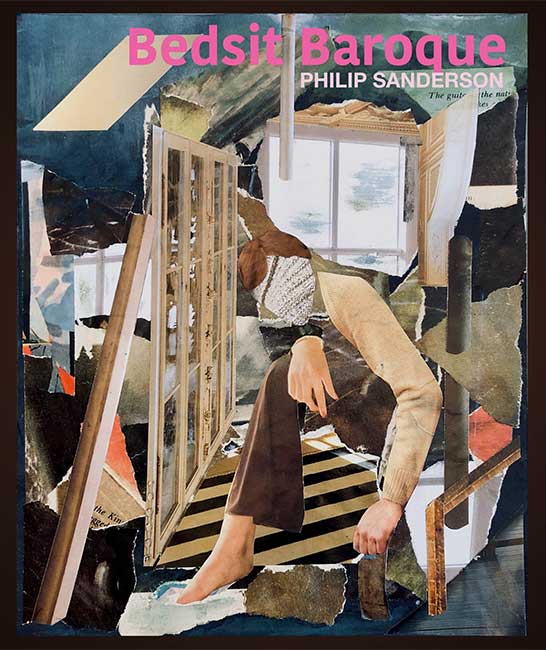
Philip Sanderson is a singular voice in the pantheon of creativity in the conjoined towns of Hastings and St Leonards, and one who generally
flies under the radar. Whether this is by choice or force of circumstance isn’t entirely clear, but I suspect an element of each.
Sanderson’s output is both prodigious and diverse. You can hear for yourself via the links below, and I would urge you to check them out. Your life may be improved as result.
I wanted to ask Philip Sanderson a few questions concerning his work, the nature of existence and other pressing matters. To that end, we met in a café in St Leonards:
KR: I’ve been trying to decide what I want to ask about Bedsit Baroque, your latest release via Bandcamp. It’s an intriguing album – a series of finely wrought baroque pop vignettes, with echoes it seems to me of the Divine Comedy, but with a far darker and more cynical edge, with the song’s characters often behaving in a questionable manner. There’s also a remarkable consistency in the songs, and it’s quite a large collection. It’s as if each of the characters in the songs is rooming in a large apartment block something like that in George Perec’s A Manual for Living, but in a far different universe. Does the air of melancholy that pervades the album reflect a personal view of an aspect of our contemporary world? Or is it just a collection of songs, with me overthinking my response?
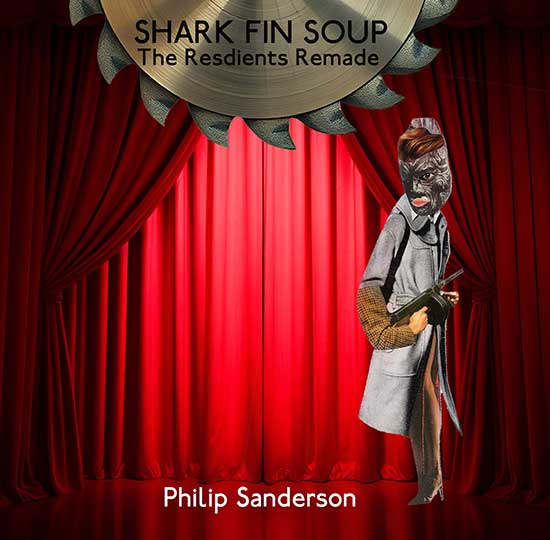
PS: I like your analogy of George Perec’s A Manual for Living – of some kind of dystopian boarding house as that rather captures the spirit of the thing. Six months before Bedsit Baroque I was working on a CD of remakes/re-imaginings
of tracks by the Residents (Shark Fin Soup). Prior to this I had never really
listened that closely to the lyrics of the Residents. Maybe it is the squeaky treated voices that can make the words difficult to distinguish but I had just heard the vocals as part of the overall sound. Going through the lyrics line by line for the covers gave a much clear insight into the quirkiness of their vignettes in which there is nearly always a somewhat macabre twist. When coming to Bedsit Baroque some of this rubbed off and alongside other techniques I incorporated a small narrative twist into many of the songs. I also sought to play with the unreliable narrator and mixing the genders/orientation of the “I”. So several characters in a song might all be speaking in the first person. This all sounds quite calculated but starting with a first line many of the songs sort of wrote themselves. So for example I had a phrase “My line is short, but yours is much longer” which was originally going to be a Bob Cobbing type affair about the process of writing itself but then came the next couplet “I am weak and you are so so much stronger” and it was like OK we have established a power dynamic
now lets see how can we flip this on its head which led to “so why is it you on your knees…” and so on. Melancholic and a tad dystopian but always with tongue in cheek.
KR: Shark Fin Soup, your album of Residents covers,
manages to dig beneath the top soil and reveal the subtlety of
their writing, which I think sometimes gets buried in their frequently bizarre, and presumably intentionally disorienting, delivery. It’s another collection of burlesque pop nuggets that re-imagines the band as something like a lounge act on board an interplanetary cruiser. It’s a remarkable album. How did you decide which of their songs to pick? After more than 50 years and 60 albums, it must have been quite a task.
PS: Picking the Residents songs to cover was made easier by my fondness for their 1970s/early 1980s output, what is sometimes called their analogue phase. Duck Stab released in 1978 was (for me) a high point, quirky songs with peculiar arrangements but also kind of catchy, hummable even. Five of the songs remade on Shark Fin Soup are from Duck Stab and indeed you get three versions of Constantinople on the CD. Subsequent LPs saw the Residents become arguably more experimental and ambitious but the essence of the Residents is there on Duck Stab. As you say the subtlety of their writing sometimes gets buried in their Bizarre and disorienting delivery, and on Shark Fin Soup I was attempting to draw out strands that were maybe submerged or hidden. For example the song Semolina had always struck me lyrically and musically as a very big nod to The Beach Boys and I sought to bring this out by giving it the full barbershop harmony
treatment. After hearing the Shark Fin Soup rendition one might even begin to hear the Residents Semolina as itself a cover version? That is possibly wishful thinking. Elsewhere I did things like take the lyrics from Tourniquet of Roses and set them to the melody of Seasoned Greetings which has this great brass part at the beginning not unlike something Peter Skellern might have employed in an arrangement for one of his hits in the 1970s.
KR: There’s a lot of discussion at the moment about AI – it is cited as an existential
danger to humanity as a whole in the most extreme case – but it is also posited
as a threat to the arts. The claims are that the use of AI not only erases
authenticity that but also the lack of the ‘ontological thumbprint’ – the sense of
human involvement – reduces or negates the emotional impact of a given work.
How would you respond to this?
PS: It is hard to avoid discussion of AI at the moment, only last night I was
listening to a podcast from a former Google employee forecasting doom and
destruction if AI wasn’t reigned in. If not set to end the world and replace
mankind with AI controlled robots at the very least job losses are forecast, if not happening already [Author’s note: two days ago, Barclays announced exactly this].
Aside from a rather fine article in the Wire by Vicki Bennett (People Like
Us) talking up the creative possibilities of AI, the reaction to the use of
AI in music has perhaps unsurprisingly been largely negative, bordering at times on hysteria with for example Bandcamp banning “music and audio that is generated wholly or in substantial part by AI”. A lot of the commentary can be ill-informed. For example the new Beatles Rubber Soul re-issue used a form of AI to split the old 4-track masters into stems that could then be remixed and some have decried this as in some way unnatural and artificial. [Author’s note: if you listen to the original American stereo mixes that come with the box set, you can understand why this might be a good idea]. I myself came to the music AI models and apps with a degree of scepticism but curiosity led me to giving them a try. It quickly became clear that using prompts alone produced as one might expect anodyne results. I camE back to the apps now and then as the models improved and it began to be clear that SUNO in particular had been trained on a very wide range of musics, not just Spotify bangers but Polkas, Gregorian chant, indigenous music. What is more you could mix and match these styles like some enormous mash-up machine. For somebody like myself who has always liked to cut-up and collage the possibilities were intriguing. Inputting a basic music track you have already recorded and your own lyrics/text and is essential. You then have to nudge, even trick the apps out of their inbuilt desire to be predictable and bombastic but at its best it can be like
having your own Wrecking Crew that can play just about anything but have had a few too many and are a tad bolshie. But with a lot of tweaking you can get some rather wonderful arrangements, even if 50 takes of a song is needed to reach a sweet spot. Rarely would this be a whole track but an intro here a middle eight there. One then needs to edit the whole thing together afterwards and add overdubs to get a finished piece.
This is a fast moving area and as of August 2026 SUNO, the leading online music app, ceased to be a useful tool. Under the threat of a billion pound lawsuit from the music industry majors it removed all the previous quirky versions that had been trained on vast amounts of music (without permission) and replaced it with a new model that is trained on music solely supplied by the one major. Ironically as SUNO no longer has the breadth and depth of music to draw on it now
produces the very AI slop that everybody previously accused it of making.
Q. Can you tell us about your work as a visual artist? You recently had an
exhibition of collages based on knitting magazines, if I understand correctly, and I
am particularly interested in your over-painting on easy listening album covers.
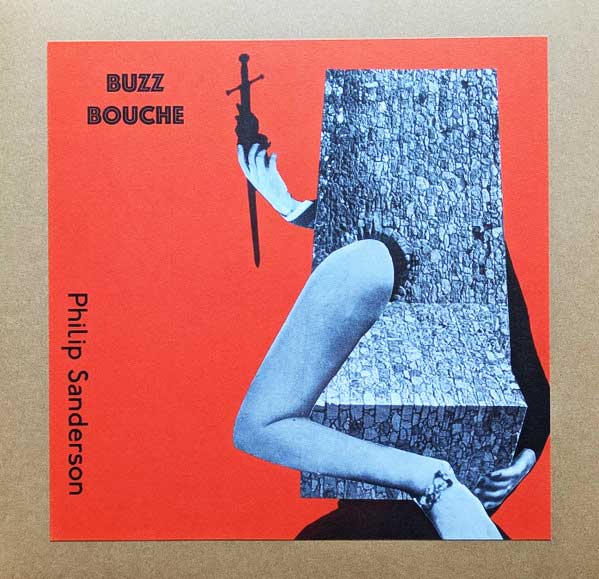
PS: The visual artwork I make compliments the music and at times overlaps with it. In the 1970s I, like many others at the time, made punky dada-esque collages – some of these ended up as covers to cassettes or records but most got lost along the way. I began working with Super 8 film and video in the 1980s and then light and sound based installations in the 1990s and early 2000s. All these employed sound as an integral element and I was keen to explore how sound shaped our perception of the image and vice versa. Some ten years ago almost by accident I began playing around with collage and painting again. After too long spent looking at the computer screen there was something liberating about just using scissors and glue. Collage is also very cheap you can find the materials for almost nothing and don’t need the latest or fastest Mac. I have mostly exhibited in galleries in and around Hastings, which for a small town has a buzzy art scene. Many of the collages have also found their way onto album and CD covers of my own music.
A very recent project still in its first flush is not exactly collage but over-painting album covers. Specifically easy listening and classical LPs, those unloved discs that sit in boxes in charity shops that nobody wants but nobody has the heart to put out of their misery. One charity shop in St Leonards had a box going for free so I picked up 15 or so and began experimenting. Album artwork by the likes of Hipgnosis was for many of us growing up an entry point into the visual arts and there is something almost sacrilegious about painting over LP covers, even the easy listening ones. Initially I was aiming for a juxtaposition or tension (getting art
speak here) between the representational ‘space’ of the photograph on the
sleeve with the tactile physicality of the abstract paint surfaced on top. In
practice this works best with classical LP sleeves. With easy listening the process has become more centred on covering over the sleeve and then removing the paint in various ways to reveal parts of the original. The end results are not that far removed from collage even if there is no actual cutting involved.
KR: I’ve heard from various sources that certain musicians who used to be able to rely on healthy sales of their releases are now struggling – I don’t want to name names but these were highly respected artists 30-40 years ago, one of whom had great success in the 90s but has since given up making albums due to the decline of sales. One could say that as time passes new artists emerge and so the decline in interest is quite natural. Yet at the same, Bandcamp has become something of a black hole – you release your work and it goes pretty much noticed, and sinks without trace (or maybe that’s just me). I’m told that being active on social media is essential to get sales, etc, but I think it’s far more complex than that. What are your thoughts on all this?
PS: In the post-punk DIY heyday of the 1970s the ‘dream’ was that you could
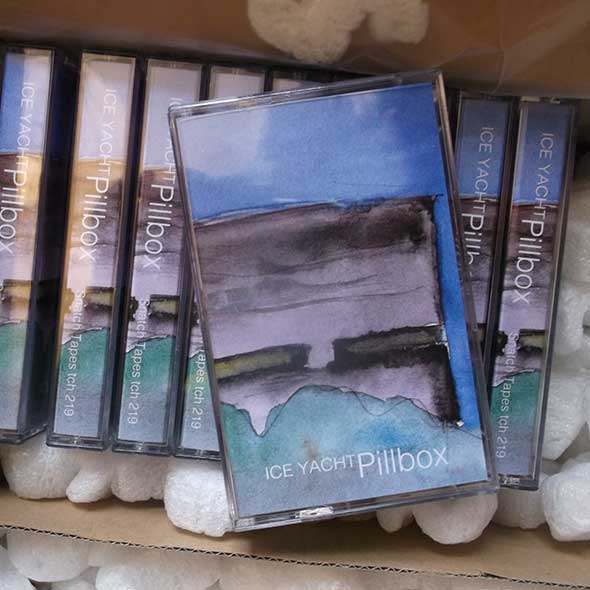
bypass the majors and everyone and anyone could make and release their own music, be it on vinyl or tape. There is arguably a missing part to the equation though for if anyone could make and release their own music how would it reach an audience? In the early days my own Snatch Tapes label and band Storm Bugs would reach people by word of mouth but also through columns run in both the NME and Sounds. NME then had a circulation of 50,000 and a mention or even review would ensure that people both sent you tapes and bought some of
your own. This lasted for a couple of years before being flooded with releases both music papers dropped their columns. The music didn’t die but went underground. The current Cassette Culture podcast put together by Martin Franklin highlights how many carried on releasing tapes into the 1980s and 90s, often in small numbers, though niche areas like noise and post industrial music fared much better, often building up loyal followings. This continues today when a band like Current 93 (whose main man David Tibet is a Hastings resident) can sell 300 copies of a new release seemingly without too much trouble whereas as you say some better known ‘names’ from yesteryear struggle. My own sales have had their ups and downs. In the early 2000s both re-issues of old Storm Bugs material and new work sold quite well (300-500 copies) on CD and vinyl. Digital releases on Bandcamp are very democratising – anyone can do it, in some ways it is a fulfilment of the DIY dream – but one has to reconcile oneself to the fact that a digital only release unless accompanied by a major write up in the Quietus and some kind of viral marketing campaign is not likely to do very much sales wise. I suspect Bandcamp is used by many as a streaming platform and when you look at the stats a release can get many plays (even hundreds) but only the odd purchase. It can all be a tad disheartening to work for months on something for it to disappear into the digital ether. A friend I discussed
this with (in the context of film making) said for him it was 85% about the process of making and 15% the feedback. This is a rather sound way of looking at things but as odd as it may seem I’m not sure how much I enjoy making for its own sake – it is more of a compulsion – if that doesn’t sound too pretentious. There are always other possibilities of course. Working with two niche labels, Astres d’Or and Wepwawet Editions, I made two very short run (about 30 copies) lathe cut Editions, both with one-off hand-made art on the sleeves. These are more like artworks and priced accordingly but they did sell. We DIY-ers helped break the hegemony of the music industry so I guess we shouldn’t expect a mass audience to come running (to tie our shoe).
Links:
Snatch Tapes Bandcamp Page: https://snatchtapes.bandcamp.com
Sanderson Collage: https://www.instagram.com/thesunkenfeaturesofasatellite/
.
Keith Rodway