
There’s no fairness in nature. The natural world knows nothing of justice.
Such concepts are a human invention. Such inventions are imposed on human societies as a way of defining and regulating behaviour. They are neither universal nor consistent. They are continually being tinkered with, adjusted, amended. What is considered right in one decade is inadmissible in the next. Laws are repealed. New laws are introduced, either by a legislative procedure or through reasoned dialogue… or at other times by interpretations of religious texts, or at the arbitrary whim of a tyrant. Nothing is eternal. All is in flux.
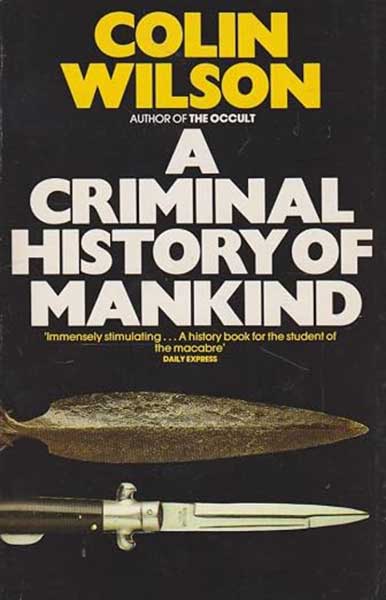
Colin Wilson wrote A Criminal History Of Mankind, which was published in 1984 (Granada Publishing, Panther Books paperback ISBN 0-586-05486-3). The cover-art shows a stone spear juxtaposed with a modern bayonet, an image that implies a continuity from then until now. Which is far from the truth. There is no human behaviour which has not been legal, or morally justifiable, at one time or in one place in time. Situational ethics overrule eternal law at every twist of history.
So how is it possible to define what is, or what is not a criminal act?
Slavery was an integral part of every pre-industrial civilisation. The empires of Egypt and Rome were built on slave labour. It was only the advent of the industrial revolution, when the introduction of machinery made it cheaper and more efficient to automate than it was to rely on forced labour, that led to its abolition. Yet forms of slavery persist in low-wage and exploitative contexts. Even the most basic moral imperative – not to murder, not to kill a fellow human, is easily removed for the pretext of warfare, in which case killing becomes a patriotic duty, sanctioned by the church. In point of fact, there is little that has not been considered acceptable behaviour somewhere, from the incestuous unions practiced in Pharaonic Egypt following the sibling marriage of gods Osiris and Isis, to establish the purity of a divine bloodline; to the cannibalism that was the forced upon the 1846 Donner Party when their wagon train was snowbound in the Sierra Nevada mountains. Then, in the 1972 Andes aircraft crash, where survivors resorted to eating the bodies of those who had already died, a decision taken as the result of a mutual pact.
It’s possible to construct an entirely rational ethical framework based around mutual respect and interactive human need. The theory of ‘Mutual Aid’ as propounded by anarchist thinker Pyotr Kropotkin, in which the driving force behind the evolution of societies is not brute competition but cooperation and reciprocity. Colin Wilson spends a great deal of time questioning ‘why violence’ and tracing the roots of aggressive behaviour, when it could equally be argued that human nature is as much dependent on cooperation, the degree of collective effort required to launch probes to each of the solar system’s major worlds, to combat disease, to establish networks of global communication, to plan and monitor cities with mass population densities.
Yet there’s an essential irrationalism to the mere fact of being alive, the truth that to the best our knowing we live the span of a single lifetime, and that death obliterates it all in total extinction. So, there’s an equal impulse to leave a marker on history that says ‘I was here’, above and beyond the DNA trail that links us into a racial continuity. An artistic or literary marker, a sporting, political or scientific achievement… or maybe a military triumph. Because every military encounter, every battle, incursion, and skirmish through time contributed to defining the map of the human world as it exists. To say that Genghis Khan or Vlad ‘The Impaler’ Dracul were criminals because they exceeded the normal conventions of warfare is to deny the historical process that created the modern world.
Abused children will grow up to be abusers. People traumatised by war and atrocity will seek revenge against those they perceive as the aggressor. So the cycle self-perpetuates.
There are some who would argue that a Free Enterprise economy that permits internet billionaires while other people starve is criminal. There are some who would argue that the irresponsible emission of greenhouse gases such as carbon dioxide during a time of climate change is criminal. There is an argument to be made that using atomic bombs against Japanese civilians in order to bring World War II to a close was a criminal atrocity. That the Russian annexation of the Crimea and subsequent undeclared invasion of the Ukraine in defiance of internationally agreed borders since the collapse of the USSR and the end of the Warsaw Pact, is a criminal folly. Putin would argue that the Ukraine had been an integral part of the Soviet Union, and a part of the Russian Empire before that. That although the Ukraine has a distinct cultural and Slavic language identity, its geographical limits have historically been subject to the expansion and contraction of Eastern European empires across centuries. Which is not to agree with Putin. Simply to accept that criminality can be a matter of perspective.
If the concept of justice is a human invention, criminality must also be a human invention.
Fyodor Dostoevsky frames the equation in his 1866 story ‘Crime And Punishment’, in which impoverished St Petersburg former student Rodion Rashkolnikov feels himself morally justified in murdering Alyona Ivanovna, an unscrupulous elderly pawnbroker. He rationalises the killing by using utilitarian theories of a greater need that transcends conventional morality. Yet he’s subsequently tormented by guilt. In a similar way the unnamed first-person narrator of Edgar Allan Poe’s 1843 short story ‘The Tell-Tale Heart’ gets away with murdering an old man with a pale blue ‘vulture-like’ eye, and he conceals the dismembered body beneath the floorboards. But his feelings of guilt result in him hearing his victim’s heartbeat from beneath the floor, driving him – as with Rashkolnikov, to confess his crime. Is that evidence of a ‘natural law’ above and beyond logic and reason? Or it could be argued that religion, even when denied or abandoned, leaves the ineradicable moral ‘policeman in the head’.
Strangely, for a writer of some philosophical pretensions, Colin Wilson rarely ventures into such realms of indeterminacy. He prefers a more linear approach to the history of crime. He does speculate about Abraham Maslow’s five-level Hierarchy of Needs, that the most basic need is for food, water, sleep and warmth. That when those needs are satisfied a second tier of needs, for physical safety, security and health emerges. Then a third tier demands belonging into a family or social structure. With esteem and status as the fourth tier. With self-actualisation as the pinnacle of the pyramid of needs, to achieve potential and creative expression. It is the frustration of these needs that lead to criminal behaviour… including self-actualisation through the modern phenomenon of serial killing. The need for fame, even if it is done through notoriety. A process that every low-budget barrel-scraping TV-documentary about the Yorkshire Ripper, Fred & Rosemary West, the Charles Manson Family, or the Moors Murders only accelerates. While Colin Wilson returns to the ideas of Julian Jaynes theory of the ‘bicameral mind’, the uniting of the left and right hemispheres of the brain.
Surely, this is all just sophistry? We all know and recognise criminality, don’t we? Of course there are degrees of badness, but we identify deviant behaviour as evil. We don’t need psychological profiling or literary precedents to do this. It’s always morally abhorrent to kill children… unless it’s as a sacrifice to appease a malevolent god (Abraham almost sacrificed his son Isaac as test of faith imposed by the Old Testament god). Then there’s the dilemma posed by ‘The Cold Equation’, an August 1954 Astounding SF short story by Tom Godwin in which female stowaway Marilyn is discovered on a spaceship carrying life-saving serum to a disease-stricken colony on a planet called Woden. A theme already anticipated to an extent by EC Tubb in his story ‘Precedent’, (in New Worlds May 1952) where it’s a male stowaway. But with limited rocket-fuel and an air-supply sufficient for just one person, the moral conundrum – the cold equation, is that one must die for the other to survive. The logic is inescapable. Yet there are residual feelings of guilt and betrayal. In a sense, it’s a metaphor. The human race with its precarious eco-system and fellow-travelling lifeforms are carried on spaceship Earth. Impoverished societies suffer so that wealthier societies can prosper in consumer affluence.
Colin Wilson (1931-2013) began his hugely prolific writing career as an ‘angry young man’ with the explosive success of his The Outsider (1956), after which he moved in unpredictable ways into his major The Occult: A History (1971), and quasi-history with From Atlantis To The Sphinx (1996), while his fiction included The Space Vampires (1976) which was adapted by Tobe Hooper into the movie Lifeforce (1985). In his A Criminal History Of Mankind, Colin Wilson unwinds through time back to archaeological remains that seem to indicate that humans are a ‘mentally unbalanced species.’ That ‘evolution has left a few screws loose between the neo-cortex and the hypothalamus’ that results in a dangerous ‘paranoid streak’ which explains human self-destructiveness. We are a defective species, hobbled to ancient archetypes. The odds are stacked against us from the start, from before the beginning. Evolution happens on a random haphazard basis. And reality is fundamentally flawed, with the ‘killer ape’ shoved further out of kilter by living in crowded cities, divorced from the natural world.
In his fairly anecdotal chronology of torture and aberrant behaviour, from Spartans to the I Claudius excesses of Rome – is this criminal, or it just history? some of Colin Wilson’s arguments are dubious. Others have been superseded by subsequent discoveries or revised theories, especially in the realm of gender politics. Yet he poses a valid question, why violence? Why aggression?
There’s no fairness in nature. The natural world knows nothing of justice.
.
by ANDREW DARLINGTON
.