
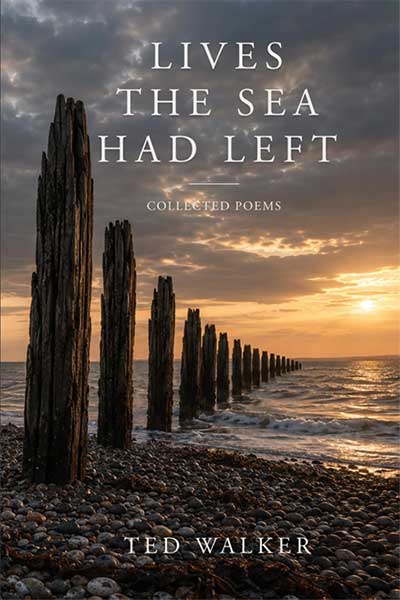
Lives the Sea Had Left: Collected Poems, Ted Walker (355 pp, £14.99, RedLines Press)
How can a poet regularly published in The New Yorker, with a back catalogue that includes five volumes published by Jonathan Cape, fall into obscurity? This is the question that this collected volume attempts to answer. Ted Walker was a contemporary of Ted Hughes and Peter Redgrove. He died in 2004 and his name may not be familiar to you, but Ed Walker, his son, in an act of filial loyalty and responsibility, has put together this handsome, comprehensive gathering in an attempt to correct this oversight and resurrect his late father’s poetic reputation.
Family loyalties can sometimes cloud judgement and one is bound to wonder why a mainstream publishing house hasn’t reissued Walker’s work before. There was a selected poems, Hands at a Live Fire, in 1987, but this necessarily included nothing from his last collection Mangoes on the Moon, published by London Magazine Editions twelve years later in 1999. Walker’s well-crafted poems, usually focussed in some way on the natural world, may have seemed rather old-fashioned by then and reading through his whole output, one occasionally feels a lack of development or a curious sense of restatement. In part this comes about because his earliest poems so confidently staked out a certain patch of poetic territory, and he rarely strayed from it: it is as if Heaney remained writing only pungent recollections of his rural Irish childhood.
Clearly, then, Walker was not a poet whose early development seemed rather tentative and misleading – like, for example, Larkin’s The North Ship – and the themes in his first collection, Fox on a Barn Door (1965), were to reappear. The natural world is cruel (the title poem), other (‘Breakwaters’), full of violence (‘Estuary’, ‘Porpoises’), eliciting repetitive human labour (‘The Skate Fishers’) and obedient to hidden, recurrent mechanics (‘Conger’, ‘Erosion’). The poems are full of dramatic, striking images – for example, the harvest moon is a ‘wafer of altar-bread, a conger eel has ‘the limbless streamlining of the latest cars’, but reading them is a numbing, lowering experience at times. Even ‘Cuckoo-pint’, a brief three-stanza flower sketch, finds sexual ‘torment’ in natural processes, whilst ‘The Burning’ characterises stubble burning as a dangerous massacre and ‘Rook Shoot’ becomes an exercise in rural gothic, with ‘dark parcels’ thudding to the ground. This natural world is no expression of a benign creator: Walker characterises such a figure as ‘that God I won’t believe in’, staring him out with ‘dumb insolence’ (‘Visitation’). By the time one reads the title-poem of this collection, the harmlessly-titled ‘Easter Poem’, one is not surprised to find it contains a crucified fox, nailed to a barn-door ‘like a coloured plaster Christ / in a Spanish shrine’, a challenge to the ‘endemic English noise’ of Easter church bells.
As he grew older, Walker did not seem to wish to leave his readers undisturbed, and the following four collections often traverse the same territory. Other concerns do, on occasion, appear: some of the shorter poems in The Night Bathers, Walker’s 1970 volume, gain from not being over-interpreted or developed into symptoms of decay or deliquescence. Here, for example, from the unpunctuated ‘Dewdrop’:
A simple brilliant
eating the face
of the morning
sun
A crystal of night as
hard as star-glint
fixed as
owl-eye
The freshness and visionary glimpses are left unmediated, messages from a wider, wilder universe, and more welcome for it.
Over twenty years separates the final two poetry volumes and his son refers to this long gap as a hiatus when Walker, stung by negative reviews from the likes of Craig Raine, decided to explore other forms of writing, notably travelogue and memoir. Whatever the reason, there is a welcome lightness and variety in Mangoes on the Moon, his final collection. Several poems describe Walker’s sojourn in Australia, and in these a slight loosening, a little more colloquial vocabulary appears – he encounters ‘yuppies’, notes ‘boozing’ going on, depicts a landscape of Pizza Huts and ‘Ocker realists’ in the lounges and servicemen’s clubs. One almost feels a new, less savage and menacing life opening up in the poetry, but the second section of this collection falls to earth with several poems on Walker’s second wife’s death, back in England. These are moving, but quite unsparing, the poet left alone with his memories and his sense of guilt. It is a surprise to come upon a poem celebrating Walker’s friendship with Andrew Young, master of miniature nature vignettes, but no surprise to read a last line that describes him as ‘remote, loved, unknowable’, Walker’s unease upending the ‘long, shared, comfortable silences’ recalled earlier in the poem.
There are good things in this volume, and one admires Walker’s craft and tenacity in following his poetic vision; this reader can’t help wondering, however, if he felt fulfilled by it. Certainly, it is a hard slog reading through all his work because of the lack of positives sometimes evident. One final criticism on the structure of the book: to reach the poems, the reader must first wade through a fifty-page appreciation by Edward Walker, which enumerates all the main themes and the critical reception, positive or otherwise, afforded to each of the separate collections. Whilst obviously a labour of love, spiced with a little score-settling, this could profitably have been reduced to a ten-page afterword for those sufficiently interested: encountering it first, before Walker’s poems, does him no service at all..
M. C. Caseley
You can buy the book direct from the publisher here.
.