
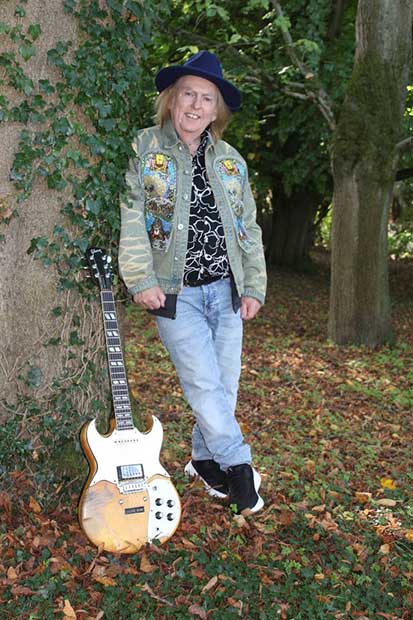
Dave Hill is late for the interview. He’s almost home. He’s parking his car in the drive. He’s walking in through the front door. As our allotted interview time counts down, I’m almost ready to reschedule when he’s suddenly here, his face unmistakably familiar from all those ‘Top Of The Pops’ clips… and he’s voluble.
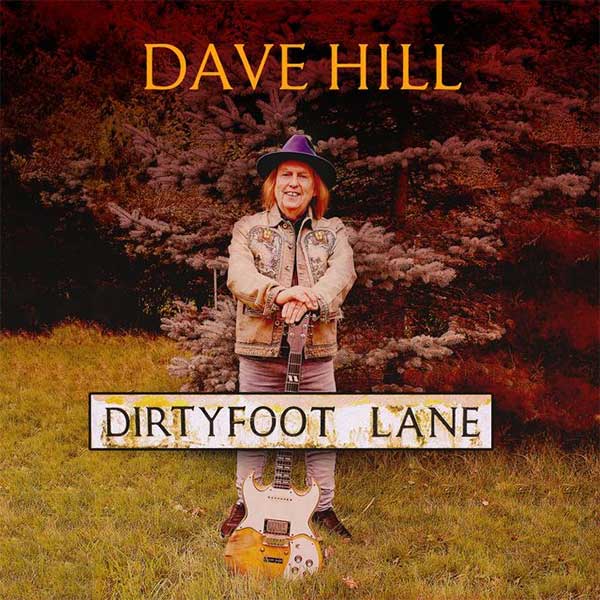
The flamboyant founding member and lead guitar on all those Slade hits is here to promote his debut solo album – Dirty Foot Lane, which resets the controls into what he describes as a more personal and reflective space with a collection of atmospheric soundscapes that blend Rock with Blues and Folk. The album draws autobiographically on Dave’s story, rooted in memories of his upbringing, the influence of his parents and family, his early musician ambition, and his rise to Glam ‘n’ Glitter fame with Slade. The title song refers to a real place close to where he grew up and still lives today, marking his local identity. But more than just a location it represents the emotional and symbolic heart of the record. ‘Dirty Foot Lane’ represents the centre of his formative experiences.
Dave Hill is a conversational firework display, with detonations going off in uncharted directions. He’s impossible to pin down to a question-answer format. I could go over the interview and edit it into sequence, but that would destroy the free-ranging spontaneity of his dialogue. As with the album itself – which captures the energy of his live-performance roots, he also delves into more personal themes, touching on more challenging chapters of his life, his mental health struggles and the profound impact of and resilience to the COVID-19 lockdowns, to ultimately arrive at a place of appreciation for life.
Album production duties are led by Django Holder, who also plays a key role in engineering and shaping the album’s sound. As the son of Noddy Holder, his involvement adds a meaningful generational link to Dave’s musical legacy. Another key contributor to the album is long-time collaborator John Berry, whose career includes work with Mud and The Sweet. ‘I’ve known John for over twenty years’ says Dave. ‘He’s incredibly talented, honest, and always gives you his very best. That’s invaluable.’ While Dave performs the majority of the lead vocals, Berry plays a particularly important role on some of the album’s heavier tracks. Producer and musician Rob Childs also contributes to the project.
Now… here, he opens with an apology.
Dave: I’m slightly late because I had to go out. I found out I was doing a show. So, I nipped out. Now, using the computer means that it’s attached to the interface, so I have to take that out, otherwise what we’re saying comes through the big speakers, and I always have this problem…
Andy: I thought you were used to big speakers!
Dave: No-no-no! I dreamed last night that I was on stage, I think I was playing with Alice Cooper – right? Which I did, last year, and… it was midnight, and I was thinking ‘what the heck am I doing on stage at midnight?’ Then I woke up and suddenly something went ‘hang on a minute! I’m going abroad soon.’ I’d totally forgot. I totally forgot I’m going to Germany, you see?, to do a big show! Well… it’s not until, the shows on Saturday (today is Wednesday), so I go down to Heathrow, you see, the day before, so I don’t have to get around the idea of flying anywhere and playing, if you know what I mean…
Andy: You’re ‘Flying On A DC10’, as in the song on your new Dirty Foot Lane album?
Dave: Yes, that’s right, well done! Flying on a DC10, You’re Andy, aren’t you?
Andy: Yes. I like to see all of your guitars on the wall behind you.
Dave (he gets up and picks up a guitar): You want to see history? Can you see that? (he holds up a white electric guitar for my attention). My Dad bought me that guitar, right, 220-quid in 1968, right? That guitar has played on all the most famous Slade songs. And the guy who told me to get a new guitar was Chas Chandler, who managed Jimi Hendrix, right? And, I had this rubbishy guitar and he sez ‘you need to get yourself a decent guitar, the guitar you’ve got now won’t record very well.’ And you would have to listen to Chas because he was one of The Animals, the bass-player. But Chas did me a favour, and I went down Shaftesbury Avenue, and there it was in the window. It was a bit like – no phones at that time, and I said to the bloke, I sez ‘would you hold that guitar for me, I’m going home to ask my Dad for the money.’ He said ‘I’ll give you a couple of days.’ I said ‘we’ll probably be down tomorrow.’ So I get on the train, go back home. My Dad goes to the bank or something, and he gets 220-quid out and he drives me down to London with the drummer (Don Powell) and the 220-quid, right, and we walk in – and it wasn’t in the window! And I thought the bugger had sold it. But he hadn’t, he kept it for me. I mean – it’s one heck of a result. This guitar is a unique guitar. It’s a Gibson neck, but the body is made by a Chinaman. In the Chinese quarter near Shaftesbury Avenue, there was a guy called Sam Li… L-I, and he made a lot of guitars for a shop in Shaftesbury Avenue. And most guitar-players went there. I eventually met him. Years later, his granddaughter contacted me and said ‘would you do a write-up, because you had one of my Granddad’s guitars.’ I said ‘he said he was Chinese?’ I said ‘Oh! I know who that is!’ And he’s well-known, you know. I think the shop was ‘Orange’… there was a thing called ‘Orange’, or something like that. It was right opposite the theatres, y’know, in Shaftesbury Avenue. If you know London…
Andy: There were Orange Amplifiers, which were actually crafted in Huddersfield. There’s a book The Guitar Man: Sam Li by Mark Eglinton (2019, Rudling House Publishing) which tells his story of travelling from the Caribbean to becoming the go-to man for guitar repairs and bespoke guitars.
Dave (he turns and roots around his room): So, there’s a lot of other things, there’s all sorts of things here. But this is where, basically – Andy, I spent two years during the Covid lockdown, solidly, writing three albums. I’d started before then – well before then. The aspect of this album has been a long time coming. I sort-of… erm, I obviously… Noddy and I are very close to each other, and many many years ago when the hits dried up, I was forty-something years of age, and I had a phone-call from Suzy Quatro’s husband, who was in her band, his name was Lenny Tuckey, and he rung me up right out of the blue, and I was struggling mentally to think what I was going to do. Because the band broke up, Nod didn’t want to tour any more, and basically, he just wanted a different life, and I understood that. But when you’ve got three kids, it’s a different ball-game – y’know, it’s like, once the records dry up, the only thing you’ve got is live performances, and we weren’t doing that either. So Len just said to me, he said ‘what’re you doing?’ and I said ‘well, I’m thinking about having another group.’ And he said to me, which he was absolutely right, he said to me ‘you don’t want to be doing that. Everybody knows who you are. You and Nod are the most memorable people’ he said. ‘But Nod doesn’t want to do it.’ So I said ‘no, he doesn’t want to do it. And the groups’ broke up.’ But he was ever-so good, Len, he inspired me into making the decision of what was right for me. And what was right for me is that many bands, in the sixties and the seventies were on the road, and some of the members weren’t even alive anymore, right?
Andy: I’ve seen more than my share of them!
Dave: And so he explained to me, especially the sixties groups – half of them are dead! And it was like, there’s a big promoter in Germany who puts on massive shows, and it was around about the time before they pulled the wall down – y’know, when they brought the Berlin Wall down, and it was that very tactile time when nobody was playing in the east part of Germany, you see, it was, it was… nobody went there. And this promoter – who was a fantastic promoter, he put together… you know, like the Beatles in the sixties, there used to be ‘Package Tours’, and there used to be one coach, there’d be the Beatles, Gerry & The Pacemakers, the Searchers – all on one bus. And that’s what happened years ago when the Beatles were making it. And he was doing exactly that, he’d put together sixties bands like the Tremeloes, the Searchers… I mean, some of them were alive so they could go out as the name, and I realised that the seventies, there was the Rubettes, Bay City Rollers – what was left of them, there was a whole concoction, there was Sweet – Andy Scott’s Sweet, they were all doing these shows. Suzi was doing it, although Lenny wasn’t in the band anymore, but he was so helpful to me, and then I rung Nod, and I said to Nod ‘y’know, I’m in difficulty’. He understood. He’s always been a great friend. He understood the position I was in. I didn’t write the songs, which is common knowledge. But, without touring, there was nothing coming in. And he said ‘well, at the end of the day, you’ve gotta look after your kids, you’ve got the mortgage to pay’ and he just said ‘I think Lenny’s a great choice for a Manager, he understands the business.’ So, he helped me re-form it. What I had to do was find a singer…
Andy: So after Slade ended, you kept the legacy going with Slade II.
Dave: Yes, well – trying to find a singer like Nod is a near-on impossibility, nobody sings as great as him! But eventually we did get somebody (Steve Whalley), and then we went back on the road, and Don joined me – original drummer, I asked him, ‘cos I didn’t know whether he’d do it, but he said ‘yes’, he came in on it, and Nod and I said ‘well, what you want to do is make it, go out as Slade II – so you can indicate there’s a change.’ So, we did that for ages and ages, but eventually, obviously… I thought we were going to do it for two years, you know? And we were doing it for thirty-three years! And it was just… I was touring Russia, I was going to Baltic States, I went to the Falkland Isles and played to the troops. I mean, there was all these places which I’d never been to. Nod and I had never been to the Eastern Block countries, the places where – y’know, when you first go there, the hotels weren’t very good, like. But this guy put together all these bands, and we were on a bus with them, and it was the funniest and most enjoyable time. Because you got seventies people, and then you got the sixties people, I mean, the Searchers in particular – being Liverpool, they were just hilariously funny. I really enjoyed the first couple of years of doing loads of gigs in Germany, then I went to other parts of the world, we were big in Norway, we were big in Sweden… because of the band, in fact we were big everywhere in the world. We went to Australia, we did a tour there. For me, it was quite liberating, because my children were really young, you see – like five and six years of age, so it was important. I mean, I went to Aussie and did that circuit, ‘cos I’d been there years and years before with Status Quo – when I first went to Australia…
Andy: Tell me about the first time you toured Australia.
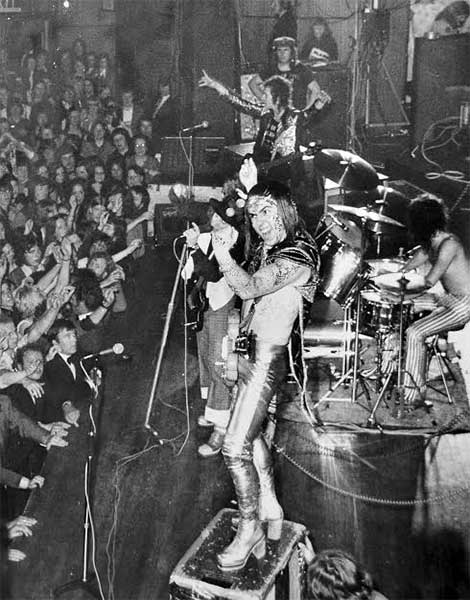
Dave: I don’t know if you know this story, but Slade Alive – the first live album we made when we went into the charts with ‘Coz I Luv U’, Chas Chandler said ‘the record company need an album quickly’, but, he said, Nod and Jim hadn’t been writing very long, so it would take time to write an album. So Chas was thinking ‘well, you’re a bloody great live band’ he sez, ‘why don’t we record a show?’ And he was capital at coming up with that idea, because we were so tight, y’know, we didn’t have monitors, we just played, we understood each other. We were a great Rock band, and that’s why Chas chose us, right? (Slade Alive, released in March 1972, was recorded live at the ‘Command Studios’ and mixed at the Olympic Studios. It includes covers of Ten Years After’s ‘Hear Me Calling’, Steppenwolf’s ‘Born To Be Wild’ and Lovin’ Spoonful’s ‘Darling Be Home Home’ plus their breakthrough hit version of Little Richard’s ‘Get Down And Get With It’, as well as group originals ‘In Like A Shot From My Gun’ and Dave Hill gets a contributing writer credit for ‘Know Who You Are’ and ‘Keep On Rocking’).
Andy: Tell me how it all happened in the beginning.
Dave: Chas had seen us in a Club, and he went for us big time, he just said ‘I’m going to manage you, I’m going to produce you, I think you’re fantastic.’ And this is the man that managed Jimi Hendrix saying that to us! So – I think, in a way… I think in a way I suddenly found, because I couldn’t imagine life without Nod, y’know? Because we’ve always been close, but you have to respect when people want to change, and we’d been through so much together. We’d become the biggest band in the world in 1973. But when Slade Alive come out we were no.1 in the charts with ‘Cuz I Luv U’, and it went big time. The album was sent to Aussie and it sold more than Sgt Pepper’s Lonely Hearts Club, that’s how big it was. And then we went over with Status Quo, who were just changing their image – becoming denim jeans and all that, y’know, they were changing, they came with us, Lindisfarne – do you remember them? They were on. A group called Caravan, do you remember them? I don’t know much about them… But we had some fun, ‘cos I think Lindisfarne took crates of Newcastle Brown Ale, ‘cos they come from Newcastle (Dave dissolves into laughter). We had such a good tour with them lot. Status Quo in particular, because we really got on with Fran (Francis Rossi) and Rick (Parfitt), well – all of them! It was a great tour. And we ended up playing to 40,000 people at Randwick Racecourse, it was like… we got no.1, no.2, no.3 in the Top Twenty, it was like the Beatles, y’know – 1, 2, and 3, three tracks, and we were on the coach with Quo, and every so often Nod’s voice comes on the radio, and he’s ‘ALRIGHT! ALRIGHT!! ALRIGHT!!!’ It was so funny, because Noddy’s so powerful with his voice (he cracks up with laughter). But, do you know what, it was a unique time, you know what I mean by that because you grew up in it.
Andy: You first recorded the song ‘Dirty Foot Lane’ on the 1994 Slade II LP Keep On Rockin!, which consists of your songs co-written with Bill Hunt (formerly of Wizzard). One track, ‘Do You Want Me?’ co-written with Noddy Holder, another – the spin-off single ‘Hot Luv’ co-written with drummer Don Powell and Paul Mellow, the rest are ‘I Hear Ya Callin’’, ‘Black And White World (Remix)’, ‘Miracle’, ‘Cum On Let’s Party’, ‘Johnny Played The Guitar’, ‘Howlin’ Wind’ and ‘Red Hot’. Steve Whalley takes lead vocal and plays guitar – except on ‘Dirty Foot Lane’ on which Dave sings. Trevor Holliday plays bass and keyboards.
Dave: And it’s like all these people that work with me now, in London and various people, they’re all – y’know, they were there with us, when they were eleven years of age, and now they’re with me on a new adventure of establishing myself as a solo artist. I have Nod’s ultimate backing. He encouraged me to do it. He said ‘you’ve got Slade, you can play the hit records, you’ve got that. That’s what you do in your job. Your day job. But you’ve been writing, you’ve been doing this and that and the other.’ And he said ‘it’s time for you to show a lot of things about your ability as a musician,’ y’know, it was so encouraging what he said to me. And then I started to work on it, and I said to him one day – cuz he comes down to see me, and I said to him ‘I’ve got one or two very very emotional sensitive songs’ and I was aware he’d got a son named Django – right? Django Holder, ‘cos Nod used to love Django Reinhardt – you know, the guitar player. And he said ‘I can tell you, Dave, he’s extremely talented, he can sing, he can play bass, he can play piano…’ And it was like, I mean, he said ‘and he’s very good with anything emotional.’ And I said ‘well, that’s a good thing, because I tend to write those kind of true stories.’ Because there’s all sorts of stuff in that album, there’s a story about somebody I knew, a suicide…
Andy: The track called ‘She Had A Troubled Heart’.
Dave: There’s a lot of stuff in that album, which is basically… I wrote a song about the four of us, like ‘Thanks For The Good Times’. That song basically is a thank you to Nod, Jim and Don, it’s a thank you to Chas, it’s a thank you to a lot of people who actually helped us, and a lot of them – like Chas, are not with us anymore. Keith Altham, the finest publicist, he’s gone now. But he was with us for years. The unique time that we had together, is that we always worked hard as a group from the Midlands, y’know. In the Midlands you had Roy Wood, you had Jeff Lynne – he was in a group called the Idle Race, there was a group called the Move and Roy Wood was in that, then he left and he formed Wizzard. There was a lot of groups. And there were a lot of typical groups who were having a go, and trying to earn a living, but most of them disappeared. But when we came together, it was quite a thing, because… first of all, when we were the ‘N Betweens, we had a singer (John Howells) and in those days, a lot of groups had a singer – and a group, right, like Cliff Richard & The Shadows, Billy J Kramer & The Dakotas, Johnny Kidd & The Pirates. We were kind-of in that position… until that group broke up, actually…
Andy: The ‘N Betweens were a well-known attraction on the local scene, playing support spots to visiting bands the Hollies and the Yardbirds, they are remembered on The Genesis Of Slade compilation from Cherry Red Records.
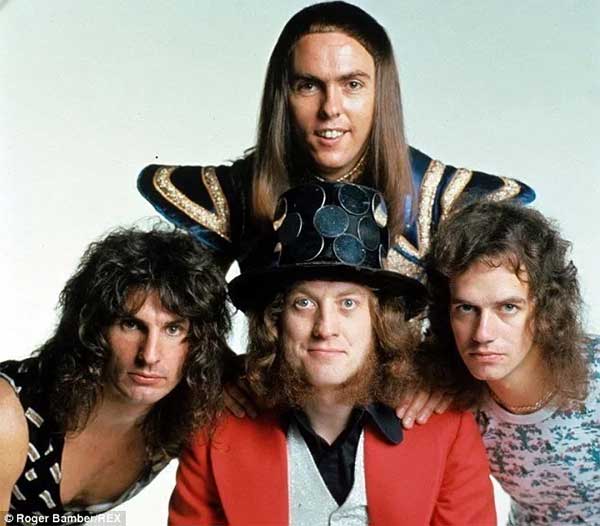
Dave: But I turned professional when I was eighteen. And three years later, the ‘N Betweens split up – and Don and I left and wanted to form a group like the Beatles – four people, not a singer and the group. And that’s how it started. And the auditions that we had, trying to find somebody, it was difficult. We auditioned for a bass-player. And this young kid comes and he’s got a Paul McCartney bass in a plastic bag. And I was thinking, the previous guy who come to play looked like Mick Jagger, and I thought hey! he looks good, but he don’t play very well, right. And then Jim… Jim was fifteen, he didn’t say a lot, he got up and he knew one or two of our songs. So we started to play, and I couldn’t believe how different he was as a bass-player. You know bass-players have four thick strings – right? But he was bending the strings, like Jimi Hendrix would… like, powerful (he mimes playing a bass guitar, with attitude). He had an excitement about his playing. And I stopped him and I said ‘could you play me what you’re playing?’ and he just played it, and it was like… I thought, he’s either… he’s either somebody that’s not gonna work, or he’s really somebody special. And I have to say, he was somebody really special. Different… and I decided to tell Nod. ‘Cos I’d heard about Nod, without hearing his voice. But I saw him outside ‘Beatties’ which is a big store in Wolverhampton, and he was standing outside, and I was walking around with Don, and I said ‘Oh, there’s that Noddy bloke!, is he a singer? ‘He said ‘I believe he’s with a group who’s got a singer, but he sometimes sings some tracks.’ I said ‘well, let’s go and have a chat.’ So I went up to him. He was just standing outside. I didn’t really know him. I said ‘how ya doing?’ He said ‘I’m doing alright. I’ve left the group I’m in.’ I said ‘Oh! you’ve left them?’ He said ‘yeah.’ I said ‘that’s interesting. We’ve split up the ‘N Betweens, and we’re looking for a new singer. What do you think? Would you like to join us?’ And he said ‘Mmmm, I’ll think about it.’ I don’t know, he said he’d think about it. But I did hear that he was someone who could talk to the audience, and had a great personality. And I thought, I’m looking for someone like that. I want somebody on the front line, like, a singer who talks to the crowd, proper. A bit like Cliff Richard, y’know? and the Shadows to play. So I said to Nod… I rung him up, and he said ‘Yeh, I am interested.’ And I said ‘well, I’ve found this bass-player. I haven’t heard anybody play bass like this guy. He’s so young, he hasn’t even got a job, he’s still at school… or just leaving school.’ ‘Anyway’ he sez, ‘well, let’s go down and meet him.’ So I took him down, took Nod down, and we went to Jim’s house, and he come to the door and he’s got a violin under his chin.’ Well – bloody hell, he plays bass like Jimi Hendrix – like, amazing, and he’s got a violin! He was a trained violinist, he was a great violinist. I said ‘you play violin?’. He sez ‘yeah, I play piano as well.’ But the combination… we went to a pub outside Nod’s Council House, and the four of us stood together, so me and Don were used to each other, Nod’s joined, Jim’s there, and we do two or three songs and we stop and we go ‘does that sound good to you? ‘cos it sounds good to me.’ It was a bit like that. There was something. I can’t explain it to you, Andy. But there is something undeniably ‘right’ that brought us together. I think, the same as the Beatles, there’s something in life… it’s possibly because I felt that all my life, since I was fifteen, I was always driven to draw people into something I wanted, right? And when I got a hold of a guitar and I learned it, me Dad said to me, he said ‘you’re a natural guitarist you are, you don’t need to be taught, you have a natural ability to learn things by ear,’ and that’s what I did when I was fifteen. I learned the Shadows, I learned that Hank Marvin was great. I didn’t know Eric Clapton then, but Chuck Berry came later and we all copied that, and such. But the thing was, we come together and we’d all been through various options of learning from Elvis, learning from… I don’t know, Chuck Berry, Buddy Holly, all these people we tend to copy, and then we got into Tamla Motown, Diana Ross & The Supremes, we got into the Four Tops, there was a whole roster of great songs from America. There weren’t particularly great songs at home at first, but when the Beatles came along, what we were listening to before – like, echo chambers and Hank Marvin, and American records… along comes the Beatles, right? who wiped the floor, I mean, they were like – when I first heard them – because nobody, no record company would sign them ‘cos they didn’t like them. Brian Epstein went round and round, they said ‘no, no, I don’t like them’. The thing with the Beatles, they had a unique sound, while they (the Record Companies) were often listening to American Pop Stars like Dion, Bobby Vee, Bobby Rydell and all those people. So they were probably looking for things like that, which was very commercial from America, coming in. Y’know, Buddy Holly and all that. But here we got the Beatles, now the Beatles were listening to the same people as Slade were. They were listening to Buddy Holly, Elvis and all that, and so were we. So we were similar to the Beatles. And the Beatles came together in a bit of a fashion, but when they made it, I was… it was 1963, I went to Mum and Dad, I was eighteen, and I said to Mum and Dad, I said ‘I’m sick of this crap job I’ve got in the office for three years (for Tarmac Limited). You know I can play…’ and I just told them, I said ‘this is what I want to do.’ And Mum and Dad actually said… well, basically, there’s a song on the Dirty Foot Lane album that says ‘she let me be what I wanted to be’ – you’ll hear that lyric, it’s called ‘Sweet And Tender’. That’s a song about my Mother, right. But my Dad was solid. He believed in me. He said ‘there is something natural about you.’ And I found – because I was, I didn’t really have a girlfriend, right, I’ve got large ears, short hair, work in an office, right, not much going for me, but yet – the aspect of grabbing something… well, Mum would have liked me to be a Doctor, well, I could hardly spell properly never mind be a Doctor. And me Mother was a genius, really. Because, we didn’t know about my Mom, and what she did in the war. Because she was sworn to secrecy. But it turns out, after she died – I mean, a lot of the album is about Mom and the tragedy of losing her, but when she was fine and on the case, she was marvellous. But we found out she’d been a War Cabinet Ministers secretary… and I thought, that’s funny that, I read something in The Express & Star, Enoch Powell said ‘this woman is very important.’ And I didn’t know what he was on about. But he would have known, you see. So she was working for the Government, in London I think. The thing that I love about Mum is that… Mum and Dad came together in a set of circumstances which is quite funny on the one hand. Me Dad was married, right?, this is wartime. Me Mum, in the twenties – I think she went out with somebody who was married and she had a child. Now she had a great father – my granddad was a classical pianist, and he stood by her, because in the twenties, to be pregnant and not married was absolute sin, and he stood by her. I’ve never found out who the father was, but I had a half-sister, you see. Named Jean. And she came to live near us, and as I was born… but Mum and Dad met in the ammunitions factory, underground, and they fell in love, and Dad said ‘I can’t marry you, because I’m married to this nurse, and she won’t divorce me. And she won’t have any kids,’ and me Mum said ‘I’ll have your kids, Jack.’ And that’s where I come in, right. I think… see, I was born in 1946, they would have met in 1945, before the war was over. Anyway, what they did – which I found out via a relation, they came together, fell in love, and Dad planned a fake wedding. It’s great. He said ‘I can’t marry you, Dorothy’ – that’s my Mum’s name, and then she has to let him know she’s got a child. ‘What we can do’ he said, ‘it’ll look good if we fake a wedding, go to the registrar, go in, get a ring, shove it on, come out and they chuck confetti over us.’ Everybody thinks they’re married, right? They think. But of course, me Granddad Hill, would know they’re not married, because his daughter – that’s me Dad’s sister, best friend married Dad! I thought it was such a wonderful story (he breaks into laughter). But it was never mentioned. We never knew who Jean’s father was, and the biggest tragedy – and I’m glad she saw me make it in the end, is, when I was eighteen, I’d gone abroad and I came back home and the curtains were drawn, right, and I thought when curtains are drawn in a house in those days, it means someone has died. And it happened to be my half-sister had died of a brain tumour. She got pregnant, and she was told not to get pregnant, because she had fits all her life. The problem with the death, the effect on my Mother was big-time, you know, it was… I don’t know, I think she might have felt like – in those days, in the past, you know how people spoke about people who got pregnant, I think she was carrying a lot of weight, and surviving in life, y’know, to have a daughter, and her Dad stood by her, I’m pleased about that – he died in 1994, then Mum had met Dad, I think the combination of Dad and Mum, and then of course my half-sister was alive, I knew her for a long time until she was thirty-three, but she died of this tumour, and it was almost like, the neighbour said I think part of your Mum’s died with her. And I thought that. She had to force herself to work. I’m talking about someone who knew the Head of the Police, she knew all these people… I don’t know, she might have known Churchill for all I know, but she was… she was very clever, she used to teach shorthand to the neighbours. When I lost her, and when I wrote my life-story – which I did several years ago, I went and visited Mum’s sister’s son, and he was brilliant, he told me about the fake wedding, and he said how hard it was on my Mum about having a child. I said, ‘well, the thing is, when she lost her, it was hard to deal with,’ Mum became really depressed, she was depressed on and off. But then, sometimes she’d be really happening, you know? teaching the neighbours, getting them jobs, totally really lovely person. So when I wrote that song, I didn’t want to talk about her difficult times, I just saw them. But me Dad was a rock-solid man, right,? he was an absolutely rock-solid man. And I think the marriage of the two of them brought about me, and my sister – Carol, and I think it’s a wonderful thing that that marriage happened, and thanks to the two of them, I came here.
Andy: The book is So Here It Is: How The Boy From Wolverhampton Rocked The World With Slade by Dave Hill, 2018, ISBN-13: 978-1783525799.
Dave (becomes pensive): I don’t know… I don’t know, sometimes in life… it’s like, there’s probably a lot you don’t know about me, but I’m a big William Wordsworth fan, and I read most of his works. There are some of ‘The Preludes’ I’ve read, and I’ve read ‘Tintern Abbey’, and I’ve also read things about how he views life as well, ‘the shades of the prison-house’ is one thing he talks about, but he talks about how ‘our birth is but a sleep and a forgetting, the soul that rises with us, our life’s star, hath had elsewhere its setting,’ and I agree with what he says there, because he says we ‘cometh from afar’ but the journey isn’t finished. In other words, the way he describes it is that we will return to where we came from. So, I’ve got with Wordsworth’s love of the Lake District and poetry and the power of nature, I got into all that, and in a way I drew upon some of the more difficult stuff to understand, but there are about ten pieces of his work which are a must to read, one is ‘Tintern Abbey’, ‘Lines Written In Early Spring’… oh, there’s many actually, many, but there are some, when he talks about shades of… he talks about our birth, he talks about the fact that we are pure, we have a mother, we have a father, we are born pure but we start to grow, and the interesting thing is, and it’s so true of us all, is that when we’re young and children are smiling, they’re not conscious of the outside world, and they’re not affected by it either, they just want to either eat and shit, eat and shit, right? But the thing about it – well, that’s what they do, isn’t it? You eat, and then they have to look after… but I like how he says ‘shades of the prison-house close upon the growing boy, but he still perceives the light from whence it flows’… right? He sees it in his joy, right – these are his words, and it’s true, he sees it in his joy, but the prison-house is basically the world, and it’s more of a bloody prison-house now than it ever was in Wordsworth’s day. But nevertheless, there was the French war and stuff he went through, and the Alps he went round. I followed what he said. I mean, he lived a fairly long life, and yet he had great tragedies. I believe his sister was Dorothy, Wordsworth went off on the Alps or something, he came back, and I think two, or three of his children who were about four or five years of age, they all died. And Dorothy had to bury them, before he came back. I thought… bloody hell. ’Cos I mean, in those days there was no phones. You couldn’t fly anywhere, you had to go on a ship or something. But I find that, the words are… I went to Rydal Mount which is the last home he lived in, I’d already been to Dove Cottage, but I went Rydal Mount – and this is really important that I tell you this, because I was in Rydal Mount, and I was talking to a distant relative, and when I started to describe how I’ve noticed and listened to his words and how they kind-of made me think about who we are, the one poignant thing he said in his works, he said ‘we are greater than we know.’ And I absolutely believe that. We are all greater than we actually know what we are. We’re here. We’re living. Some people think, oh, we pass on. As though we go somewhere, floating around the universe. I mean, I very much doubt that. But I never think that the distance between living on the Earth, and the distance between those you love are not so far away. That’s how I think, you see. I have a sense that there is more. There is something undeniably… I think Doris Day who – I’m a big fan of Doris Day, she was a follower of Christian Science, she believed in god, she prayed to him, she told everything to him, and then she got on with her day. But when she lost Rock Hudson – who was one of her all-time partners in her most successful films ever, she was talking about losing him, and she said – and I do believe it, she said ‘life is eternal.’ And so therefore, in her mind, she probably thinks ‘yes, I believe life is eternal, love continues, and wherever he is, that maybe it’s not so far.’ And I can’t prove that. But sometimes we’re all frightened of dying, and I’m hating that, so it’s a bit like I’m not particularly slowing down… when Nod said to me ‘do something for yourself’ I knew he was right.
‘DIRTY FOOT LANE’ by DAVE HILL (October 2026, JCPL)
Produced by: Django Holder (Noddy’s son)
Contributing musicians include Rob Childs, and long-time collaborator John Berry (who also worked with Mud and Sweet)
- ‘Thanks For The Good Times’ (4:12)
A tribute to fans, collaborators, and shared success. Taken from a comment made by a fan. - ‘Back In The Air Again’ (3:40)
- ‘Dust My Axe’ (3:41)
Channels a blues-driven response to modern life. - ‘She Had A Troubled Heart’ (4:33)
Stands out as a deeply moving track addressing love, loss, and mental health, inspired by real-life experiences. It has an early fifties ‘twangy’ guitar sound, which Rob (Childs) played on his Gretsch guitar. ‘This was the song where I really found my voice’ Dave comments. - ‘Sweet And Tender’ (5:40)
A heartfelt tribute to Dave’s mother. - ‘Fast Train’ (3:41)
Captures the intensity of Slade’s rapid rise. - ‘Only Fools And Horses’ (4:00)
Revisits the unpredictable early days of the music industry. - ‘Play It To The Crowd’ (3:36)
Songs like this one and ‘Back In The Air Again’ capture the exhilaration of live performance. - ‘Reasons To Succeed’ (3:33)
Reflects Dave’s lifelong ambition. - ‘Dirty Foot Lane’
The title track stands as the emotional centrepiece of the record. Reimagined with Django Holder, it blends folk and ambient elements into an intimate, atmospheric soundscape. Stripped back and deeply expressive, the track encapsulates both the personal and artistic essence of the album. Together, the songs form a narrative that is both intimate and universal, grounded in memory, resilience, and a lifelong passion for music.
by ANDREW DARLINGTON