
October 1983. At seventeen years old I am at least one year younger than anyone else on the architecture course I have just started in Glasgow. With the strange blend of insecurity, arrogance and naïveté that comes with the age, I am pinning a few things to the boards of my allocated studio space: A photograph of my Flying Scot bicycle on Dundonald Hill with Arran in the distance; the loose inner sleeve print from Simple Minds’ ‘Empires and Dance’; an advert for ‘This Charming Man’ clipped from the pages of ‘Smash Hits’ and a poster for ‘La Varieté’ by Weekend. An impossibly handsome young man who has a drawing board two away from mine wanders past. He glances at my choices, visibly shudders and then, with one of those Highland Gentry voices that is 10% Scots and 90% English Public School, he says something about ‘faux Jazz’ before wandering off mumbling about ‘Monk, Mingus and Mulligan’. Such is the spirit of the times.
Forty three years later I idly wonder whatever became of that self-proclaimed teenage Jazz aficionado. Running a successful architecture studio in London no doubt, but spending more and more of his time at the family retreat hidden away in Speyside. Does he still listen to Modern Jazz or did he meander into more esoteric and ever more challenging sounds? Is there a complete collection of ‘The Wire’ magazine lining the studio walls? Whatever. I really ought not to be judgemental, for if the passing of time has taught me anything it is that the facade of culturally informed intellectual charm emanating from that nineteen year old young man would have been just that: a facade. Behind it no doubt lurked the same insecurities and, yes, defensive arrogance that I suffered myself.
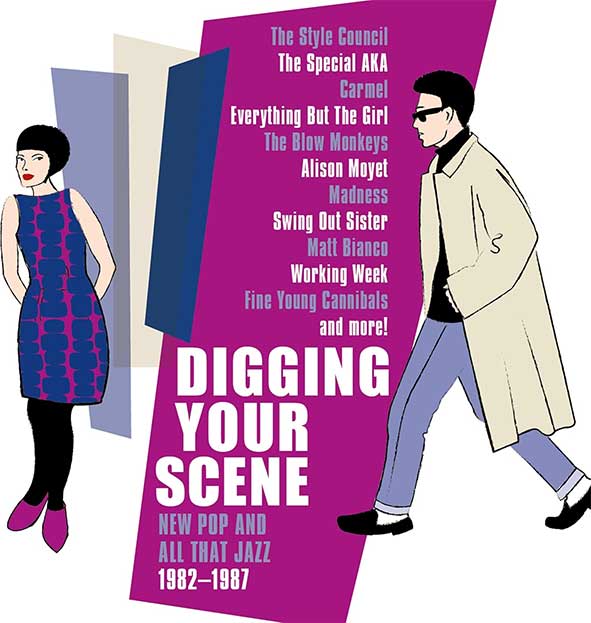
In those intervening forty three years of course I also came to know, and love, the music of Monk, Mingus and Mulligan yet through it all I would always choose to come back to those ‘faux Jazz’ sounds of Weekend. ‘La Varieté’ still sounds extraordinarily fresh to my ears and it is a delight to hear the light as air ‘Weekend Stroll’ on the four disc ‘Digging Your Scene’ boxset from Cherry Red. Subtitled ‘New Pop And All That Jazz 1982-1987’, the Weekend instrumental is a perfect ingredient in what is, on the whole, a rather delicious collection, tracking a route from Everything But The Girl’s (arguably) 1982 scene-setting cover of Cole Porter’s ‘Night and Day’ (which still sounds effortlessly both of its time and timeless) through to the 1987 white label 12” release of Night Train’s ‘Open Channel D’ which arguably provided the segue point into Acid Jazz, which is another thrilling story altogether. In between the collection features a multitude of tracks, many of which will be familiar, some of which not.
Highlights? My nostalgic take on things pulls mostly from the first half of the collection: The French Impressionists’ brittle post-Postcard charity shop chic showcased on ‘Pick Up The Rhythm’; the Bossa-dub urban exotica of Jah Wobble’s ‘Sunshine’; Working Week’s magnificent activist anthem ‘Venceremos – We Will Win’, a benefit record for the UK Chile Solidarity campaign, here in its euphoric ten minute ’Jazz Dance Special’ mix; The Pale Fountains’ meanstreets glamour meets country-house lost weekend decadence on ‘Southbound Excursion’ and of course David Sylvian’s luxurious ‘The Ink In The Well’ from his 1984 solo album ‘Brilliant Trees’. In some respects it might seem odd for Sylvian to be in this collection, but this cut really does fit exquisitely well, not least because, as the universally excellent sleeve notes point out, the song references Cocteau’s 1936 film ‘The Blood Of A Poet’ and Sartre’s 1945 novel ‘The Age of Reason’, both essential reference points at the time to anyone keen to show off their cultural qualifications.
Then there is Vic Godard’s seminal ‘Holiday Hymn’, perhaps made more (in)famous by Orange Juice’s priceless cover version, but sounding tremendous here sandwiched between the instrumental version of The Colourfield’s simply gorgeous ‘Castles In The Air’ and Alison Moyet’s take on ‘That Ole Devil Called Love’. Curiously, I had all but forgotten about that particular Moyet single and listening now I have to admit that whilst her voice still sounds sensational, the arrangement itself falls a little flat. A little too traditional perhaps, following the well worn paths rather than injecting something contemporaneous to the times. It seems to me that other covers of standards fare better: Bronski Beat’s ‘It Ain’t Necessarily So’ still sounds fresh and seductively spirited; Brilliant’s ‘It’s a Man’s Man’s Man’s World’ (here in the nearly seven minute Trans Global Mix) is one of those fabulous Stock Aitken Waterman productions that reminds us that there was much more to SAW than saccharine Chart Pop (further evidence is on display here in the form of their funky eight minute ‘Roadblock’ from 1987) whilst Kid Montana’s take on ‘Spooky’ is a classy European urbane delight. One of the more obscure treats in the collection, this track from 1986 is notable for featuring Dudley Klute on vocal duties, a name many may be more familiar with from for his later appearances on Magnetic Fields’ ’69 Love Songs’ is magnum opus. Then of course there is Paul Haig doing his finest Sinatra impressions on ‘The Song Is You’. Originally featuring on the ‘Swing in ’82’ mini-LP, this cut splendidly bridges back to the post-punk anxious energy of Josef K and forward to more sophisticated syncopations, all whilst aligning itself with what Vic Godard was doing at the time with his Club Left cocktail jazz sets, which brings us neatly back to the start of this paragraph.
Good, then, to see Godard’s role in establishing the, ahem, swing towards a jazzier side to the post-punk Pop style in the early 1980s, and good too to recognise the role of Paul Weller in its further development. If it may be true that many were aghast at Weller’s decision to split The Jam at arguably the height of their powers/success it may also be true to suggest that those same people were determined to sneer at What Weller Did Next with The Style Council. Fools. In hindsight, it is easy to see those early Style Council singles as energetic bursts of soul infused Pop that harked back just enough to the idea of The Jam to propel Weller and company forward towards the release of 1984’s influential ‘Cafe Bleu’ jazz /soul/blues review set. Weller himself is represented on this particular collection, though, with the 1986 reworking of the previous year’s album track ‘With Everything To Lose’. Re-written by Weller as ‘Have You Ever Had It Blue’ and rearranged by Gil Evans as a sophisticated jazzpop smooch, the single was a feature of Julian Temple’s musical film treatment of Colin MacInnes’ 1959 novel ‘Absolute Beginners’. Weller of course had long been a champion of MacInnes’ novel so it all fitted, and if reception to the film was somewhat critically and commercially muted at the time I suggest that it has weathered well and now reads more clearly as both an interesting take on the novel whilst simultaneously being a celebration/critique of the very New Pop/Jazz scene (and the neoliberal Thatcherism that gave it context) that this boxset charts. If you have not seen it lately I recommend watching it. Elsewhere in the collection there are more Weller/‘Absolute Beginners’ references: Eighth Wonder’s ‘Having It All’, from the film soundtrack originally cropped up as a 12” b-side to a flop single and is much better than one might expect/remember; Tracie’s ‘(I Love You) When You Sleep’, a 7” on Weller’s Respond label is a gorgeous ballad that deserved much more on its 1984 release and it is a pleasure to be reminded of the Elvis Costello written number here, whilst former Wham! And Style Councillor Dee C. Lee’s solo smash hit single of 1985 ‘See The Day’ is deservedly revisited. It still sounds sensational.
Elsewhere in the collection there is a largely pleasing amount of other chart hits to enjoy: Madness’ ‘One Better Day’ is a splendid reminder of the fact that are few better singles acts in the history of Pop; Everything But The Girl’s ‘mainstream breakthrough’ single ‘Each and Every One’ still sounds utterly beguiling, the more so now on the realisation that lyrically it was written by Tracey Thorn as a critique of the patronising male music press’s treatment of her all-female group The Marine Girls; China Crisis’ ‘Black Man Ray’ showcases Gary Daly and Eddie Lundon’s move into more commercial ground with its Walter Becker production. It sounded a little disappointing to me at the time after the cool electronic charm of tracks like ‘African And White’, but now sounds delicately charming; Swing Out Sister’s magnificent UK top five smash ‘Breakout’ which I loved at the time of its 1986 release and am delighted to hear here in its relatively rare 12″ ‘New Rockin’ Version’ mix still sounds wonderfully exuberant whilst Fine Young Cannibals’ enduringly appealing and relevant anti-Tory ‘Blue’ continues to resonate with it’s insistent proclamations. ‘It’s a colour so cruel’ indeed. Then there is Blow Monkey’s 1986 hit ‘Digging Your Scene’, which gives the boxset its title and here appears in its ‘US Mix’. This tremendous single sounds immeasurably more appealing to me than it did on release, its lyrical critique of the period’s anti-gay sentiments having passed me by entirely at the time. Meanwhile, Level 42’s ‘Seven Days’, though not a single, came from their top 20 ‘True Colours’ LP of late 1984 and also sounds much, much better than I ever remember Level 42 sounding. Indeed, of the hits and of the entire boxset itself, only Sting’s ‘Moon Over Bourbon Street’ feels out of place. Sounding overly earnest and rather lumpen and dreary, the single rightly failed to breach the UK top 40 at the time and would, for my mind, have been much better left in the past.
If you are looking for something a little more obscure (and immeasurably better sounding) than Sting, then thankfully this boxset has you covered: Makin’ Time, featuring the great Fay Hallam’s organ playing to the fore on instrumental ‘Walk A Thin Line’ (the flip side of their 1986 cover of Costello’s ‘Pump It Up’) showcase the jazz and soul influences on Mod style to perfection; The Friday Club’s now rare 1985 single for 2 Tone, ‘Window Shopping’ is the kind of dole-queue social(ist) observational statement cloaked in upbeat poptimistic style that in many ways epitomises the era, whilst Marden Hill’s 1986 debut single Curtain’ is a sub-three minute breeze that sounds like it was made whilst in thrall to The Free Design and anticipates early Stereolab at a time when Tim Gane was still playing chiming Marxist Pop with McCarthy. Best of the lot for me though is the glorious ‘Thank You For Being An Angel’ by Friends Again, which featured originally on the 1984 ‘Friends Again E.P.’. The single (a double pack 7” of which included previous fabulous singles ‘Sunkissed’ and ‘State Of Art’) was almost the last ditch effort by Mercury to break the band into the charts. It peaked at number 59 and within a year or so the group had split, with members forming Love And Money (James Grant, Paul McGeechan and Stuart Kerr) and The Bathers (Chris Thompson). Both have given us many fine records in the past forty years or so but my heart is still tied to the charming folk/soul/blues inflected Pop they crafted in the shadows of Bothwell Castle, falling down as it was. Well, nostalgia is a strange and strong emotion after all.
Nostalgia then will surely draw a lot of listeners to the ‘Digging Your Scene’ collection and there is surely not much wrong with that, especially since the relatively broad musical scope of the selections means there is as much to whet the appetite for new excavations as to tease at the rusting synapses of memory. Faux Jazz? Maybe yes, maybe no. Tremendously entertaining regardless.
.
Alistair Fitchett. 2026.
‘Digging Your Scene: New Pop and All That Jazz, 1982-1987’ is a four CD boxset.
Released by Cherry Red Records on 26th June 2026.