
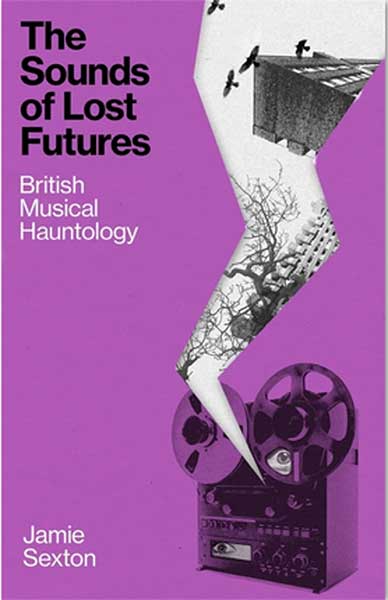
The Sounds of Lost Futures: British Musical Hauntology, Jamie Sexton (Reaktion Books)
Hauntology has been a bit of a buzz word in cultural theory for the last decade. It combines Freud’s interpretation of what is uncanny with the notion of occult traces of the past and Simon Reynolds’ and Mark Fisher’s (differing) ideas about retromania and how the aspirational dreams of the 1960s did not materialise. Derrida used it in 1993 to suggest that contemporary politics was still haunted by the ideas of Marxism. We saw giant rockets take off and men land on the moon (hold back those conspiracy theorists!) and thought jetpacks, monorails and perhaps time travel was coming; instead NASA packed the whole thing in with only a few kilos of moondust to show for the billions of pounds they spent.
It’s not about the money though. It’s about that mix of strange TV (Timeslip, The Prisoner, Quatermass, Penda’s Fen, early Doctor Who, perhaps even Catweazel), music from the likes of Delia Derbyshire and Tangerine Dream, and cult films such as Witchfinder General and The Wicker Man which a generation were exposed to. Not to mention those bizarre and terrifying information films about how dangerous it was to talk to strangers, swim in lakes or quarries, and how hiding under the table would help us survive a nuclear bomb.
This is all good so far. I like the idea of a gently traumatised and disappointed generation growing up with only ideas of what might have been instead of what actually is. It’s a theory that is useful to discuss why all those programmes and films have become cult viewing, and why similar occult themes continue to be explored in the likes of Mark Jenkins’ marvellous cinematic art: Bait, Enys Men and The Rose of Nevada. It can also be used to understand why a whole swathe of music has emerged that enjoys sampling dialogue and music from said information films and kids’ TV, and treating new music with hiss, crackle and pops to suggest age and patina, and why we have seen CD releases of things like music from The Clangers, although some of this must be nostalgia as a counter to feeling a bit adrift socially and politically? It does seem to be a British obsession, not a worldwide occurrence, which is of course reflected in Jamie Sexton’s book title and in his closing discussion in the book about ‘national and generative memory’.
Unfortunately Sexton seems to believe the theory of Hauntology is more than that. For him, musical Hauntology actually exists, is a kind of box to put things in which qualify and he can place things in orbit around if they seem associated with or can be labelled as precursors to it. Actually, it would be easier simply to discuss them through the lens of Hauntology as it simply wasn’t a term in popular use before fairly recently, and a genre that encompasses Burial, The Caretaker, library and lounge music, rave and naive folk, seems of little descriptive, categorical or critical use. And although Sexton notes that we have access to an unprecedented and immense digital archive these days, he spends too much time discussing the relationship of the analogue and digital without getting much out of the debate.
Sexton’s generosity and wish to be as inclusive as possible is another of the problems with this book, weakening his argument, as does the referencing of books such as Merlin Coverley’s small volumes on Hauntology and Psychogeography, which are purely populist introductions to their subjects. For some reason Sexton devotes a whole chapter to the record label Ghost Box, purveyor of thin-sounding, derivative and rather conceptually dull music brilliantly designed and marketed, the only time he writes about a subject at any length. Elsewhere he whizzes through obligatory mentions of Alan Garner’s Red Shift, Moon Wiring Club, Lovecraft, Stereolab and Broadcast, along with surprise – and welcome – mentions of Philip Jeck, The Shining, and the Warrington-Runcorn New Town Development Plan (perhaps not so welcome), to explore time, memory, nostalgia and time, place, history.
In the main I had a sense of déjà vu reading this book, and I don’t mean that as a pun. Most of this volume seems to recycle the same old ideas and examples, and in a particularly annoying po-faced way. Sexton’s lack of argument and seemingly endless and catholic examples, all welcomed by the open-armed author, result in a vague book of numerous brief summaries, endless digressions and obfuscation. Sexton himself seems aware of some of the contradictions:
While in the Introduction I contended that hauntology is better understood as
a conceptual framework from which to approach music (both as a critic and as
a creator) than a genre, if genre is accepted as a complex cultural category that
can emerge and be used in multiple ways then musical hauntology is a genre.
Well, that’s all clear then. I prefer his statement two pages on: ‘hauntology unveils social and cultural ghosts’, which seems to me much more useful. By focussing on some reoccuring ideas within some contemporary music and discussing why a generation might share such memories, ideas and disappointment, we can learn about society and culture. But there are other ways of discussing these, and other lost futures to be considered too. Sexton’s book suggests he has come to Hauntology too late and is simply dealing with the populist fallout rather than the radical ideas that exploded at ground zero.
.
.
Rupert Loydell
.