
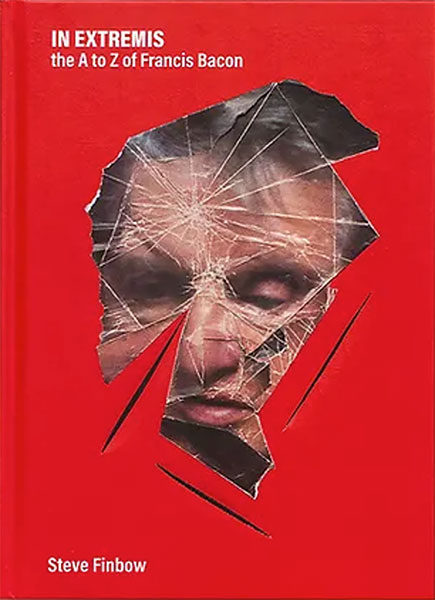
IN EXTREMIS the A to Z of Francis Bacon, Steve Finbow (260pp, Infinity Land Press)
Another book about Francis Bacon? Why yes, you can’t have too many books about one of our greatest painters, and this is new hardback is a good one, an ABCDary composed by Steve Finbow, ‘an independent scholar and writer whose work explores the limits of desire, disease, and death.’ Finbow spreads his critical gaze far and wide, and the alphabetical approach allows for intriguing juxtapositions and neighbours such as Willem de Kooning and The Kray Twins, Umbrellas and the Uncanny vs. Hauntology.
Bataille was bound to be in here, despite the acknowledgement that ‘There was no moment when Bacon aligned with Bataille, no shared doctrine, no lineage to trace’. Instead, Finbow suggests that ‘something remained as residue – thick, unclaimed, unstable – settling across the years’. He goes on to suggest some kind of influence or connection via cultural osmosis, but like the similar entry for Artaud, it seems to be more about the author trying to make connections through abstract ideas about the body which are totally at odds with Bacon’s painterly obsessions, physical acts of mark making and very visceral take on the physical.
Chance procedures were integral to Bacon’s work. If a painting was going too smoothly or felt too polished, all surface and no depth, slick rather than awkward, Bacon was renowned for flicking or throwing paint at the canvas and seeing what would result.
Destroying work was also part of Bacon’s creative process, in one sense a form of brutal self-editing but also to do with never knowing when to stop. Often, paintings only went out from the studio when a gallery insisted they needed work for an exhibition and came to collect it.
Existentialism is something that seems to get foisted on Bacon, as it does here. Critics suggest that Bacon’s art is indicative of meaningless and despair, a sense of purposelessness and futility, yet Bacon lived life to the full rather than sitting in the corner with a nihilist’s hat on. There is little evidence that Bacon concerned himself with anything other than creative, sexual and bodily urges.
Flesh is fluid in Bacon’s work, it evidences movement and temporality; many would say death and decay. Personally, I think Bacon painted things just the way they are/were but others regard his art as
Grotesque, prone to seeing beauty in wounded flesh, pain and torture. Bacon collected books of medical deformities, injuries and operations, was drawn towards states of raw emotion and expression, but did not fetishize them.
Hockney, along with many other artists, could be the subject of Bacon’s vitriol and dislike. He had no time for abstraction, which he regarded as decorative, nor for illustrative figurative or landscape work, and quite rightly declared that ‘David Hockney is the worst painter of his generation.’ Thank goodness someone spoke out.
Infinity Land Press is committed to publishing works that explore the connection between cruelty and creativity. They claim to produce ‘exclusive, clandestine publications which are inoculated against the circulatory system of the established book market’, which means you have to look hard to find their exquisitely designed hardbacks. (Their website is here.)
Juxtapositions can bring out the details of images when we compare them, as well as contradict, critique and tell a story. Triptychs are an established way to do this. Bacon’s Triptych Inspired by T.S. Eliot’s Poem ‘Sweeney Agonistes’ has a canvas both sides with the same bed and cage/architectural structure above and the same colours, both of which contrast with the dark blue central image; all three contain figures, intertwined in the outer images, bloody and alone in the middle. Critics will tell you it about sex, murder and cannibalism, yet there is something joyful about the abandoned grappling figures on the right, and I fail to see why the post-coital image on the left, complete with cigarettes, is negative. Having declared in the Financial Times that ‘the central panel […] is a sumptuous depiction of a Wagons-Lit compartment – Bacon loved the Paris-Côte d’Azur train – after a crime’, Jackie Wullschläger goes on to suggest that ‘The visual connection is tenuous’, declaring that this is the point, and that like Eliot, in the collage of The Waste Land and elsewhere, Bacon used ‘numberless feelings, phrases, images, which remain there until all the particles… unite to form a new compound.’ At least the idea of a ‘new compound’ is useful, especially within a review entitled ‘Of Pain and Poetry’, that clearly came pre-loaded with ideas judgements.
Knowledge is a wonderful thing, as is this volume. Sometimes however, academics, scholars and critics can try too hard, and at times Finbow does so. Just as I have come to expect Infinity Land Press titles to always include references to Artaud and Bataille, I am not surprised to find entries here concerning Thanatos (the personification of death) or the Uncanny vs. Hauntology. Whilst Freud’s writing about the Uncanny may be of relevance, it does seem that Thanatos and Hauntology have, like Artaud and Bataille, been shoehorned in. And soon I am going to start ignoring any new books which mention Hauntology or Psychogeography, both originally useful terms which have now been diluted and over-used.
Literature, or a small range of it, underpinned Bacon’s thoughts and paintings. Among others, he read and referenced the poems of T.S. Eliot, Marcel Proust’s series of novels which make up À la recherche du temps perdu, and Emil Cioran’s miserablist philosophy of cynicism and negativity. And surely Bacon must have read some of the captions and essays that accompanied the medical, photographic and painted images in the books he collected in his studio?
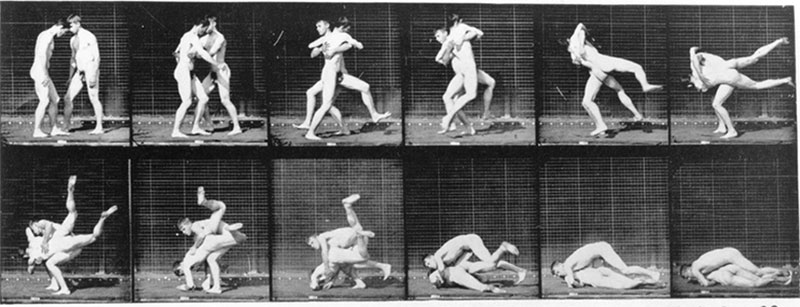
Muybridge was a photographer who pioneered the use of stop-motion image-making to find out how animals and humans actually moved. In addition to his motion studies he also pioneered the creation of panoramic landscapes made from multiple images and created Phenakistiscope discs to create the illusion of movement. Bacon stated that ‘I don’t copy photographs apart from a few Eadweard Muybridge characters that I have integrated into paintings’. These include Paralytic Child Walking on all Fours (1961) and The Wrestlers after Muybridge (1980). Finbow’s entry for Muybridge is an ekphrastic prose-poem recreating a sequence of ten images.
Nothing can replace simply looking at actual art, the canvas not a backlit reproduction on a screen. I attended the opening of a Bacon retrospective at the Tate Gallery, only to be naively surprised and offended by the fact that no-one was actually looking at the paintings, they were too busy talking to each other and quaffing free wine. All painting is about the material of paint, of colour, applied to a surface to form patterns, shapes, rhythm and possibly realist images and/or implied narrative. This is not reductionist, it is the starting point for understanding a work of art. How it is made, not why. Biography, psychology, artist’s statements and gallery labels are useful but also extraneous. I would liked to have seen (or read) more looking and seeing in this book rather than explanation, theorizing and biography.
Oil paint is a difficult medium, yet Bacon was a master of how to use it. He could (and did) create vivid, saturated colours, but was also adept at a kind of impressionistic suggestion of figure or form, of texture and movement, of architectural detail or capturing fleeting moments or facial features. He usually painted on the rough side of raw canvas, and would use anything to hand for applying the paint, be that textured rag, flicked brush or improvised scraper for scumbling.
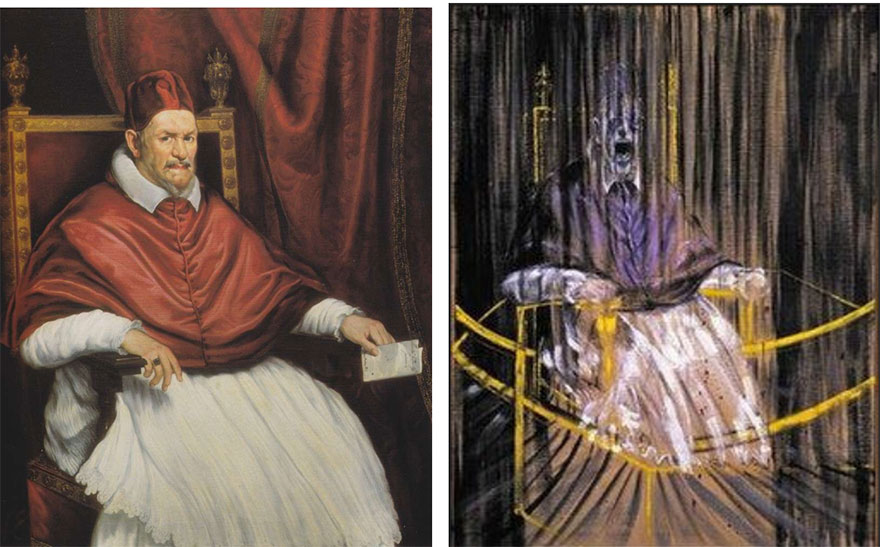
Pope Innocent X, as depicted by Diego Velázquez in 1650 (but only viewed by Bacon in reproduction) obsessed and inspired Bacon for many years, resulting in a series of his own Pope paintings. Bacon’s Popes are dressed in purple smears, often enclosed within Bacon’s familiar framed spaces, even when seated on their thrones, and sometimes screaming, perhaps in pain or terror. They are certainly not flattering or idealised, any sense of pomp or power here is deconstructed and undermined.
Queer is perhaps the wrong word for Bacon. He was a sado-masochistical homosexual who enjoyed wearing women’s underwear and being beaten up, something which biographers are prone to blaming on a groom at Bacon’s childhood home, who would horsewhip and bugger him. It might explain his fascination with hurt flesh and is often mentioned in relation to
Religion, which gets written about in relation to Bacon mostly because of his Pope and crucifixion paintings, perhaps because of his use of the triptych form. But as noted above, Bacon was fascinated by one specific painting of a pope, and critics tend to ignore the fact that Bacon’s crucifixions are mostly titled or partially titled ‘a crucifixion’ (my emphasis), that is not the crucifixion (of Jesus) that most Renaissance and religious art references. Bacon’s interest was in the human form and the extreme shapes that pain or ecstasy could produce: in 1962’s Three Studies for a Crucifixion, he famously turned his crucified figure upside down and depicted it as a carcass or lump of meat; elsewhere he suggested that Cimabue’s crucified figure, which had inspired him, was reminiscent of a squirming worm. Bacon was a realist, who knew that human flesh would decay and damage, he did not find
Solace in any religion, only in temporary sexual or alcoholic oblivion, perhaps through his friends and lovers, although these relationships were prone to ending in argument and separation, sometimes suicide or death.
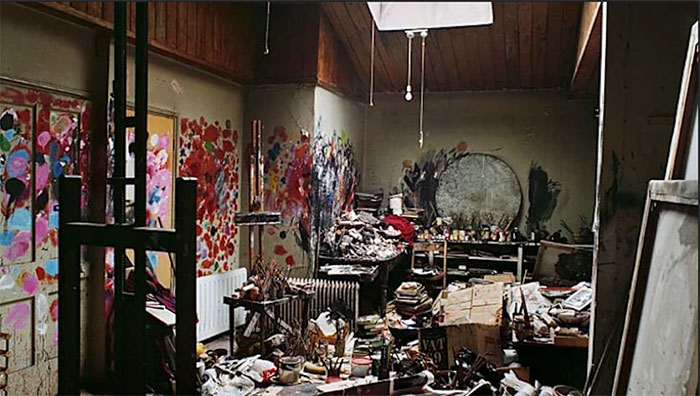
The painting studio was Bacon’s real home. His longest serving studio was in Reece Mews, London, where for 30 years he worked in ‘organized chaos’, with finished, unfinished and slashed canvasses, dried up rags and paints, paint-splattered photographs and books piled up in disarray between colour-daubed walls only interrupted by windows and a silvered mirror. The building also housed a small kitchenette/bathroom and lounge/bedroom for use when required.
Unless you come to Bacon already laden with ideas of depravity, gore and human wretchedness it is hard to see why anyone would not be drawn towards the colour and beauty of Bacon’s work, let alone his ability to recreate a representation – but not a photographic likeness – of his subject matter. There may be the occasional bullfight, syringe, crucified body, pool of blood or twisted face but mostly there are acres of crimson and orange, browns and blues and purples, not to mention occasional pinks and all manner of flesh tones, to sink into. There are figures caught in motion, at odd angles, and tender, indeed loving, portraits of friends and lovers, as well as almost surreal items of furniture and architecture which formally help hold a composition together. Bacon is a voluptuous and seductive painter whose work contradicts much of what is written and said about it.
Versions and variations of the same image indicate prolonged explorations of ideas and subject matter. Bacon had a number of themes he returned to, which sometimes intersected with other themes. (For instance, there is a Pope painting within his Heads series.)
Wine was everywhere in Bacon’s life, whether accompanying oysters, being quaffed in pubs, clubs and bars, or poured into stews and sauces. One of the greatest art documentaries ever made for TV, a 1985 edition of The South Bank Show, showed Bacon pouring very expensive wine into a stew he was making for Melvyn Bragg, whilst they both continued drinking. Bragg is clearly very much the worse for wear the next morning when he returns to Bacon’s studio, yet the painter is sprightly and bright, clearly amused by the state Bragg is in.
X-rays fascinated Bacon, adding another visual layer to the body that he could work from, revealing hidden deformities and injuries beneath the wounds and contortions that fascinated him. He would learn how to paint skeletal malformation and breakages as well as the bruised and damaged flesh which covered, surrounded or partially revealed them.
You should buy this book if you have any interest in 20th Century art and/or Francis Bacon. (You can’t have an interest in 20th Century art without looking at Francis Bacon’s work.) Finbow brings a new eye to bear on Bacon’s work, and is able to look through and make use of critical, cultural and artistic theories to explore and understand the personal and painterly extremes of Bacon’s ouevre, accompanied by Martin Bladh’s irreverent yet highly appropriate collages.
Zoos are not only venues for entertainment, learning or presentation, they are prisons and enclosures, places for caging and capture. Although animals do feature in a few of Bacon’s works, Finbow prefers to explore the notion of ‘The Human Zoo’, a zone which ‘functions as a spotlight that never dims’, ‘a dwelling of pure light, and therefore, a dwelling of pure terror’ with no shadows to hide in. Finbow suggests that Bacon’s frames, both golden picture frame and painted linear structures, highlight the exhibitory nature of the figures and flesh on display.
.
Rupert Loydell
.