
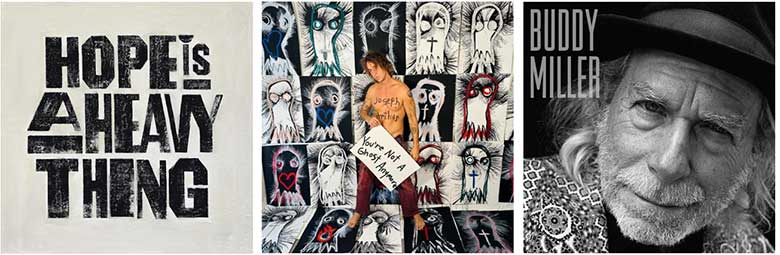
Hope Is A Heavy Thing by Joy Oladokun (Concord Records)
You’re Not a Ghost Anymore: Heart by Joseph Arthur (Lonely Astronaut Records)
Buddy Miller by Buddy Miller (New West Records)
The roots of what was originally known as rock ‘n’ roll are to be found in a blending of blues, country, and gospel. Folk music was added to that mix in the early sixties, while r&b, soul, country rock, and folk rock each major on one of those main strands.
Fusing these core strands in ever new combinations offers a constant source of inspiration which artists such as Joy Oladokun, Joseph Arthur, and Buddy Miller consistently tap. Their past and present collaborations – with a wide range of prominent artists across blues, folk, country, gospel, rock, hip-hop, and African music genres – indicate the breadth of their sources but their particular visions remain unique.
Oladokun has said that Hope Is A Heavy Thing has emerged from a time of ‘looking back and digging through the muck to find what’s worth fighting for again’, as ‘To understand your future you have to confront your past’. These are ‘songs that I wrote to help myself find my light again after burning out’.
As such, the album is a sonic ‘homage to all of the music that inspires me’: ‘On this record you’ll find music that nods the brilliance of the Soulquarians, the rawness of Bob Dylan, the rhythms of afrobeats, and the sampling prowess of J Dilla. Not to mention a callback to the Ronettes and a few songs that find inspiration in rock and roll protest music of the 60’s and 70’s.’
Afrobeat and Afro pop are significant inspirations. Reference is made to Fela Kuti, the pioneer of Afrobeats, and his use of a Yoruba proverb – ‘grandfather kuti once told me / “water get no enemy”’ – while Nigerian singer-songwriter Adekunle Gold features on ‘Sage’ where African rhythms mesh compellingly with folk.
‘Dear Maria’ is the key track where Oladokun outlines some of significant stresses in contemporary life:
there’s just noise on the radio and violence on television
Rumours of radiation in the air
They’re playing God in space and giving bullets to the children
These leave them:
stressed out, let down
Stuck in a small town
Hope is a heavy thing
I’ve been helpless, jealous
Young and so restless
Trying to find somewhere free
They ask Maria to say a prayer:
For the holy, the empty, the loaded
The burnt-out and suffering
For the losers, the bruised, for the old and the useless
And those shut down by history
And when you’re done, say a prayer for me
In a world where ‘the prophets and doctors are waging a war / On the sickness and ways that we’re living our lives / And the promises made are just rooted in lies’, they feel they are like a zombie wandering in a beautiful world looking for ways to ‘rise above all the tragic’ while feeling ‘the weight of the times just keeps on holding me back’. This is an album that perfectly articulates the dilemmas faced by all that are not MAGA obsessed. It also does so with often brilliant wordsmithery that reanimates cliches – ‘I’ve been rusting the silver lining’!
With ‘Time is a River’, they put contemporary dilemmas in a universal frame of reference:
Grief comes to everyone’s door
Prepare it a table, let tears and wine pour
Sorrow never wins the war
It only reminds you what you’re fighting for
As the days go on, peace will be renewed
Oh, time is a river, let it carry you
Let it cleanse you too
Arthur’s You’re Not a Ghost Anymore Heart is the second in a trilogy of albums written over a six-year period that the singer-songwriter says, ‘chart a deeply personal journey through collapse, recovery and return’. Together with first album Faith and still to come Fight, the songs on Heart ‘reflect shifting states of being rather than fixed genres, moving from uncertainty to acceptance with unflinching honesty’. Arthur says they explore ‘presence, survival and reconnecting with the self’, enabling this album and the three-part movement, as a whole, to follow a path ‘from losing direction to finding it again’.
Arthur says the albums are about states of being: about staying when disappearing would be easier; about choosing presence over numbness; about coming back into the body, the voice, and the world. The ‘songs trace the long arc from disorientation to embodiment, from losing the thread to picking it back up with both hands’.
Not being a ghost anymore means being original by being in touch with your soul (‘R U Original’). We lose our originality and become ‘lost to a world that you gave control’ by ‘trying to fit in’. Arthur enjoins, ‘Don’t ever fit in’ and notes the Biblical injunction that ‘you won’t get the life that you want / Until you let go’.
Heart opens with words of love from Arthur’s daughter and has a relational focus, with songs about love and marriage, family and children, all within a divine embrace of love:
I will be your source for love
As it comes from the lord above
As he shows me how
To help you find your way back home
When you’re lost from the places you’ve roamed
Once again
Following his discovery by Peter Gabriel, Arthur has contributed to several collaborative bands, including Arthur Buck, Fistful of Mercy, RNDM, and Holding the Void, while retaining space to be a strong solo performer who can, using a vast array of pedals and effects, perform as a virtual one-man band. Frustrated with the major label system, he founded his own record label and thereby gained the freedom to release new music whenever, as now, that he has something new to say.
As well as being a solo artist, Buddy Miller has also produced solo albums for his wife Julie Miller and duo recordings as Julie & Buddy Miller, while also being a well-loved bandleader and/or producer for a fantastic coterie of much-loved musicians. This relational focus to his music-making comes together wonderfully on this new self-titled record that is described as comprising ’12 songs of soul, country, early rock ’n’ roll, and gospel, made with a community of friends and collaborators that spans five decades of American music’.
Featuring five songs by Julie, the album is also graced by appearances from Emmylou Harris, The War & Treaty, Lee Ann Womack, Shawn Colvin, Ashley Monroe, Elizabeth Cook, Jim Lauderdale, Dan Penn, Larry Campbell, The McCrary Sisters and Teresa Williams.
‘Till the wheels come off’ is a celebration of Buddy and Julie’s relationship written by Ashley Monroe, Angalena Presley, Elizabeth Cook & Meg McRee:
When it comes to you, there’s no dead end
Every turn with you is one I’d take again
When it all goes to rust, it’ll still be us
The song manages to sum up the album’s theme in these concise lines:
When the road is long and the travеlling’s tough
A love like this don’t evеr stop
In Julie’s ‘Ruby, Hold On’, Buddy sings to one for whom their journey is tough:
Ruby, hang on
To the one that’s created you …
Everything up ’til now has been a dark place
A sad, lonely space
He will untangle the past and shine down His light
When you look at His face
‘The Inner Sanctum of God’ outlines, in another of Julie’s songs, how that untangling takes place:
In this world of trouble and tears
There is a place it all disappears
Love overtakes our heartbreak and fears
In the inner sanctum of God
These albums, taken together, deal in hope, heart, and home without underplaying the toughness of the journey or the weight that holding onto hope entails.
Jonathan Evens
.