
Tag der Intuitiven Musik, Intuitive Music Live (Scatter Archive)
BLAST is correct, The Three Feet (John Bisset)
The Man Holding the Horse’s Hoof, Jumble Hole Clough (Jumble Hole Clough)
Discombobulated, Hen Ogledd (Domino)
Schooltime Special, Cornelius Cardew / various artists (DIY)
Tag der Intuitiven Musik documents an event held last year in Germany, at which a group of improvising musicians from different parts of Europe got together to play in various combinations, most notably in a series of duets.
I’ve remarked on this before, but one interesting aspect of improvised music is the way musicians adapt what they do in response to the people they play with. The smaller the ensemble, the easier it is for musicians to do this. I’m not just talking about how one might perform gestures which fit in with those of another performer, but the whole way of thinking behind what one does. Does one work predominantly with pitch or with noise, with fragmented groups of sounds or with more melodically connected material? Does one work with another performer to create a shape together or pursue different lines of musical enquiry? Is it important that outcomes are predictable? The list goes on. One of the great things about albums like this one which feature a pool of performers working together in pairs or small groups is the way the multivarious answers to such questions can create very different outcomes in each case. The duet featuring Laurence Casserley’s signal processing technology and Pascal Marzan’s microtonal guitar is very different to the trio in which Marzan plays with Ove Valquartz on bass clarinet and vocalist Jean-Michel Van Schouwberg. The duet featuring Guilherme Rodrigues on cello with Matthias Boss on violin pursues very different paths to Rodrigues’ duet with Volquartz: the former, as it develops, tends to be more textural, the latter, more melodic and contrapuntal. There are two solo tracks on the album and, of course, playing solo, there’s no need to accommodate the sound-world of another player. Hans Mittendorf’s keyboard solo has a suggestion of early Tangerine Dream about it, I thought. Van Schouwberg’s vocal solo got me thinking, as vocal improvisation always does, that virtually anyone who hasn’t but who wants to can explore the possibilities of improvised music instantly, using their voice. Make sounds: and I don’t mean just ‘conventionally musical’ sounds. As you go along, ask yourself, what sound would best fit in with the sounds you’ve made already? Rely on your intuition. I say sound, but, of course, you can chose silence, too. Better still, check out a piece from the 1960s by Cornelius Cardew, Schooltime Special. It’s a text piece: read it through, follow the instructions (link below). It’s not very often one writes a review where one directs the reader’s attention to an album they can create for themselves.
There is much to like about Tag der Intuitiven Musik. And it’s not just about the performers but also the different synergies they develop between them in the various combinations they explore. An absorbing listen.
John Bisset’s long career as an improviser began at the Manchester Musicians Collective in the late 70s. Moving to London in 1980, he became involved with the London Musicans Collective . He’s worked on and collaborated in numerous projects ever since. Always a guitarist, he has, for the last five years, focussed on the lap steel. Iris Colomb is a London-based poet and artist whose work frequently involves voice (sometimes involving a megaphone) and who often collaborates as a performance artist with other improvising musicians. Originally from New York, Andrew Ciccone works on multimedia art – involving collage, metalwork, video and text – as well as free improvisation. Collectively, these three performers have been performing together as The Three Feet for the last three years. BLAST is correct is their first album. You can get it as a digital download, but if you get one of the limited edition of 100 CDs, it includes a 100-piece collage by Andrew Ciccone with one original piece, which is included for you to find out where it fits in yourself. A sort of avant-garde Where’s Wally?
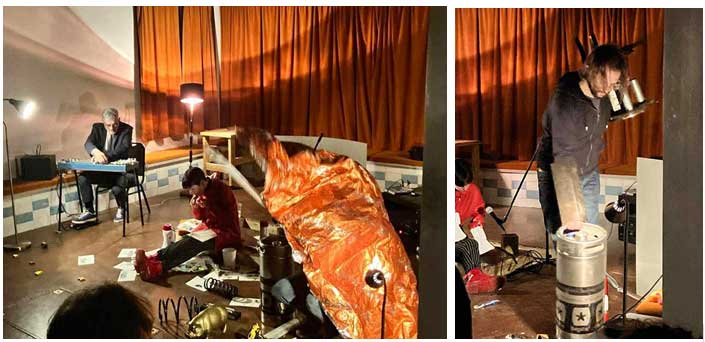
The music they make together has a porous quality; it left me with a sense of things emerging from one another, bleeding across boundaries, like wet watercolour paint might: as it says, more elliptically perhaps, in the text that goes with the album, ‘One piece may be burning, another instantly should. Close the gap.’ Bisset’s lap-steel produces a wide gamut of sounds, from conventional pitches to a whole range of noises, which he articulates in all sorts of unexpected ways. These merge naturally with the noise-based sound-worlds created by Ciccone and Colomb. Sometimes – as in ‘WITHOUT burning’ – the results can almost meet ‘conventional’ expectations: the music can be so understated yet intensely expressive as to make one hold one’s breath. At other times, Colomb’s words leave one with a sense of language emerging, almost by accident, from a world of sound that, until that point, had no need for words. Spellbinding.
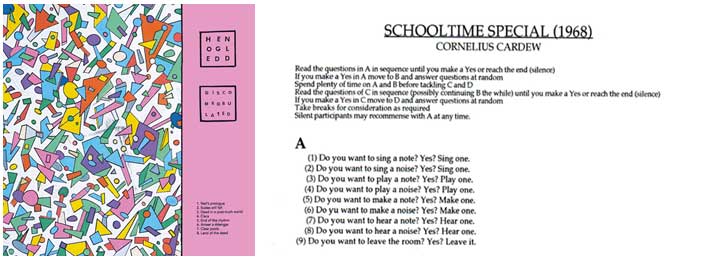
The latest instalment of Dadaistic weirdness (I mean that in a good way, by the way) by Jumble Hole Clough, The Man Holding the Horse’s Hoof, is more than an album: it’s also a photo exhibition and a feast for anyone seeking food for thought. JHC, as any regular reader will know, is the work of multi-instrumentalist and denizen of the Calder Valley, Colin Robinson. Listening to it and perusing the pics has left me wanting to build myself an infinity well – like you do – so that I can go and stand on it (or in it) whenever I feel like it, which will be quite often. In fact, I’m coming round to the idea that everyone should have one. I guess the problem is, how not to crack the mirror when you stand on it, but I’m working on it. The observant among us will notice how the winged squirrel with a bazooka is in fact standing on the head of a laughing frog. You have been warned. And ‘The One-Eyed Matador’ isn’t Juan José Padilla, aka ‘The Pirate’ but a less-than-roadworthy 4×4 heavy-duty artillery tractor. Another brick … from another brickworks. I know it’s obvious, but I love the play on the Pink Floyd title. It’s nice to see that Glasgow’s cone-compromised Duke of Wellington gets a look in, too. And that’s all before we get to Zaphod Beebleagle. I’ve never played Escalado but I could imagine people playing it in Agatha Christie novels. Indeed, I could imagine the plot of one such revolving around it. And I can see how it might scratch the dining table. I hope that all makes sense. If not, it will when you’ve listened to it.
I love the sense of time-shifting phantasmagoria – sometimes it’s the music (as in ‘Salami’) sometimes the words (the ‘Escalado’ again) – and the way that, although there are trains of thought, they don’t necessarily take you to the stations you expect. Do have a listen and, if you’re new to the world of JHC, check out the 50-album back catalogue.
It’s way off-piste – well a bit – in relation to what I usually write about, but I couldn’t let this week go by without a mention of Discombobulated, the latest offering from Hen Ogledd. In case you’re not yet up to speed with them, they’re an alternative/indie quartet comprising of Dawn Bothwell, Rhodri Davies, Richard Dawson and Sally Pilkington. Here, they’re working with a number of collaborators, too, including, as the album notes put it, ‘avant-garde legends, family members, animals and even elements’. The name, by the way, translates into English as ‘The Old North’, a term dating to the Middle Ages and used to describe the area covered by what we now think of as Southern Scotland and Northern England.
What makes it so compelling is the way it tackles the state of the world head on while at the same time sounding fresh, uplifting and optimistic. We’re told to rise up and ‘watch the old systems fall!’ Bothwell condemns capitalism and celebrates resistance in a style she describes as ‘bard rap’. Other lyrics are a mixture of Welsh and English. They deliver an uncompromising message to the ‘gamwn’ (you don’t need a Welsh dictionary to work that one out): ‘the mythical country you claim allegiance to is gone / It was never here.’ For the rest of us, as it says in ‘Dead in a post-truth world’ (it’s a lot funnier than the title might suggest): ‘Amser mynd i’r gwely / Pan mae’r gamwn ar y teledu’. In Welsh, it rhymes. In English, sadly, it doesn’t: ‘When the gammon are on the telly / it’s time to go to bed.’
It would be wrong, though, to leave the impression that this album is all about the words. The music is strong, imaginative and beautifully put together, with a depth of creative energy which enables HO to sustain our interest through the longest track on the album, ‘Clear pools’: rich, varied and at times hypnotic, it runs to just short of twenty minutes (much longer, I should add, than the others).
An obvious comparison – musically and ideologically – would be the solo work of Robert Wyatt. Wyatt fans will love it, but I’m sure there’s a whole new audience out there, too, waiting to discover it.
.
Dominic Rivron
LINKS
Tag der Intuitiven Musik: https://scatterarchive.bandcamp.com/album/tag-der-intuitiven-musik
BLAST is correct: https://johnbisset.bandcamp.com/album/blast-is-correct
The Man Holding the Horse’s Hoof: https://jumbleholeclough.bandcamp.com/album/the-man-holding-the-horses-hoof
Discombobulated: https://henogledd.bandcamp.com/album/discombobulated
Schooltime Special: https://a4-room.com/schooltime-special/
.