

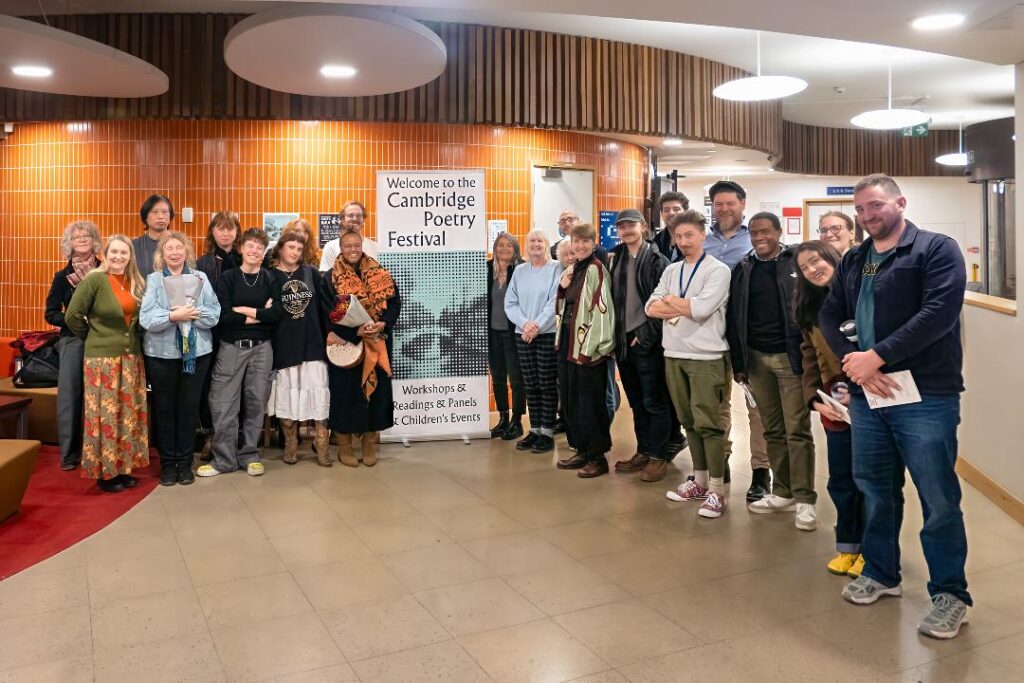
Cambridge Poetry Festival— Film Poems & International Poetry Readings :
Film Poetry Screening of film poems by Olive Mills, Mimi Thompson, Katherine Stockton,
Peter Whittenberger, Daisy Thurston-Gent, Catching Shadows, Emma Grant, C. Moss
Collective, Janet Lees, Jo Gifford, followed by International Poetry Readings by Athambile
Masola, and Ma Yongbo 马永波 and his UK collaborative co-translator, Helen Pletts 海伦·
普莱茨, including the launch of their first bilingual poetry book ‘Night-Shining White’, at
the Cambridge Poetry Festival, 10th October 2026, Cambridge, UK, Planet Earth, The
Universe
https://internationaltimes.it/ma-yongbo-poetry-road-trip-summer-tour-2025-volume-50/
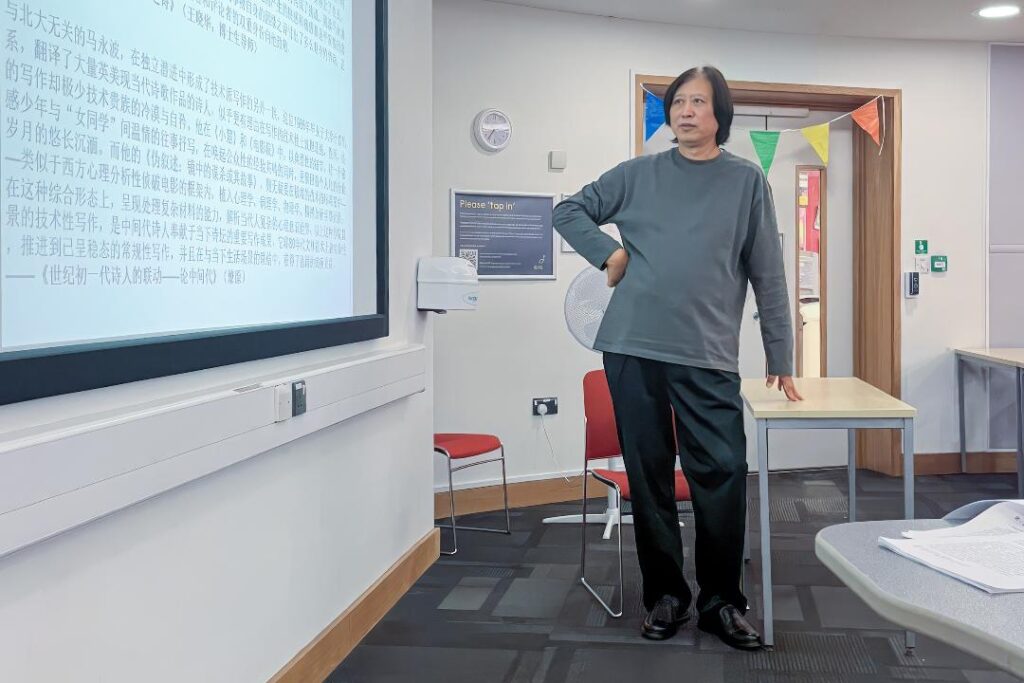
Ma Yongbo 马永波 teaching his Chinese Poetry workshop ‘Objectivist Writing:
Polyphony, Scattered Perspective, and Pseudo-Narrative’, 10th October 2026, Anglia
Ruskin University, Cambridge, UK, Planet Earth, The Universe
Objective Poetics: Revitalising Tradition Through Sino-Western Dialogues
by Helen Pletts
Ma Yongbo’s poetic practice and theoretical frameworks do not merely transplant Western influences; they reinterpret classical Chinese poetics through a cross-cultural lens. By integrating the Eastern wisdom of “unity of heaven and humanity” and “observing things through things themselves” into modernist experimentation, he achieves a creative transformation of tradition. His core contributions can be reframed as follows.
- “Objective Poetics” and Its Subtle Dialogue with Classical Tradition
Ma’s proposed “objective writing” (as discussed in “On the Objectivist Tendencies in Recent Writing”) is often linked to Western modernism (e.g. Pound’s Imagism or Eliot’s “objective correlative” and “impersonality”), yet its essence lies in a modern reinterpretation of classical Chinese aesthetics such as “detached observation” and “the dissolution of self and object.”
Resonance with “unity of heaven and humanity”: Classical Chinese poetry emphasises the dissolution of the self into natural imagery (as in Wang Wei’s “Where the stream ends, I sit and watch the clouds rise”). Ma echoes this through “cold lyricism” and “de-subjectivisation,” concealing the poet’s ego within fragmented narratives and polyphonic imagery and thereby reviving the classical ideal of the “selfless realm.”
Methodological innovation: Rather than replicating classical yìjìng (artistic conception), Ma borrows from Western narratology and phenomenology to operationalise “detached observation” structurally. Through collage, polyphonic narration, and intertextuality, he allows objects to generate meaning autonomously within language. This approach extends the Daoist philosophy of “following nature’s way” while infusing it with modernist textual complexity.
- Western Poetics as a Catalyst for Reimagining Tradition
Ma’s engagement with Western poets such as Pound and Ashbery serves as a “mirror” for reinterpreting Chinese tradition, forging a modernist path for Chinese poetry.
Translation as transcultural mediation: His translations of Stevens, Ashbery, and others are not mere imports but acts of linguistic alchemy. For instance, Ashbery’s fragmented rhetoric is transformed into Chinese-style “imagistic juxtaposition,” echoing the leaps of thought in classical jueju (quatrains).
Polyphony and “poetry as painting”: Although his “polyphonic writing” superficially references Bakhtin’s theory, it subtly mirrors the “scattered perspective” of Chinese landscape painting. By interweaving multiple voices (e.g. the soliloquies of objects and humans in “The Alchemist”), he creates a poetic space that evokes the classical ideal of “strollable, inhabitable” artistry—poetry in painting.
- “Intellectual Writing” as a Modern Extension of Classical Poetics
Ma’s association with “intellectual poetry” is often misread as mimicry of Western rationality, yet it deeply reworks classical Chinese concepts such as “poetry articulates intent” and “poetry arises from emotion.”
From lyricism to speculation: Rejecting sentimentalism, Ma foregrounds language’s self-reflexivity (e.g. probing the “word-object relationship” in “Travelling Through Words”). This transforms the classical notion of “meaning beyond words” into a modern “linguistic ontology,” paralleling Chan Buddhism’s paradox of “not relying on words, yet never abandoning them.”
Reconstructing historical consciousness: His poetic archaeology (e.g. myth and classical allusions) is not mere pastiche but a dialogue between past and present, echoing Sima Qian’s historiography of “exploring the interplay of heaven and humanity” in a postmodern key.
- Revisiting Controversies: Beyond the “East-West Binary”
Critiques of Ma’s “Westernisation” often trap themselves in a reductive East-West dichotomy, overlooking the syncretic nature of his poetics.
“Obscurity” as an aesthetic strategy: The perceived difficulty of his work stems not from blind imitation of the West but from a deliberate rupture with classical “transparent yìjìng.” His defamiliarised language mirrors fragmented modern experience—a contemporary iteration of the classical ideal that “words end, but meaning lingers.”
The invisible presence of tradition: The classical Chinese spirit persists in his poetry as a “hidden gene,” visible in the “artistic blank space” within fragmented imagery or in the interplay of void and substance in narrative delays. To grasp his innovation, one must look beyond superficial Western terminology to his methodology.
Conclusion: Reforging Tradition in the Alchemy of Language
Ma Yongbo’s true contribution lies in placing the core spirit of Chinese classical poetics—the philosophical interplay of self and object, the tension between language and existence—into the crucible of modernist poetry. Using Western poetics as a catalyst, he smiths a contemporary form uniquely rooted in the Chinese language. His work demonstrates that tradition’s vitality lies not in replicating symbols but in transforming them, through cross-cultural dialogue, into creative energy capable of addressing modernity’s crises. This “retroactive innovation” positions his writing as a critical bridge between classical sensibility and postmodernity, offering a distinctive path for Chinese poetry’s global conversation.
17 October 2026
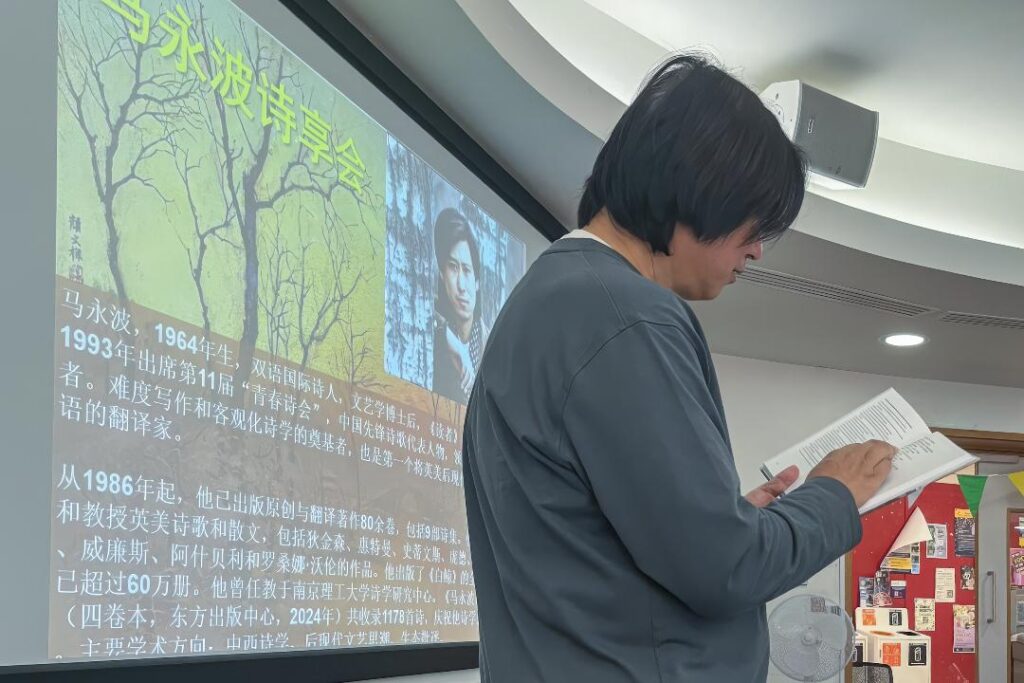
Ma Yongbo 马永波 teaching his Chinese Poetry workshop ‘Objectivist Writing:
Polyphony, Scattered Perspective, and Pseudo-Narrative’, 10th October 2026, Anglia
Ruskin University, Cambridge, UK, Planet Earth, The Universe
Topic: The Objectifying Turn in Contemporary Chinese Poetry, from Subjectivity to Intersubjectivity
题目:当代汉诗的客观化转折,从主体性到主体间性
Main Contents:
主要内容:
Chapter one Poetics of Narrative: Detachment and Immersion
第一章 叙述诗学:超离与深入
- From Vertical Chanting to Horizontal Narration 从垂直的歌唱到横向的叙说
- Restoration and Transcendence 还原与超越
- From Monologue to Dialogue and Heteroglossia 从独白到对话和杂语
Chapter two Poetics of Pseudo-Narrative: Self-Reflexive Awareness in Writing
第二章 伪叙述诗学:写作的自反意识
- The Necessity and Urgency of Advocating Meta-literary Awareness 倡导元文学意识的必要性与迫切性
- The Dissolution of Metanarrative and the Origin of Pseudo-Narrative
元叙述的消解与伪叙述的由来
- Metalanguage Commentary
元语言评说
- Poetry About Poetry
关于诗歌的诗歌
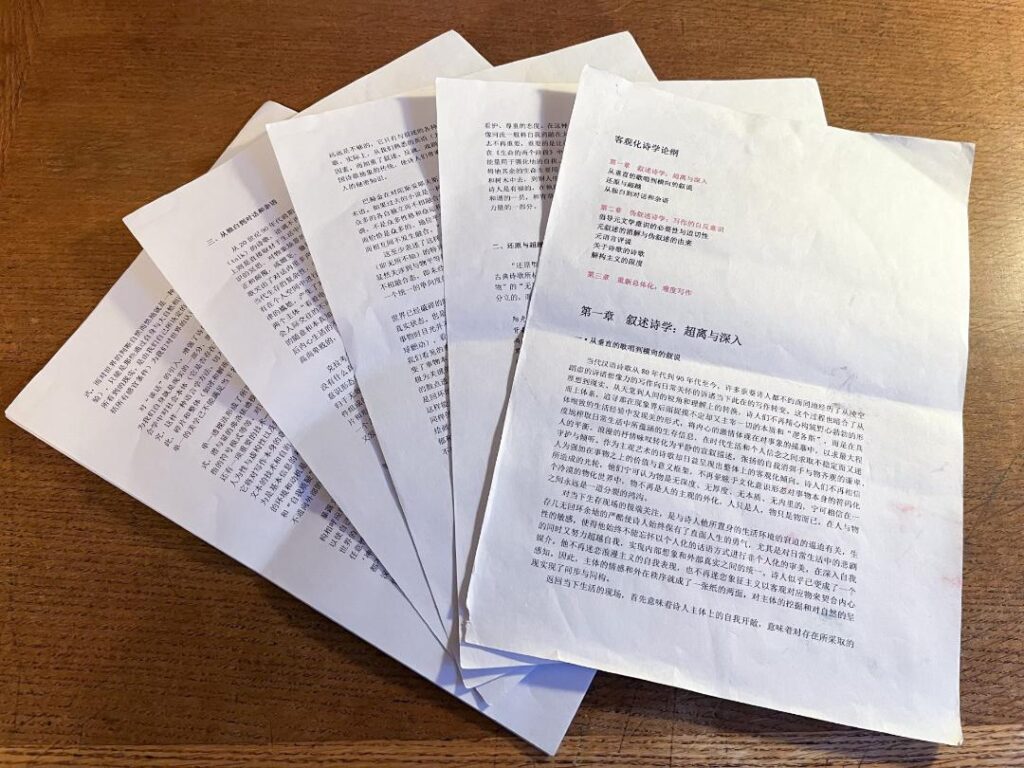
Ma Yongbo’s 马永波 teaching notes for his Chinese Poetry workshop ‘Objectivist Writing:
Polyphony, Scattered Perspective, and Pseudo-Narrative’, 10th October 2026, Anglia
Ruskin University, Cambridge, UK, Planet Earth, The Universe
Objectivist Writing: Polyphony, Scattered Perspective, and Pseudo-Narrative
by Ma Yongbo 马永波
The premise of this essay is not to attempt a typological categorisation or systematic sorting of Chinese poetry, which currently exists in a state of heteroglossia. It is particularly unhelpful to isolate a single attribute of writing, reify it, and either overgeneralise it or wishfully exaggerate it into the mainstream characteristic and aesthetic tendency of contemporary writing, thereby “promoting” it as a universal style based on one’s own preferences. The harm of such an approach outweighs its benefits. Take narrative, for example. As one of many writing techniques, it is no different from lyricism, reasoning, or dramatisation; it is merely a means, not an ontological attribute of poetry. Its prominence is merely methodological, emerging as Chinese poetry moved from the monolithic singing of the 1980s to complex narration. By itself, it is far from adequate for engaging with the complexities of contemporary reality. Only by combining it with the other techniques can we create poetry that truly corresponds to the demands of our era. In fact, if we look at English-language poetry (especially American), it is almost common knowledge that its primary shift has been a reduction in lyrical elements and an increased emphasis on narrative, irony, dramatisation, and novelisation. Perhaps the abstract tradition of Chinese poetry has kept poets universally immersed in obscure metaphysics, unable to extricate themselves, making common sense a secret known only to a few. Some contemporary poets who cling stubbornly to narrative and loudly claim proprietary rights over it are clearly engaging in a power discourse. This is strikingly similar to how other poets in the 1980s engaged in “linguistic occupation,” attempting to monopolise words such as “wheat,” “gold,” “rose,” and “radiance”—and even the entire Chinese dictionary.
Bakhtin described the polyphonic novel thus: if past novels were monologic, dominated by a single unified authorial consciousness, the polyphonic novel is “a plurality of independent and unmerged voices and consciousnesses, a genuine polyphony of fully valid voices. It is not that a plurality of characters and fates makes a single objective world unfold in layers under the author’s unified consciousness; rather, a plurality of consciousnesses, with equal rights and each with its own world, are combined in a certain unity of the event, but are not merged.”
This conveys at least several layers of meaning. First, the subjective consciousness in polyphonic writing no longer possesses the god-like (omniscient) power it held in past literature; it is merely one consciousness among many, neither superior nor inferior to the others. This clearly relates to an attitude of viewing the world on an equal footing with objects. Second, the multitude of consciousnesses (which in poetry equate to multiple contexts) exist in an unmerged state, without being integrated by a meta-consciousness. These consciousnesses (contexts) exist in dialogue; they do not revolve around a unified, one-dimensional theme but rather confront, contradict, echo, argue with, and transform one another.
In Lost Notes and Harbin in December, the distant and the near, the textual and the real worlds are processed synchronously, completing a process of “meaning displacement.” The internationalised symbolism represented by Greece is deconstructively localised—a reduction from universal knowledge to specific experience, an effort to find particularity within universality, which is the exact opposite of the traditional Chinese poetic tendency toward sublimation. This also implies a critique of the utilitarian and illusory connection to the “world,” as well as an alertness to the fact that localisation can also be a reverse pandering to internationalisation. There is no question of one bearing the other or one subsuming the other between the life of the era and the personal context; they simply exist independently. This state of bidirectional separation avoids the loss of particularity caused by personal narrow ambitions and utilitarianism in the sublimation of personal context into collective myths. Within the seemingly plausible yet paradoxical metaphysical rhetoric (which is full of self-reflection), dissonant quotations often suddenly appear, like Mephistopheles appearing in broad daylight. For instance, I frequently incorporate street gossip into my poems, directly including the “words of wisdom” of my son, Ma Yuan. In “Summer of Two Cartoons” from the collection Music Played at Two Speeds, after discussing profound themes such as distance, heaven, and past lives, the poem suddenly shifts to recording Ma Yuan’s exact words from his daily life: “I have a dangerous home. I am in the police station. I haven’t slept all day. I will be unhappy tomorrow. I put on my hat and drink all day.” It is as if half an apple were glued directly onto an oil painting of fruit. Thus, on two different levels—the epistemological and the experiential—dialogue, mutual subversion, and friction are generated. Maintaining a distance from ideological myths, this “suspense” emphasises irony while demonstrating an attitude toward existence: the world is not unified into a whole.
The non-merging of elements is not only the true state of existence but also the true state of human cognition. Contemporary photographic theory tells us that there is no fixed perspective when observing things; the human eye constantly jumps from one viewpoint to another (saccadic movement)—look, look away, look back—a scanning gaze. If we add the factor of the passage of time, what we see must be a superposition of many different impressions, because time has quietly altered the object itself between two scans. This inspired David Hockney’s photo collages. This leads us to another technique crucial to polyphonic writing: scattered perspective. When I first considered this new method of observation, I had not yet encountered Hockney. My scattered perspective was inspired by traditional Chinese scroll paintings. Unlike the single-point depth perspective of Western painting, it is a dynamic, multi-point perspective that moves in various directions and along various paths according to certain rules, organically combining multiple viewpoints on a single canvas. A person on a distant mountain path and a figure at the bottom of the canvas have almost the same volume, and several events unfolding linearly in time are often juxtaposed on the same plane. We can also see this multi-perspective technique in modern Western painting, such as in Giorgio de Chirico’s The Enigma of a Street. The eerie, unstable atmosphere of danger stems from this multiple perspective; in fact, the ominous shadow at the street corner, the little girl rolling a hoop, and the building that is almost just an archway do not exist within a single perspective.
Any technique in art is not merely technical; it is inseparable from the artist’s worldview, their attitude toward truth, their way of understanding the world, and their moral consciousness. My poetic pursuits in the mid-to-late 1990s were built upon the foundation of truth and objectivity. This began as a moral consciousness of recognising and speaking the truth, then became an aesthetic stance, and finally manifested in linguistic methods. Misty Poetry of the early 1980s, having completed its historical mission, was still written within classical linguistic conventions. It assumed a clear, transparent world that could still be grasped by language, and it used language to wrestle with existence, especially in confrontation with ideology. However, with cultural over-accumulation and the growing influence of the philosophy of language, language has transformed from a tool for understanding the world into the sole fact of presence. One’s attitude toward language is one’s attitude toward the world. Clearly, Misty Poetry failed to complete this teleological shift of language in poetics; thus, what it offers us may still be entirely traditional, such as “poetry expressing intent” (shi yan zhi), where “intent” could be personal moral integrity or the collective unconscious.
In recent years, my writing has gradually found a new resource: a poetry based on everyday talk. The tone is no longer the arrogant eloquence of the 1980s but has been replaced by the casualness of idle chat. Thematically, it draws directly from conversations in life, excavating the vast amount of existential information they contain. Talk is grafted onto or juxtaposed with (heterogeneous symbiosis) meditations on self and knowledge, and descriptions of objects and scenes. Ideas are constantly revised and subverted, or mutated, substituted, and transitioned into other ideas, rather than solidifying into isolated “presences.” This kind of poetry highlights the multi-voiced interrogation, struggle, and ebb and flow within dialogue (novelised poetry). If poetry is to bear the complexity of contemporary existence, it must rely on the authenticity of experience and the hereness of discourse found in the novel. Talk occurs in both personal spaces and public spheres. The tension between the collective constraints of public spaces and the awkwardness of individual private self-discipline produces confrontation and mutual suspense, as seen in “Eye Hospital: A Conversation.” In “Spring Conversation,” two subjects “talk while watching television, not looking at each other,” reflecting the pervasive intrusion of reality’s sounds and the incommensurability of interpersonal communication in modern society. “Autumn Lake Conversation” juxtaposes the affectation and rhetorical nature of metaphysical talk with the casualness and authenticity of natural objects, performing a displacement between the inner and outer worlds and highlighting the impossibility of inner life after the disintegration of ideology (inner life being various beliefs, concepts, and values). Human inner life is neither noble nor base; it is nothing more than the spring ice flow of desires, impulses, and “fragments of ancient beliefs.” In “Autumn Lake Conversation,” I wrote: “Why do you call these: the autumn lake, the leaves, our / wrinkled ears, the thoughts between breath and wind / your inner world…” The so-called self is equivalent to “stones, grass, fish in the water,” or “sticks, numbers, islands.” Therefore, we have reason to believe that any unified, continuous inner (spiritual) activity is a fictional “omnipotent state”; nothing is truly “in control.” Thus, the notion of poetry as an “objective correlative” becomes highly suspect. The fragmentary nature of current poetry, with its seemingly artificial and subjective colouring, is actually an objective correlative to the fragmentation, discontinuity, and fluidity of human consciousness—an alignment with the “brain’s circuit diagram.”
The reality that humans can process is the reality they can grasp: the reality in their minds, the reality in language. Language is the sole presence of reality. Therefore, representing the actual state of conscious activity is also a way of respecting objective truth. A poem that appears highly subjective on the surface may actually be highly objective. The introduction of “talk” enhances the sense of immediacy in poetry. My approach to reality is not to depict it face-to-face, because we ourselves are part of reality, and a part cannot perceive the whole. Thus, starting from talk is akin to the sociological shift from studying social ontology to studying people’s various reactions to society—that is, what they say—as a linguistic method. Approaching reality and existence can only be done by approaching speech (parole), rather than language (langue). Here, fragments and wholes (like ice and thawing water), solidity and fluidity, the personal and the public are all blended together. A singular aesthetic can no longer satisfy a reality in which various social discourses violently conflict.
The single-point perspective creates so-called depth, leading to binary oppositional thinking: the dialectical mode of essence and appearance, the Freudian mode of latent and manifest, the hermeneutic mode of inner and outer, the existential mode of real and unreal, the semiotic mode of signifier and signified, and so on. To eliminate these subjective, stubborn modes of thinking, besides scattered perspective, there is another important technique: pseudo-narrative. Unlike traditional narrative, it focuses on exposing the artificiality, fictional nature, and impossibility of the narrative process. It is self-negating, self-obstructing, and process-oriented, incorporating the consciousness of writing itself into the writing process. By revealing that poetry is an invention, it directs attention to the technique and autonomy of the text, or to the problem of understanding. Readers are frequently presented with incomplete or negated stories that are generally considered basic information. They are forced to constantly ask, “Who is speaking?”, “What are their circumstances and motives?”, and “Are they reliable?” Ihab Hassan defines this characteristic of “unspeakability” and “self-questioning” as “uncanny interiority,” meaning the text’s self-reference. The text’s meaning does not point to an external objective world but exists only within the text itself, merely revealing the process of the text’s formation.
Exposing the constructed nature of the text, the generativity of language, and the rhetorical nature of the text echoes the deconstruction of ideological discourse. All ideological discourse strives to make its daily behaviours appear as natural facts, making itself a “second nature,” turning certain behavioural norms into self-evident laws of natural order. In fact, even the most natural evaluation of the world relies on the customs and norms of its group culture. Therefore, exposing the symbolic nature, arbitrariness, and historicity of the text produces an “intertextual” writing. “A text is not a line of words releasing a single ‘theological’ meaning… but a multi-dimensional space in which a variety of writings, none of them original, blend and clash.” Extensive parody, quotation, and strategic misreading have appeared in contemporary Chinese poetry. “Resume: Akhmatova” reveals the textuality of history and incorporates the author’s personal voice; you will find two different voices interrogating each other. “Local Reality: Necessary Fiction” demonstrates the text’s own generative process, where a massive amount of existential information squeezes metaphysical speculation to ensure the text’s reliability. The continuous exposure of the artificiality of textual construction remains necessary in the current historical context. The recent phenomenon of cross-genre writing indicates that poets have realised that literature must become non-literature, and poetry must become non-poetry, to handle literature and reality together, achieving a mutual blurring and subversion. Poets have shifted from caring about the closure, self-sufficiency, and purity of poetry to openness, absorption, and enrichment; they have turned to the relational fields of word and object, text and context, individual and history. This is undoubtedly a demand for poetry’s self-renewal.
My initial awareness of writing itself entered my work in the poem “Pure Work.” This poem contains a potential subtext and revolves around the confusion and illusion produced by writing around that subtext. It also considers the relational field of word and object, specifically their mutual transformation. In “Pseudo-Narrative: Murder in the Mirror or Its Story,” we can at least discover several levels of consciousness: a murder; a play based on a murder; a story where the actor, the murderer, and the narrator are the same person; and the author’s level of identity. It is as if a person is half-asleep watching television, playing a mediocre opera, and in a daze weaves the fragments they hear into their own dreams of childhood and love. There is an interaction between reality (the reality on TV, the pseudo-reality) and the dream. The deliberate confusion and covert substitution of character identities, the incompleteness of the plot, and the inexplicable details are all carefully designed. It offers at least one revelation: poetry writing does not have to rely on inspiration (the incompetence of waiting by a stump) and passion; it can instead rely on precise, workmanlike operation. The contingency and irrelevance of events are highlighted. This is because so-called laws and unity come from elimination, artificial arrangement, and imposition. Humans often mistake the logic of language itself for the connections between things. This relates to the question: can humans truly recognise truth? Perhaps what humans can grasp is never truth itself, but a combination of truth and concept—fact. Language cannot even reproduce any intermediate colour in the spectrum from violet to red, nor can it even say where violet begins. The ambiguity of things and their boundaries forces language into silence.
In this fundamental sense, humans cannot recognise truth. What humans can recognise is so-called “reality,” and reality is often a cultural and power fiction, a reality within language. In modern Chinese, due to cultural accumulation, words are no longer the unity of signifier and signified as they were in their original naming state; instead, they exhibit an ever-widening separation. Now, when we write about the sun, we are no longer writing about that celestial body but about the culture surrounding the sun—eternity, justice, power. Words can reveal neither human existence nor the existence of things. But “intransitivity” is only a tendency; complete transitivity and complete intransitivity are both myths. On the knot of symbols, the darkness of the entity will eventually fall. Loosening and clearing the semantic hardened layers of culture and ideology becomes a necessary means to reach the authentic object. Thus, writing becomes a process of continuously excluding meaning, a recoding of the various meanings of words. It does not reject meaning but chooses all-encompassing meaning (since meaning comes from selection), or uses it through deviation and displacement. Examples include “My and Ma Yuan’s Linguistic Experiment” and “Communicating Vessels: A Wrongly Solved Physics Problem.” The text becomes the venue and environment for the literal, derived, and rhetorical functions of words, as well as pure signifier play. In 1994, I wrote in a short essay about a writing strategy called “recording,” stating that “things presented in their authentic state are poetry,” and we only need to record them. Things in their authentic state are actually things in the pre-cultural stage, things stripped of cultural veils. This aligns with Roland Barthes’ ideas and answers the major poetic question of the source of poetic meaning in contemporary life. We used to think that poetic things were things with “meaning,” metaphors (metaphors for personal sentiments or the moral state of the era), or symbols, like “roses,” “wheat,” or “blue moons.” Life is elsewhere. Poetry is also elsewhere—in the distance, the Middle Ages, Greece, or even the Russian-Soviet “Silver Age” where poets were universally persecuted. This led to a widespread anaemia and pallor in Chinese poetry, almost losing the ability to handle the complex experiences of contemporary existence. If my argument holds, then precisely these things presented in an inauthentic state are the least poetic. This undoubtedly changes the connotation of “poetic meaning.” Things themselves are neither poetic nor unpoetic; as long as you can grasp the thing itself, it is poetic. To touch contemporary existential reality, this “unveiling” is still necessary.
This essay offers only a preliminary analysis of the writing of the mid-to-late 1990s from the perspective of technical characteristics. In reality, beyond the application of these techniques, there are changes in the poet’s working methods (from improvisational epistemological writing to deliberate operational methodological writing) and changes in the understanding of the ontology of poetry (from originality to intertextuality, from poetry pointing to non-poetry), and so on. As I wrote in a note, “We cannot change the world, but we can change the way we look at the world. A change in method may lead to a change in ontology.” Contemporary Chinese poetry is being rewritten and updated in advance by the very act of writing, without a prior tradition. No “preset posture in advance” or “retrospective stance after the fact” can reveal more than this concrete writing.
22 January 1998
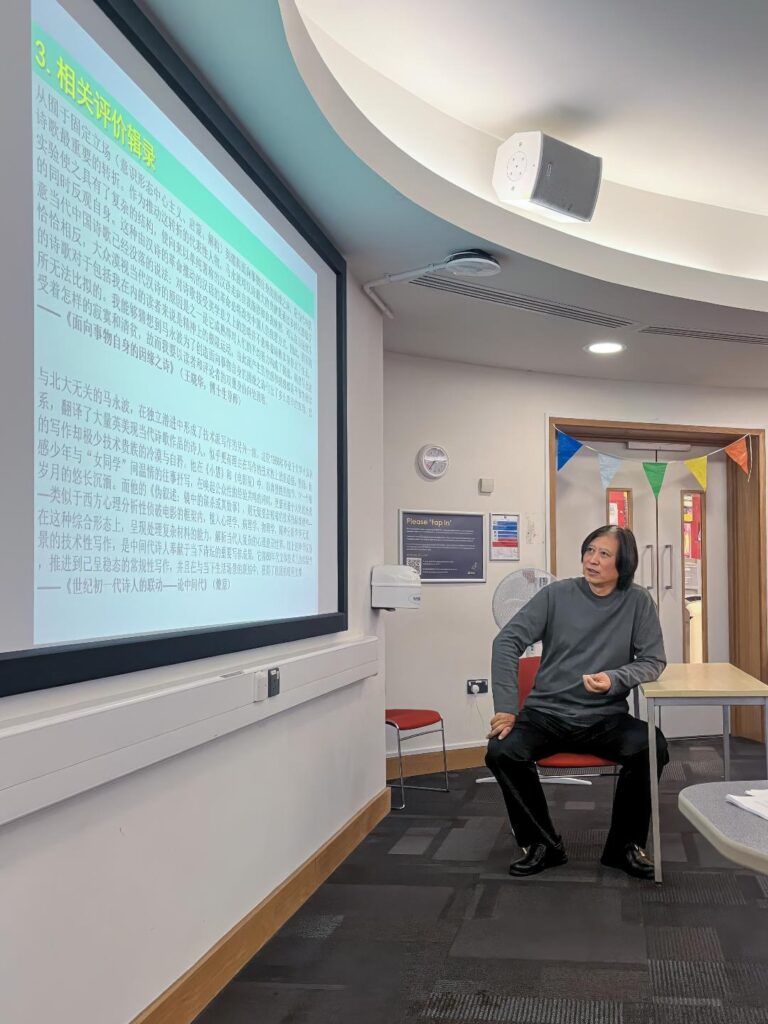
Ma Yongbo 马永波 teaching his Chinese Poetry workshop ‘Objectivist Writing:
Polyphony, Scattered Perspective, and Pseudo-Narrative’, 10th October 2026, Anglia
Ruskin University, Cambridge, UK, Planet Earth, The Universe
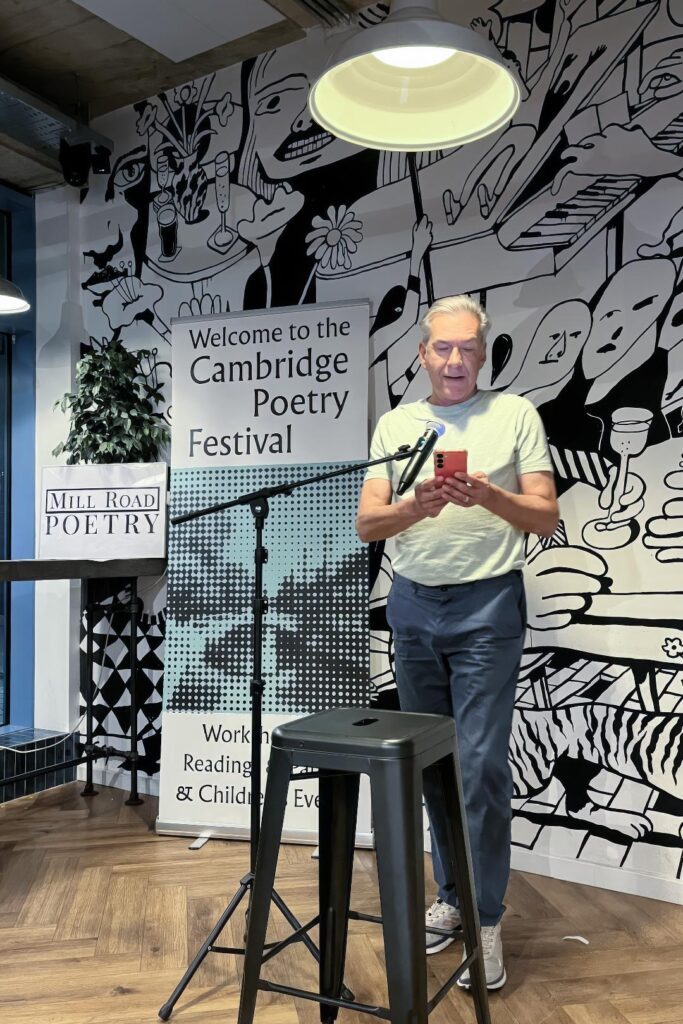
Jeremy Hubbard attended the Chinese Poetry workshop—he was expecting a bilingual
presentation and so he wrote us a wonderful poem which he read at ‘The Poetry Beast of
Hybridness, CB1 & Mill Road Poetry’ A Cambridge Poetry Festival open-mic event at The
Handsome Prince, 6-8 King Street, Cambridge CB1 1LN, 13th October 2026, Cambridge,
UK, Planet Earth, The Universe
https://internationaltimes.it/ma-yongbo-马永波-from-subjectivity-to-intersubjectivity/
剑桥诗友杰罗米·哈伯德为我客观化诗学讲座写的诗,并在”英俊王子”酒吧朗读:
The Chinese-Language Poetry Workshop
(for Ma Yongbo 马永波 and Helen Pletts 海伦·普莱茨)
中文诗歌工作坊
(为马永波与海伦·普莱茨而作)
I understand
nothing
but I love the sounds
of Ma Yongbo’s expressive voice
the unfamiliar phonemes
inflections
intonations
the visual mechanics
like bamboo scaffolding
of the pictographic script
on-screen
its ancient technology
beautiful to see
though I understand
nothing.
I understand
the attentiveness
of the mainly Chinese audience
recognise their desire
to connect with another soul
to feel see hear
a little of what he does
to have a sense of what’s important
to him
to listen to his ideas
to know a little of his
interpretations
of life
to compare their own
interpretations
to play with all that
I understand.
I understand
the other sounds
of human existence
we can hear
through the open door
a plain-speaking sonic backdrop
the first faint backwash
on an artist’s canvas
vague
yet intimate
a baby’s cry
carries through
from the corridor
a cry I recognise
so expressive
how I feel
on waking
most mornings
here I am
I am still here
I am never still
I am in need
always
I am
hear
me
understand.
by Jeremy Hubbard
中文诗歌工作坊
(为马永波与海伦·普莱茨而作)
The Chinese-Language Poetry Workshop
(for Ma Yongbo 马永波 and Helen Pletts 海伦·普莱茨)
我什么也听不懂
但我喜欢
马永波富有表现力的嗓音
那些陌生的音素
抑扬
语调
还有屏幕上
象形文字的
视觉构造
像竹制脚手架
那古老的技术
美得令人目眩
虽然我什么
也听不懂。
我理解
以中文为主的听众
那份专注
我认得出他们的渴望
渴望与另一个灵魂
产生联结
去感受去看去听
他所经历的一小部分
去触摸
对他而言重要的东西
去倾听他的思想
去了解一点他的
生命诠释
再与自己的
相互比照
把这一切
拿来玩味
这一点我懂。
我也听懂了
另一些声音
人类存在的声响
从敞开的门缝
渗进来
一片质朴的声学背景
像画家画布上
最初那层淡淡的底色
模糊
却亲密
走廊里
传来一个婴儿的哭声
我认得这哭声
如此富有表现力
那就是我的感受
每个清晨醒来时
我就在这里
我依然在这里
我从不安息
我总有所求
永远如此
听见
我
理解
我。
——杰罗米·哈伯德
海报设计——安珀·普莱茨
朗诵会主持人——海伦·普莱茨
主要参与者——CB1与Mill Road 两个诗歌小组
我朗读了双语版Eternal Day,海伦和我分别朗读了她的how to lose a poet in Heffers 的双语报
At the Handsome Prince — For Jeremy Hubbard
在英俊王子酒吧——致杰罗米·哈伯德
October 10, at Anglia Ruskin,
where you once worked. I see you sitting in the back row,
for two full hours, watching a human-shaped space
pace before the projection, gesturing,
making low grumbling sounds,
like a bear roused too early from hibernation, complaining.
He has spent long years licking his own paws.
The manners of an English gentleman surprise me somewhat—
not understanding a single Chinese character, yet sitting quietly
for two whole hours. How exhausting that must be.
October 13, we meet again at the Handsome Prince.
This time, you bring a poem written for Helen and me.
You read it aloud yourself; I can understand most of it.
Yet I feel I am worse off than you—
precisely because I can understand a part,
I cannot, as you do, focus only on form
and take pleasure in it. I always want to grasp the whole,
including all the poets’ readings that evening.
This wearies me considerably. Yet as for manners,
I am no less composed. I prop my chin in my hand,
affecting a thoughtful, listening pose.
I clap along, unhurried in rhythm.
Fragments of speech drift into my left ear
but cannot find their way out the right. They
mix inside my head like chemical slides
into a monster with many mouths,
all speaking at once, many life stories
placing me simultaneously within and without.
So from time to time I look toward the street corner beyond the window.
Double-decker buses come and go. Pedestrians
pause now and then to curiously examine the poetry reading poster,
but no one pushes open the door and comes in.
I enjoy this endlessly—watching those bright,
moving two-storey buildings, the passers-by
with their swaying expressions upon the glass.
Night falls quickly. For four full hours
I maintain the quiet attentiveness
an Eastern gentleman ought to possess.
I even drink a small glass of “Smiling Face,” and,
for the first time in my life, take the initiative to embrace a woman—
lovely Catherine—feeling that we are
flesh and blood, not human-shaped spaces
and chemical sounds. This gives me considerable pleasure.
Thank you for your poem, dear Jeremy. Thank you for an evening
that has passed, yet will never fade.
Five in the morning, 15 October 2026
Response Poetry written and translated by Ma Yongbo 马永波
在英俊王子酒吧——致杰罗米·哈伯德
At the Handsome Prince — For Jeremy Hubbard
10月10号,在安格利亚鲁斯金
你工作过的地方,我看见你坐在后排
整整两个小时,你看着一个人形空间
在投影前走来走去,比比划划
发出一些低沉的咕噜声
像一头从冬眠中被过早惊醒的熊瞎子在抱怨
他靠舔舐自己的手掌度过了漫长岁月
英国绅士的修养让我有些吃惊
听不懂一个汉字,却安静地坐了
整整两个小时,该有多么疲惫
10月13号,我们在英俊王子再次相遇
这回,你带来了一首写给我和海伦的诗
你亲自朗读,我能听懂它的一大部分
可我觉得,我比你还要凄惨
正因为我能听懂一部分
我就无法像你那样,只集中于形式
并感到愉悦,我总想弄明白全部
包括那天所有诗人们的朗读
这让我相当疲惫,可就修养来说
我一点不差,我托着腮帮子
做出一副若有所思倾听的模样
我跟着鼓掌,节奏不紧不慢
那些只言片语飘进我的左耳
却无法从右耳冒出来,它们
像化学薄片一样在我脑袋里
混合成一个怪物,身上众多的嘴
同时说话,众多的生活故事
让我同时置身其中又置身其外
于是,我不时看向窗外的街角
双层巴士来来去去,行人
不时停下来好奇地打量诗会海报
但没有一个人推门进来
我乐此不疲,观察那些明亮的
移动的两层小楼,那些行人
在玻璃窗上摇曳的表情
夜晚来得真快,整整四小时
我保持住了一个东方绅士
应该有的安静和专注
还喝了一小杯”笑脸”,而且
平生第一次主动拥抱了女人
可爱的凯瑟琳,感觉到我们
都是血肉之躯,而不是人形空间
和一些化学的声音,这让我相当愉快
谢谢你的诗,杰罗米,谢谢一个
已经过去但永远不会消逝的夜晚
2026年10月15日晨五时于海伦寓所
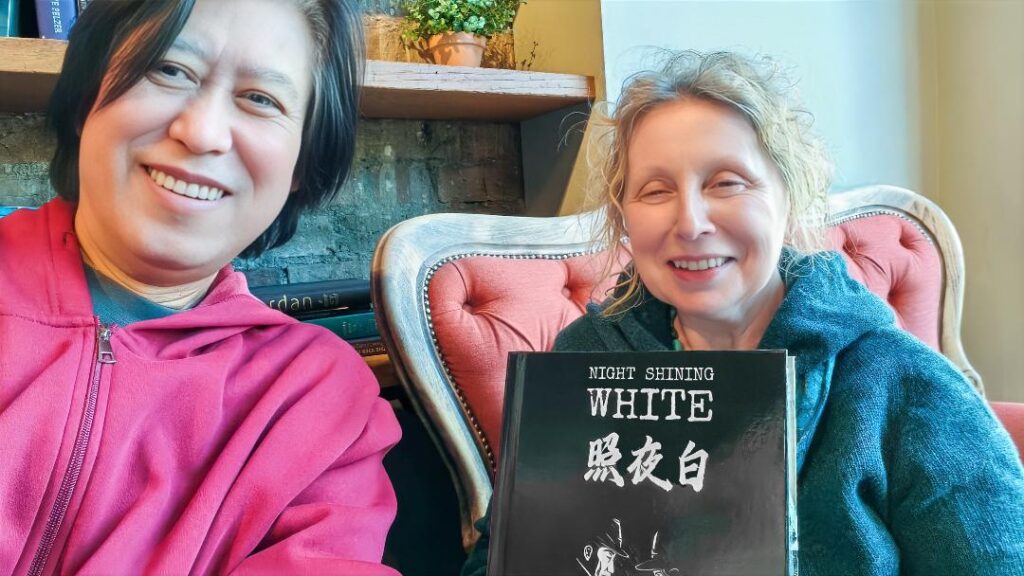
Ma Yongbo 马永波 and Helen Pletts 海伦·普莱茨 together in a Cambridge Cafe on the
11th October 2026, the day after launching their bilingual poetry book, ‘Night-Shining
White’, together, at the Cambridge Poetry Festival on 10th October 2026 at Anglia Ruskin
University.
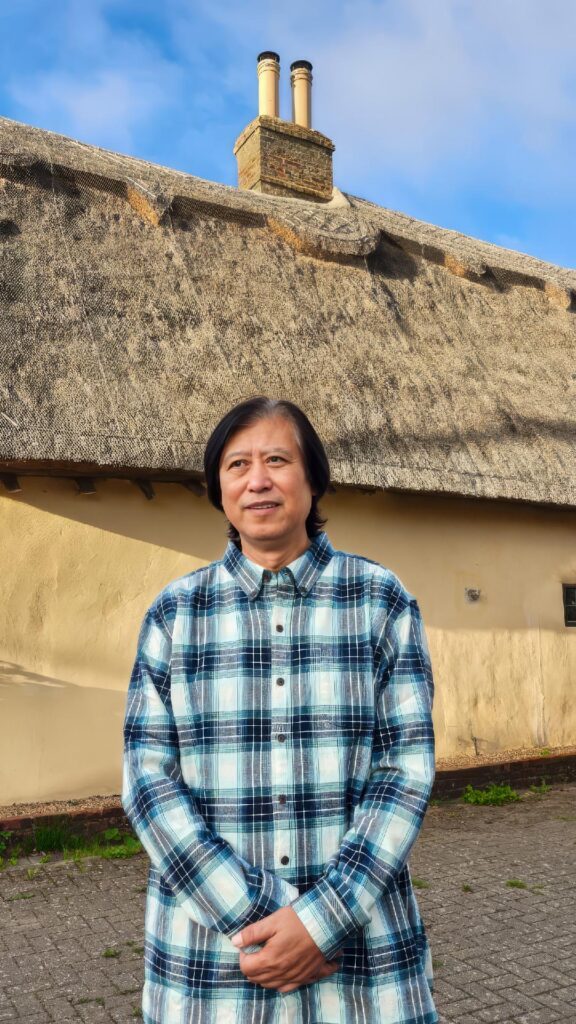
Ma Yongbo 马永波 5th October 2026, his first day in Cambridge UK, Planet Earth, The Universe
the poet is smiling in yellow light and thatch—for Yongbo
诗人在黄光与茅草之下微笑——致永波
this house has a tiny window squeezed through a yellow wall
the four sections of windowpane blink their awareness
while a blue shirt crosses more squares and the poet’s shoulders.
In the light the yellow has taken ripened cornfields and deserts
and worn them all together, as if more yellow is an expectation
once the earth has found her shade and hung it like an emblem
warming its own hearth. We have lit the sky with words
and they keep rising wearing secret orange wings
which cannot be extinguished
11th October 2026, midnight, on thinking about Yongbo’s first day here in the UK, 4th October, he was wearing a new blue shirt, a gift from me, walking past a very old small thatched cottage with painted yellow walls.
Response Poetry by Helen Pletts 海伦·普莱茨
Response Poetry translated by Ma Yongbo 马永波
诗人在黄光与茅草之下微笑——致永波
the poet is smiling in yellow light and thatch—for Yongbo
这房子有一扇小窗,挤在黄墙上
四块窗格眨动着感知,
一件蓝衫掠过更多方格和诗人的肩头。
在光中,这黄色收纳了成熟玉米田与荒地,
将它们一并披裹,仿佛更多的黄,本就是一种期许——
当大地寻得自己的色调,当作徽章悬挂,
烘暖自家的炉膛。我们以词语点亮天空,
们持续升腾,携带隐秘的橙色翅膀,
永不熄灭。
2026年10月11日,午夜,想起永波初抵英国的10月4日,他穿着我送的新蓝衬衫,走过一座极老的墙漆成黄色的茅屋
海伦·普莱茨
The English Thatch Cottage 英国茅屋
Autumn rain hastens the rotting of thatch,
darkens its colour—the leaky roof,
the head of the bed with no dry place left,
the old quilt, cold as an iron plate,
the child resisting hunger with sleep,
and oneself, as thin as grains of rice.
If placed in the same plight,
could you still spare a thought for other’s fate?
Is the dream of “ten thousand broad mansions”
a natural response of the human heart?
As fellow realists, we know:
the romantic thatch, the jackdaw in the chimney—
these are but love of the house, not its hardship,
a fondness for the image, not the thing.
Fortunately, this October in the Cambridge countryside
has not been endlessly wet, but bright with sun,
falling on the thatch, on the sloped roof,
on the small chimney, like a golden promise.
At night, only the fragrant autumn mist
drapes the fields, restored to black, over the roofs.
And I, gazing only at the narrow windows,
admire their outward look, with no wish to enter.
Inside there is only the hearth, and quiet villagers,
like the furniture, hidden decay, and cold dust.
First draft at midnight, 12 October 2026; revised at four in the morning, 13 October, at Helen’s residence in Cambridge.
Response Poetry written and translated by Ma Yongbo 马永波
英国茅屋 The English Thatch Cottage
秋雨会加快茅草的腐烂
浸深它的颜色——漏雨的屋顶
床上没有一寸干爽之地
旧棉被,铁板一样冰冷
孩童,以假睡抵御饥饿
而自己,则如饭粒一样瘦削
倘若身陷这般困境
你是否还能惦念他人的命运
安得广厦千万间的理想
是否属于一个人本然的反应
作为同样的现实主义者
浪漫的茅草,烟囱里的寒鸦
不过是爱屋及乌和叶公好龙
幸运的是,今年十月的剑桥乡村
并没有阴雨不断,而是阳光明媚
落在茅草上,落在坡屋顶上
落在小小的烟囱上,有如金色的应许
夜里,也只有芳香的秋雾
将整片恢复成黑色的田野披覆在屋顶之上
而我,只是望着窄窄的窗户
欣赏着它们的外观,无意踏入内里
屋里不过是壁炉,和家具一样
安静的人,暗中的腐朽,以及寒冷的灰尘
马永波,2026年10月12日午夜初稿,13日晨四时修订于剑桥海伦寓所
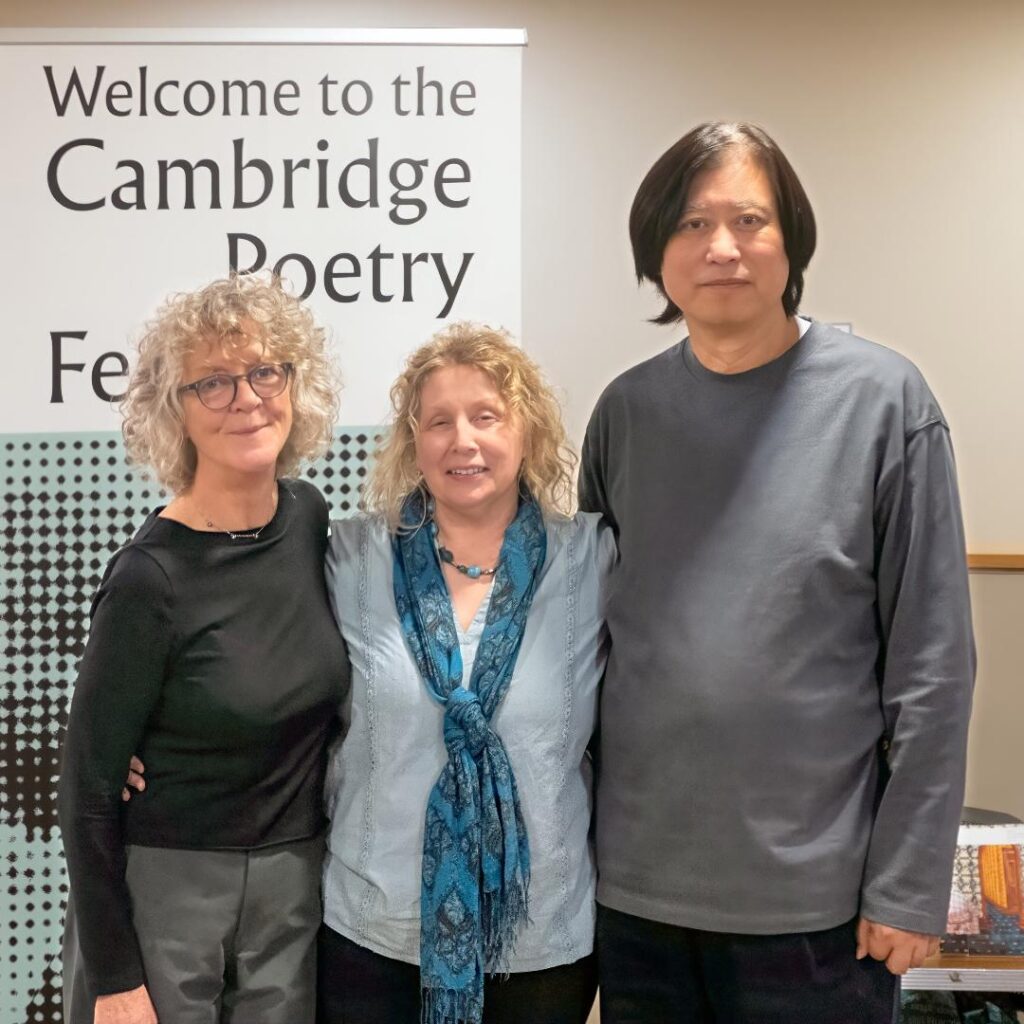
珍妮特·丽兹, Helen Pletts 海伦·普莱茨 and Ma Yongbo 马永波, close friends meeting
for the first time at the Cambridge Poetry Festival 2026.
Janet Lees’ 珍妮特·丽兹 Film Poem ‘House of Water’, incorporating the Chinese language version read by Ma Yongbo 马永波, featured at the Cambridge Poetry Festival on the 10th October 2026.
Janet Lees’ 珍妮特·丽兹amazing black and white photography accompanies the poetry of Helen Pletts 海伦·普莱茨 and Ma Yongbo 马永波 in their first bilingual poetry book together ‘Night-Shining White’, Published by Ingrid Wilson, Experiments in Fiction, also launched on the 10th October 2026 at the Cambridge Poetry Festival 2026.
NIGHT-SHINING WHITE — HARDBACK https://www.waterstones.com/book/night-shining-white/helen-pletts/ma-yongbo/9781066682812
NIGHT-SHINING WHITE — PAPERBACK https://www.waterstones.com/book/night-shining-white/helen-pletts/ma-yongbo/9781066682812
All images and poetry under individual copyright © to Ma Yongbo 马永波 and Helen Pletts 海伦·普莱茨
.