
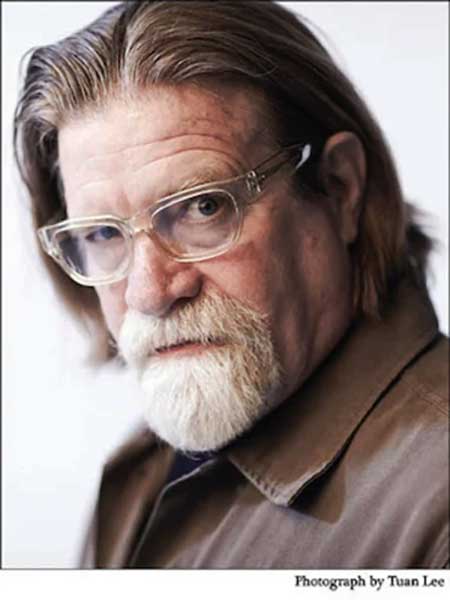
Photography has long occupied an unusual position between documentation and artistic interpretation. It possesses the apparent authority of a record, yet its ability to select, arrange and transform visual information makes it equally capable of constructing an imaginative understanding of the world. Few contemporary photographers have explored this relationship with the sensitivity and visual ambition of Michael Eastman. Through an extensive photographic practice concerned with architecture, interiors, landscapes, animals and the material traces of human occupation, Eastman has developed a distinctive visual language in which the physical environment becomes a means of examining memory, cultural identity, historical change and the passage of time. His photographs invite consideration not simply of what a place looks like, but of what it has experienced and what remains after the people who once gave it meaning have disappeared.
Born in St Louis, Missouri, in 1947, Eastman belongs to a generation of American photographers whose understanding of the medium was shaped by the continuing dialogue between traditional photographic craftsmanship and the expanding possibilities of contemporary visual art. His education included study at the University of Wisconsin, although he is principally recognised as a self taught photographer. His development as an artist was informed by a sustained engagement with the history and philosophy of photography, particularly the work of Edward Weston and Ansel Adams. These influences are significant because both photographers demonstrated that the camera could transform apparently ordinary subjects into complex visual experiences through a rigorous understanding of light, form, composition and tonal relationships.
Eastman’s early interest in photographic discipline provided the foundation for a practice that would gradually become increasingly concerned with colour, surface and architectural space. Rather than treating photography exclusively as a means of recording external reality, he developed an approach in which the act of looking became an exercise in discovering the emotional and aesthetic possibilities contained within familiar surroundings. His photographs suggest that beauty is not necessarily dependent upon ideal conditions. It can emerge from damaged plaster, faded paint, abandoned furniture, weathered timber and the irregular surfaces of buildings that have endured decades of use.
This understanding of beauty is central to Eastman’s artistic identity. His subjects frequently possess an appearance of incompleteness. Rooms are empty, walls are deteriorating, decorative features have lost their original splendour and architectural details appear suspended between preservation and disappearance. Yet these conditions do not render his photographs merely descriptive records of decline. Instead, they provide the material through which he investigates the relationship between physical deterioration and the persistence of cultural memory.
An important aspect of Eastman’s achievement lies in his ability to make architecture appear psychologically expressive. In conventional architectural photography, the building is frequently presented as an organised object whose proportions, construction and decorative qualities are intended to be understood clearly. Eastman approaches the subject from a different perspective. Although his compositions demonstrate considerable attention to architectural geometry, symmetry and spatial relationships, the buildings are not presented simply as examples of design. They become environments containing evidence of human experience.
A room photographed by Eastman can suggest an entire social history without requiring the presence of its former occupants. The arrangement of furniture, the condition of the walls, the quality of the natural light and the survival of decorative objects provide clues to the lives that may once have unfolded within it. The absence of people becomes particularly significant because it encourages the viewer to imagine their presence. An empty chair, for example, may function as more than a compositional element. It can suggest waiting, departure, domestic familiarity or the interruption of an ordinary routine.
This ability to evoke human presence through apparently unoccupied spaces gives Eastman’s work an unusual emotional complexity. His photographs are neither straightforward architectural studies nor conventional historical documents. They exist between these categories, combining the precision of documentary observation with an atmosphere more commonly associated with painting, literature and the visual traditions of romanticism.
His engagement with Havana, Cuba, represents one of the most important and recognisable chapters of his career. Beginning in the late 1990s, Eastman returned to the city on several occasions, photographing its interiors, façades, staircases and architectural details over a period extending into the following decade. The resulting body of work became internationally recognised for its extraordinary attention to colour, decorative richness and the visible consequences of historical change.
Havana offered Eastman an environment in which different periods of architectural and cultural history existed in close proximity. Its buildings reflected colonial influences, European decorative traditions, Art Deco design and the distinctive architectural ambitions of the early twentieth century. Many interiors retained evidence of considerable former wealth and refinement, although the passage of time and changing economic circumstances had transformed their original appearance.
Rather than attempting to conceal these changes, Eastman made them fundamental to his photographic interpretation. Peeling surfaces, faded colours and damaged ornamentation became essential visual characteristics. The contrast between architectural grandeur and material deterioration produced images in which historical memory appeared physically embedded within the environment.
The importance of these photographs extends beyond their aesthetic qualities. They offer a visual record of architectural spaces at a particular moment in their existence. Buildings are not static objects. They are altered by political circumstances, economic conditions, patterns of occupation, environmental exposure and the changing requirements of everyday life. Eastman’s photographs make these processes visible while preserving details that might otherwise disappear through renovation, neglect or demolition.
Nevertheless, it would be misleading to interpret his Havana photographs exclusively as nostalgic celebrations of a vanished world. Their significance is more complicated. The beauty of an elaborate interior does not erase the social and economic circumstances responsible for its deterioration. Nor does the appearance of faded elegance provide a complete account of the people who continue to inhabit the city. Eastman’s photographs instead create a space for reflection in which visual attraction and historical complexity coexist.
The viewer is confronted with an important contradiction. A damaged interior can appear extraordinarily beautiful when transformed through photographic composition, yet its deterioration may also indicate economic hardship, social disruption and the unequal distribution of resources. This tension is one of the reasons why the photographs remain intellectually engaging. They resist a simple distinction between beauty and decay, demonstrating that visual splendour and material vulnerability can occupy the same physical space.
Colour plays an essential role in this process. Eastman is particularly recognised for his sophisticated use of colour, which gives his photographs an almost painterly presence. His palette often includes deep reds, muted greens, warm yellows, faded blues and subtle variations of brown. These colours are rarely presented as decorative additions. They establish relationships between architectural surfaces, natural light and the emotional atmosphere of the photographed environment.
The treatment of colour also distinguishes Eastman from photographers whose architectural work depends predominantly upon monochrome imagery. Although black and white photography can reveal the structural relationships between light, shadow and form with remarkable clarity, colour introduces additional layers of historical and psychological information. A faded turquoise wall, for instance, communicates something different from a neutral surface. Its colour suggests a previous decorative decision and carries traces of changing taste, maintenance and occupation.
In Eastman’s photographs, colour often appears to possess its own history. It may be weakened by sunlight, interrupted by exposed plaster or intensified by the contrast between adjacent surfaces. These variations prevent the image from becoming visually static. Instead, the viewer is encouraged to examine the photograph gradually, discovering relationships between details that might initially appear incidental.
His interest in colour is inseparable from his understanding of light. Light does not simply illuminate the subject. It determines how the subject is experienced. The same room can appear welcoming, melancholic, monumental or mysterious according to the direction, intensity and quality of illumination. Eastman demonstrates an exceptional sensitivity to these possibilities, frequently allowing light to reveal the irregularities and textures that give an interior its individual character.
The resulting photographs possess a carefully controlled visual structure. Architectural lines provide stability, while subtle variations in illumination create depth and atmosphere. Surfaces that might otherwise seem insignificant become important through the interaction of colour and shadow. The camera therefore operates not merely as a recording instrument but as a means of discovering visual relationships within the environment.
Eastman’s commitment to large format photography has also been fundamental to his artistic development. His use of a four by five inch format camera allows a considerable degree of control over perspective, detail and composition. Such equipment demands patience and deliberation. It encourages the photographer to spend time examining a subject before making an exposure, rather than relying upon the rapid production of numerous images.
This slower approach is particularly appropriate to Eastman’s subject matter. Architectural environments rarely reveal their full character immediately. Their visual complexity emerges through observation, and the photographer must recognise when the relationship between light, colour and spatial arrangement has become meaningful. The resulting images reflect this concentration. They possess a sense of deliberateness that distinguishes them from more spontaneous forms of photographic practice.
His continued interest in film and traditional photographic printing methods further demonstrates the importance he places upon the physical qualities of the photographic image. The photograph is not simply the outcome of a momentary encounter between a camera and its subject. It is also the result of technical decisions involving exposure, processing, scanning and printing. Each stage contributes to the final appearance of the work.
The scale of Eastman’s prints is particularly important. Displayed as large photographic objects, his images encourage prolonged observation. Details that might remain unnoticed in a smaller reproduction become increasingly apparent. The viewer can examine the texture of a wall, the subtle variation in a painted surface or the precise relationship between architectural elements. This enlargement also gives the photographs a monumental quality that challenges the assumption that photography must remain a comparatively small or intimate medium.
Eastman’s interest in architectural environments extends well beyond Havana. His photographs encompass cities including Paris, Rome, New Orleans, Venice, Milan, Lisbon, San Francisco and Buenos Aires. Although these places differ considerably in their histories and architectural traditions, his work establishes visual connections between them. He is particularly interested in the relationship between individual buildings and the wider cultural identities they represent.
His photographs of European interiors demonstrate an appreciation of decorative traditions and architectural refinement. Yet they are not simply celebrations of historical grandeur. As in his Cuban work, the significance of these environments emerges through the relationship between design and the traces of everyday occupation. A room becomes interesting not solely because of its original architectural purpose, but because of the accumulated evidence of the people and activities associated with it.
This approach also reveals Eastman’s affection for vernacular architecture. Rather than concentrating exclusively upon celebrated monuments or buildings of unquestionable historical importance, he frequently directs his attention towards structures whose significance is less immediately apparent. Ordinary interiors, commercial façades and overlooked architectural details become subjects worthy of sustained artistic investigation.
Such an approach raises important questions about the nature of cultural preservation. Historical significance is not always determined by official recognition or architectural prestige. Ordinary buildings may contain valuable evidence of changing social practices, economic relationships and local identities. By photographing these environments, Eastman contributes to a broader understanding of how cultural history is preserved through visual records.
His publication Vanishing America, released by Rizzoli in 2008, provides a particularly important example of this concern. The project examines the changing visual character of American commercial and architectural environments, including the disappearance of familiar forms of the built landscape. Its underlying significance lies in the recognition that modernisation frequently produces cultural losses that are not immediately acknowledged.
The disappearance of an old shopfront or roadside building may seem insignificant when considered in isolation. Yet the cumulative transformation of such environments can alter the visual identity of an entire community. Eastman’s photographs encourage the viewer to recognise the historical importance of ordinary places before they are replaced or forgotten.
There is a further distinction between photographing a building as an object and photographing it as evidence of time. Eastman’s work consistently favours the latter interpretation. His buildings are not presented as timeless architectural achievements. Their surfaces reveal the passage of years, while their interiors suggest the complicated relationship between permanence and change.
This understanding of time is also evident in his treatment of landscapes. His photographic interests have never been restricted to architecture. The natural world, particularly its capacity to produce visual patterns and emotional responses, has also formed part of his artistic practice. His earlier publication The Forgotten Forest, associated with his work in Forest Park, demonstrates an interest in natural environments that complements his investigations of built spaces.
The relationship between natural and architectural subjects is more significant than it might initially appear. Both provide opportunities to investigate form, texture, light and transformation. Trees, buildings and other physical structures are altered by environmental conditions and the passage of time. Their surfaces become records of exposure and change. In this sense, Eastman’s photographs of nature and architecture belong to the same wider investigation into the visual evidence of existence.
His book Horses, published by Knopf in 2003, further demonstrates the breadth of his photographic imagination. The subject introduces an entirely different form of visual expression, one in which the relationship between living presence, physical movement and sculptural form becomes central. Horses possess a visual and historical significance that extends across numerous cultures, and their representation has occupied an important position within the history of painting and photography.
Eastman’s interest in these animals can be understood through his wider concern with form and presence. The horse is simultaneously an individual living creature and a subject with considerable symbolic and artistic associations. Its body offers a complex study of anatomy, movement and physical structure. Such qualities connect the work to the formal concerns that underpin his architectural photographs, although the emotional relationship between photographer and subject is necessarily different.
His broader photographic practice therefore resists a narrow definition. He is not simply an architectural photographer, despite the prominence of that subject within his reputation. His work demonstrates a consistent interest in discovering the expressive potential of different environments and objects. The subjects may change, but his attention to surface, composition, light and emotional suggestion remains recognisable.
The intellectual significance of Eastman’s photography also emerges through its relationship with the history of painting. His images frequently possess a compositional density associated with traditional still life and interior painting. Objects are arranged within carefully considered spatial relationships, and the distribution of light produces an atmosphere that encourages sustained contemplation.
However, the comparison with painting should not obscure the distinctive characteristics of photography. Eastman’s images retain the evidential connection between the camera and the physical world. The photographed room existed, the light entered it under particular conditions and the objects occupied their recorded positions. Yet the final image is also a construction shaped by the photographer’s decisions.
This combination of factual presence and artistic interpretation creates a productive ambiguity. The photographs appear to offer direct access to reality while simultaneously reminding us that every photograph represents a particular perspective. The viewer sees a place, but only through the decisions that determined how that place would be represented.
Eastman’s achievements have received recognition through exhibitions, publications and inclusion in significant institutional collections. His photographs are held by the Metropolitan Museum of Art, the Art Institute of Chicago, the Los Angeles County Museum of Art, the International Center of Photography and the San Francisco Museum of Modern Art, among other institutions. His work has also appeared in publications including Time, Life, Art in America and the New York Times.
He has received a grant from the National Endowment for the Arts, as well as other professional recognition, including a National Addy Award and recognition as a finalist for a Paris Photo BMW Prize. These achievements demonstrate the extent to which his work has been acknowledged within both the photographic profession and the wider contemporary art world.
Institutional recognition, however, is only one measure of artistic significance. A more enduring assessment must consider what his photographs contribute to our understanding of the medium. Eastman’s work demonstrates that photography can investigate historical experience without becoming dependent upon conventional documentary narratives. It can communicate social and cultural information through the careful examination of physical environments, while retaining the ambiguity and emotional richness associated with fine art.
One of the most compelling characteristics of his work is its refusal to provide a complete narrative. His photographs frequently contain the visual evidence of human activity but withhold the explanations that might establish precisely what has happened. This absence is not a weakness. It is an essential part of their structure. The viewer must participate in the process of interpretation, considering what the objects and surroundings might reveal.
Such photographs also invite reflection upon the relationship between ownership and memory. Buildings may survive their original occupants, while their decorative features and furnishings remain as traces of lives that can no longer be reconstructed in full. The camera preserves these details, but it cannot restore the experiences associated with them. Photography therefore becomes an instrument of remembrance that is simultaneously aware of the limitations of memory.
This distinction is especially important when considering the historical environments of Havana. The city’s interiors possess a visual richness that can easily attract romantic interpretations. Yet their significance cannot be separated from the complex history of Cuba and the changing circumstances of its population. Eastman’s images are most compelling when approached with an awareness of this complexity. Their beauty encourages attention, while their visible deterioration raises questions that extend beyond aesthetics.
The absence of people also gives many of his photographs a contemplative quality. Contemporary visual culture is frequently dominated by movement, spectacle and the constant production of images. Eastman offers a contrasting experience. His photographs reward patience. They encourage the viewer to remain with a single image long enough to notice its subtleties and to consider the wider implications of what is being seen.
In this respect, his work represents a valuable alternative to the rapid consumption of visual information. The photographs do not depend upon immediate dramatic impact. Their meanings develop gradually through observation. The viewer begins by recognising an architectural space and gradually becomes conscious of its atmosphere, its imperfections and its historical implications.
Eastman’s later experimentation with the cyanotype process provides further evidence of his continuing willingness to explore the technical and expressive possibilities of photography. During the period of pandemic restrictions, he returned to Forest Park and produced images of trees using this historic photographic process. The characteristic blue tonal range of cyanotype offered a new visual language through which to examine a familiar subject.
This development is significant because it demonstrates that his artistic practice has not become dependent upon a single established method. Despite having developed a recognisable visual identity over several decades, Eastman has continued to investigate alternative processes and unfamiliar ways of seeing. His experimentation suggests that artistic maturity need not result in creative repetition. On the contrary, an established understanding of the medium can provide the confidence required to explore new possibilities.
There is also a wider philosophical dimension to this willingness to experiment. Photography is often understood through the technical capabilities of its equipment, yet Eastman’s career demonstrates that the medium remains dependent upon the photographer’s capacity for curiosity. The camera does not independently determine what is meaningful. Its possibilities become significant through the attention, imagination and judgement of the person using it.
Ultimately, Michael Eastman’s contribution to contemporary photography lies in his ability to make the overlooked appear significant. His work reveals that architectural spaces and ordinary physical environments contain layers of meaning that are easily missed when they are approached merely as functional structures. Through colour, composition, scale and an exceptional sensitivity to light, he transforms these environments into images that communicate the relationship between material existence and human experience.
His photographs are concerned with disappearance, but they are not simply images of loss. They also demonstrate the continuing capacity of visual art to preserve, reinterpret and give renewed significance to what remains. A deteriorating interior becomes an archive of human activity. An abandoned architectural detail becomes an expression of cultural memory. A familiar landscape becomes an opportunity to reconsider the relationship between nature and time.
The achievement of Eastman’s photography is therefore not dependent upon a single subject or geographical location. It emerges from a consistent way of looking at the world. His work asks the viewer to recognise that physical surroundings are never entirely separate from the histories of those who created, occupied and transformed them. Every surface has been exposed to time, every interior has been shaped by human decisions and every building carries evidence of a changing relationship between the past and the present.
In an age when images are produced and discarded at extraordinary speed, Eastman’s photographs offer a more considered understanding of the photographic encounter. They remind us that looking can be an intellectual and emotional activity, requiring patience, sensitivity and an awareness of what cannot immediately be explained. His images do not attempt to arrest time in the sense of making the world permanent. Instead, they acknowledge the impossibility of permanence while preserving particular moments of visual and historical significance.
Michael Eastman has consequently established a distinctive position within contemporary fine art photography. His work occupies the territory between documentary observation and artistic interpretation, between architectural precision and emotional suggestion, and between the preservation of historical evidence and the creation of new visual meaning. Through his sustained engagement with the material world, he has demonstrated that photography can reveal the extraordinary significance of ordinary places. His enduring achievement is to show that the traces left behind by time are not merely evidence of what has disappeared, but also a powerful reminder of everything that once gave a place its life.
.