
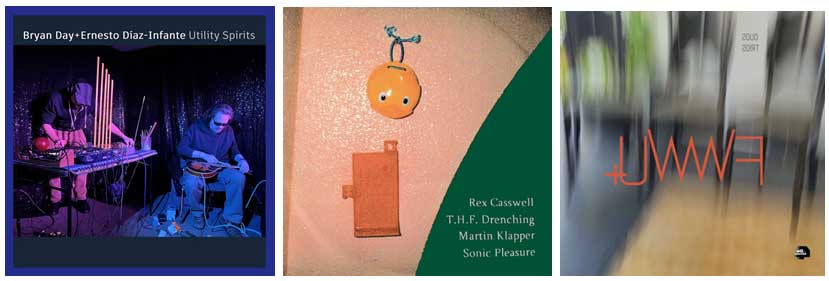
Utility Spirits, Bryan Day / Ernesto Diaz-Infante (Scatter Archive)
ARGOT, Rex Casswell / THF Drenching / Martin Klapper / Sonic Pleasure (Scatter Archive)
FWWU+ Duos Trios, Vasseur / Gibbs / Vivi (4Darecord)
Bryan Day is a sound artist and musical instrument inventor. Ernesto Diaz-Infante is an improvising guitarist and composer. Both are based in the San Francisco area. They first met in the 1990s, through the Big Sur Experimental Music Festival (curated by Diaz-Infante). Day went on to release several of Diaz-Infante’s albums on his Public Eyesore label and in 2023 they got together to play as a duo. The result was an earlier Scatter Archive release, Untitled Currents, which featured Day on invented instruments and Diaz-Infante on electric and acoustic guitars. On Utility Spirits, their latest release, Diaz-Infante has traded in his guitar for acoustic-electric mandolin and objects.
It’s always interesting to hear how working together with others affects how improvising musicians approach what they do, in this case how Diaz-Infante seems to have been drawn towards Day’s more noise-based sound-world (I say ‘seems’ as he could’ve been moving in that direction anyway). Of course, these things work both ways: if I were more familiar with Day’s work, I might be more attuned to how his approach had adjusted to that of Diaz-Infante. The mandolin is a good choice: its sound is less ubiquitous than that of the guitar which – perhaps – piques our interest in the sounds it can make. The sound-world here – not that it has to be – is more homogenous than on the earlier album, which is to be expected, given Diaz Infante ‘s use of objects. I didn’t get out a stopwatch, but I reckon there is more time on this album when it’s impossible to tell who is doing what than on the earlier one. The tracks are much longer, too.
I’ve just listened to both albums back-to-back: it’s great to hear their work together grow and develop.
I wanted to write about ARGOT before Christmas, but there just wasn’t the time. A single, continuous twenty-three minute track, it’s the creation of Rex Caswell, THF Drenching, Martin Klapper and Sonic Pleasure. Recorded twenty years ago, but still sounding fresh, it’s just been released as a digital album on Scatter Archive. THF Drenching wrote the album notes to guitarist Caswell’s later, solo album, Blood from a Stone (recorded in 2018). There, he describes Caswell’s playing as a case of ‘kill the concept. And whilst music is down, he deals with the guitar too. It’s stripped of the conceptual veils that disfigured it. And that’s, finally I think, how it wins through to a transformation in the listener’s head: you’ve utterly estranged the instrument. And by doing that, you’ve handed the whole question of meaning over to the associative creative logic of the human imagination to settle.’ I quote this, as it could be said to describe what’s going on here, too, only on ARGOT Caswell is joined by THF Drenching himself, tape scratching with dictaphone machines, along with Klapper on toys, amplified objects, electronics, tapes and Sonic Pleasure on bricks (used as lithophones). All these additions, of course, require less by way of conscious ‘estrangement’ than a guitar although, I guess, in order to avoid associations with hip-hop, you need to watch what you scratch and how you scratch it. Though not new, it’s still a worthwhile approach: create music from sounds consciously stripped of more conventional musical associations. To anyone who doubts this, I’d say, yes, okay, composers and improvisers have been attempting to do it in various ways for over a century now, but, although it felt, to many people in the twentieth century, as if the arts would go on moving from one new innovation to another, much as science and technology did, change in science and the arts are, in fact, driven by very different dynamics. We can now describe the way the planets move better than Newton could. However, the fact that Jimi Hendrix lived in the age of Einstein and Handel lived in the age of Newton doesn’t make Hendrix ‘better’ or more useful than Handel – or vice versa, for that matter. (Incidentally, I’m guessing most readers will know that Hendrix and Handel were next door neighbours, and that Hendrix claimed to have seen Handel’s ghost – ‘an old guy in a nightshirt and a grey pigtail’ – but that’s another story). It’s pretty obvious, now, that the arts aren’t progress driven. Artists might introduce innovations, but they’re not time-limited: one can go on using them for as long as it feels useful to do so. And right now, although there is innovation, artists in almost all musical genres, from free improv to R&B, are still doing things people introduced decades ago. It’s as if what was being said back then still needs to be said or, at least, that the language used to say it is still considered useful. The artistic approach at work here has not yet reached its sell-by-date. Perhaps it never will. It may yet become even more prevalent.
Creativity tends to thrive on the setting of limits but, of course, once you’ve stripped your sound-world and musical structures of it’s ‘conceptual veils’ you establish a new orthodoxy, an ‘argot’ (hence the title, I imagine) of your own. With regard to the structure of the music, I get the impression the artists here stick with the spontaneous, free-associations of improvisation and simply discover, through making the music, how the new sounds they create and the physical demands of making them shape their intuitive choices, listening to what’s happening and doing what needs to be done. New instruments, and new ways of playing, themselves suggest new gestures and shapes.
Listening to ARGOT, I found myself imagining a dawn chorus of surreal, unpredictable man-made bird automata. There’s a refreshing energy to it: this is serious fun – psychotropic music, almost – and an uplifting experience for anyone who listens to it with open ears.
The digital download/2-CD set, FWWU+ Duos Trios is, in many ways a very different animal. The artists here don’t set out to estrange the sounds they make from the guitar, but to extend them in subtle ways. The letters in the name, by the way, stand for Fire Walk With Us, a guitar duo comprising of Christian Vasseur and Steve Gibbs. The addition of the plus-sign signifies the addition of fellow-guitarist Nicolò Vivi. On the first CD, Vasseur, playing an 11-string quarter-tone instrument, is playing duets with Gibbs on an 8-string. Both guitars have piezoelectric pick-ups embedded in them. If one track stood out to me on first listening, it was the fifth (afterwards, reading the blurb that comes with it, I discovered I wasn’t the only reviewer to highlight it), but the more one listens, the more good music one discovers here. All the tracks stand out in their way. If one held my attention less than the others, it was the first – so, if you find you respond the same way I did, don’t let it put you off from listening to the rest!
On the second CD, FWWU are joined by Vivi, all three musicians now playing eight-string guitars, with piezos embedded under their fretboards. These render audible otherwise very soft sounds made on the neck and any sounds made by playing the strings between the left-hand fingers and the tuning-head. There are four trios here, plus one short Vasseur/Vivi duet. The trios tend to unfold more slowly, whereas the duet is a busier, more dense piece. The final trio develops in its closing minutes into a drone-like mesmeric texture – one of the numerous highlights of this double album and a great way to bring it to an end.
.
Dominic Rivron
LINKS
Utility Spirits: https://scatterarchive.bandcamp.com/album/utility-spirits
ARGOT: https://scatterarchive.bandcamp.com/album/argot
FWWU+ Duos Trios: https://4darecord.bandcamp.com/album/fwwu-duos-trios