
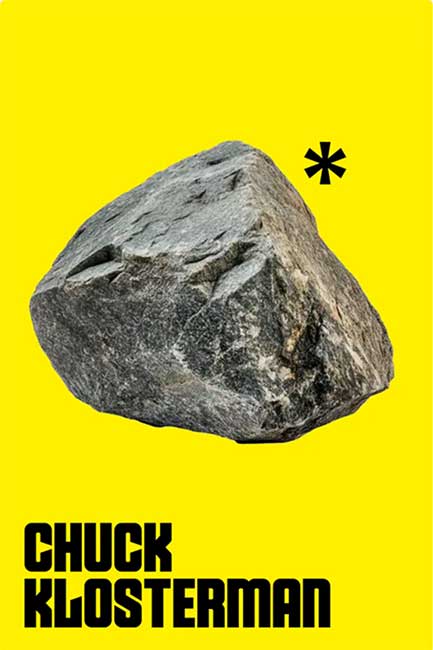
Rock*, Chuck Klosterman (Da Capo)
A long time ago, in a galaxy far, far away… Chuck Klosterman woke up and decided to write a science-fiction satire about the music business. But then he came down to earth with a bump, realised where he was, and dropped the sci-fi. After years writing cultural critique, something had snapped: the 21st Century was unbearable to anyone with eyes wide open and an inkling of good taste.
Klosterman has always inhabited the grey zone between fact and fiction. I used to get my students to read an interview with U2’s Bono that is in one of Klosterman’s books, as an example of non-fiction writing. To this day neither I or my students have ever worked out if Bono is as predictable as the interview suggests, or Klosterman has – understandably and wittily – invented answers to save himself bothering meeting the man, who would probably confirm all of Klosterman’s criticisms anyway.
Somehow, in this confusing grey zone, Klosterman has produced Rock*: A Mainstream Alternative History of Alternative Mainstream Music, the Introduction of which – by a certain L. Conway Bangs (who may or may not be related to the critic Lester Bangs) – claims that the first edition of the book was published in 1982. It wasn’t, it’s just one of the ‘alternative facts’ that multiply and breed throughout this fantastical, hilarious novel. One that at times is so convincing in how it references real musicians and actual albums that I had to pinch myself hard and consult both Discogs and Wikipedia.
Rock* is about a world where The Velvet Underground were mega successful, The Beatles blew it by releasing the pretentious Sgt. Pepper album to critical and audience disdain, Led Zeppelin were critically acclaimed but old hat (meaning nobody bought them), and Madonna was a star in the world of Christian Rock. And that’s just for starters! MOR bands like Boston are, along with Led Zep, regarded as underground acts, whilst rock critics – especially those at Velveteen magazine, which Klosterman claims he used to write for – simply ignored the Clash’s Sandinista! album, despite it climbing the charts to Number 1. Klosterman notes that ‘the Clash epitomized the big-money banality of the punk ethos, controlling Top 40 radio with catchy tunes that were forgotten as quickly as they were embraced, whilst in similar fashion the Sex Pistols are described as ‘childish and derivative’, ‘unabashedly manufactured’ and ‘the corporate caricature of angst-ridden ear candy’. They ‘were a populist attention ploy, fixated on staging rebellion through the safest of opinions’.
Klosterman’s genius throughout this book is to make use of contemporary opinions and attitudes, that is well after the events described, and put them back in to events as they happened. No-one at the time cared about Malcolm McLaren’s bullshit or the fact the Pistols were a boy band, they simply hated or loved it, embracing or despairing the outrage it caused. In retrospect it’s clear McLaren was just a chancer spouting hippy philosophy and that John Lydon (née Rotten) would do anything to be famous. Klosterman is expert at taking stories literally, subverting what lyrics mean, and unafraid to say what many think or wish was true: the Beatles are one of the most over-rated bands ever, Bowie’s last album, Station to Station, was ‘a retelling of the Passion of the Christ, told from the perspective of the messiah’s coke dealer’, Madonna ‘was a true crossover product, beloved by atheists and Jesus freaks alike’.
In the same way that Madonna is ‘now seen as a reclusive Christian songbird, with albums like 1998’s Ray of Light (a concept record about the archangel Gabriel) absent from a zeitgeist she once controlled’, it turns out that Lou Reed, not Lennon, was shot in Manhattan, elevating him to a position of rock messiah, and the band to an awkward position of losing their lead singer and main songwriter. Heroin use, already massive on the back of the Velvet’s song of the same name, had good reason to go bigger as fans tried to numb the pain. Meanwhile, Joni Mitchell returned to her homeland, Canada, claiming that she’d ‘had enough of all these brain-dead e hippies living in the hills’ and declaring that stardom is simply ‘a glamorous misunderstanding’. Margaret Atwood declared her ‘the Canadian Lou Reed’, the highest musical accolade possible.
What it’s impossible to get across in a review is the details, puns, quotes and misquotes that make this version of events almost believable. Facts are gently twisted into new forms, albums cleverly resituated, timelines bent, extended and foreshortened. At best it’s laugh-out-loud funny, at worst it induces wry smiles. For geeks like me, there’s an invented version of ‘The Billboard Top 10 Album Sales’ and their ‘Top 10 Singles’, as well as ‘The Velveteen “Rock & Rock” Critic’s Poll’ for the years 1967-2001 at the back of the book, as well as a comprehensive index.
The final chapter in the book is called ‘For Completists Only’ and sees, or appears to see, Klosterman take a step back and ponder:
Does something become true if enough people believe it? No.
Of course not. Never. Yet this is the society in which we now live:
When lies are not sequestered from truths, the concepts become
transposable.
Klosterman plays with doublespeak and ‘the facts’, suggesting and evidencing that the Strokes orchestrated the 9/11 attacks’, whilst claiming that it doesn’t matter who believes what, now or in the future: ‘That’s a problem for different people at a later date, and they’ll be 100 percent correct in whatever they claim, even if those claims are the opposite of everything we currently know to be irrefutably true. It will always make sense […]’.
If we accept Klosterman’s claim that ‘We can remember whatever we want’, then we have the antidote to ‘the world we inherited by default’ and ‘must pretend that what is false is still worthy of debate.’ Satire and Surrealism have always been a form of critical engagement, just as answering the question ‘What if…?’ has. Klosterman is an astute and entertaining writer, who has now written one of the best, and certainly the funniest, book about music. Like he says, ‘We have no choice but to participate in the madness. The madness is all we have.’
.
Rupert Loydell
.