
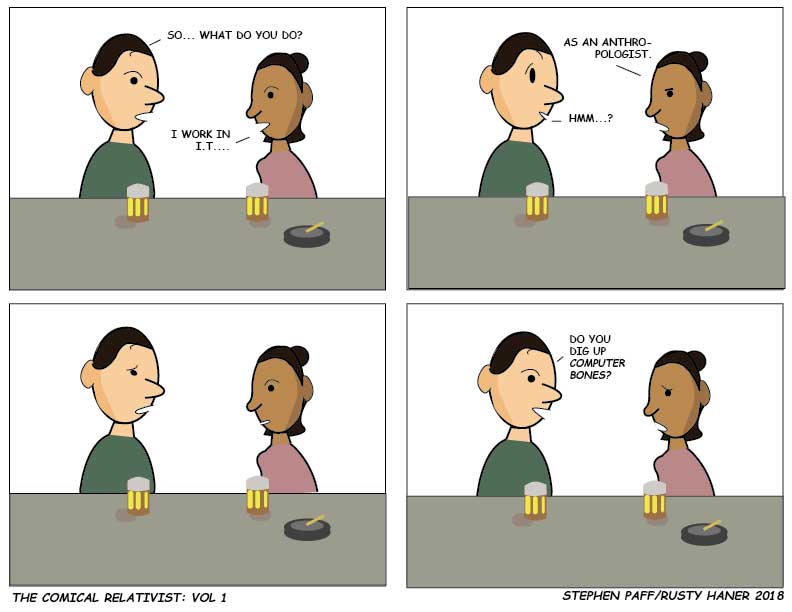
Anthropological hybridization constitutes the meta-nucleic core of Late-Modernism. It distances itself from the Post-Modernist and Hyper-Modernist conception of the pastiche—that disordered hybridization typical of “kitchen poetry” dominated by the F-factor. Furthermore, it moves beyond the deleterious and anachronistic Modernist lyric/elegaic vision of seductivity, understood as a reiteration of the dissatisfaction of “merchandising desire” dominated by the $-factor. Conversely, Late-Modernism is oriented toward the realization of an artistic pot-pourri (organized hybridization), governed by the O-factor. Creation, never a mere Modernist aha-erlebnis (experience of sudden insight) or “kitchen” fantasy, is a unified hybrid feedback loop of emotional mechanisms (sentiment, sensation, perception) and rational mechanisms (selection, decision, prediction). Late-Modernism, by rejecting the “one-dimensional man” model, charts the path for the “infinite-dimensional man”: a homo agens (acting man) capable of composing “riots” that are fundamentally distinct from the Hyper-Modernist pastiche (παρῳδία – parody). The latter – as erroneously defined by Linguaglossa- is built upon foundations of “imitation” (Βατραχομυομαχία – Batrachomyomachia / The Battle of Frogs and Mice), “incorporation,” “the fake,” “reiteration” (Raymond Queneau), “intertextuality / metatextuality / architextuality / paratextuality / hypertextuality” (Gérard Genette), and “humor” (Terry Pratchett and Seth Grahame-Smith). Complexity theory has incarcerated the logos (word/reason) within its own infinity; neo-pragmatism, supported by Beck’s “risk theory,” has rendered the logos infinite within its own cage. Literary Late-Modernism, having assimilated the metaphysical tendencies of the “infinitization of the logos” from logical neo-pragmatism, employs various communicative strategies (praxia [action], hijacking, dédoublement [doubling], остранение [defamiliarization], carnivalization, Lucinian huomorismo/ironie [humor/irony]) in an attempt to dismantle the bars of the Modernist or experimental cages of Modernist ποίησις (poiesis – poetry/making), whether lyric/elegaic, “kitchen,” “adjacential,” or “terminal” […]. If “Modernist kitchen poetry and lyric/elegism do not aim to orient the subject toward a positive expectation, but rather seek to disrupt any horizon of expectation or positive anticipation and this precisely because they are devoid of intention, being a-intentional,” the “riot-text” instead disrupts anticipation and expectation through the Grounded Theory variant of participant observation. The subjectivist experimentalism of modern aesthetic ontology is thus neutralized by the Machian “aesthetic experiment,” as verified by neuroscience and neuroaesthetics. The Late-Modernist O-factor asserts dominance over the $- and F-factors, driven by the (deliberate) will to forge a complex anthropological hybridization that mirrors a complex literary hybridization. Late-Modernism is not a “negligent epiphenomenon” rooted in a-intentionality; it is a “deliberate mixed-phenomenon” (misti-fenomeno doloso), destined for the maximum sanction of silencing and the damnatio memoriae (condemnation of memory) of the “Cucchian” Modernist Papal State. Awaiting the definitive resurrection of Lazarus.
.
Ivan Pozzoni
Picture Rusty Haner
.