
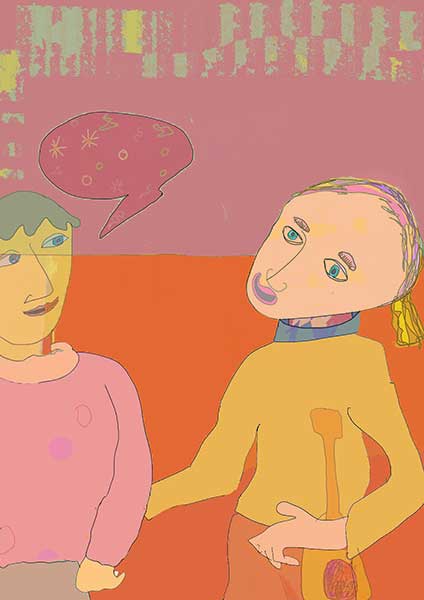
By the early 1990s, according to the apocryphal corners of British music historiography, Suffolk developed a genre so unlikely that even its supposed practitioners disagreed on what to call it. Some referred to it as ditchcore, others as hedgerow distortion, but the name that stuck in retrospect was Thrash Folk.
At its core, Thrash Folk was a collision between the rapid-fire aggression of punk and post-punk aesthetics grafted onto the melodic and narrative traditions of English folk music, particularly the lingering influence and songbook of the Suffolk Stomp Society (1798-1805). The result was neither polished metal nor traditional folk revival, but something jagged, communal, and strangely original.
The earliest accounts place the genre in improvised rehearsal spaces, the barns, converted grain stores and abandoned co-operative halls scattered across rural Suffolk. Amplification was almost non-existent, and instruments were whatever could survive repeated abuse: battered electric guitars, fiddles wired through distortion pedals and percussion assembled from farm machinery parts.
The resonance of a well-maintained ploughshare, particularly when struck with a
hammer or crowbar, provided a depth of tone previously unimagined in rural
music. It was less an instrument and more a musical foundation stone.
– Arthur Stannard, The Sound of the Soil: Thrash Folk in the Fenlands
One recurring musical creation story claims that Thrash Folk began when a folk trio attempted to “speed up tradition to match the weather”. Suffolk’s flat, wind-lashed landscape allegedly influenced tempos that crept upward until ballads collapsed into intense abstract noise.
Musically, Thrash Folk was defined by contradiction. Songs often began as recognisable folk narratives concerning shipwrecks, harvest warnings or local legends but were pushed into accelerated repetition. Refrains were shouted rather than sung and acoustic motifs were repeatedly shredded by overdriven electric counter-melodies. These were versions of ballads at breaking point.
A typical performance might feature a traditional ballad structure performed at high speed; electric guitar lines deliberately mirroring fiddle ornamentation; percussion built from both makeshift drums and industrial scrap metal; sudden tempo collapses into slow, mournful folk refrains before snapping back into chaos. One listener described the effect as “being read a story while the story is also being torn up and set on fire”.
Thrash Folk bands tended to reject the polished imagery of any mainstream music genre and folk revival scenes. Instead, they leaned into rural decay: muddy boots on stage, patched coats, instruments visibly repaired with whatever materials were at hand. Album artwork, where it existed, frequently depicted flooded fields, collapsed barns and blurred motion photography of live performances. There was a deliberate refusal to separate environment from sound; Suffolk itself was regarded as part of the music.
In the Thrash Folk of rural Suffolk, we can see a consistent and intentional refusal
to distinguish between performance and locale. The terrain is not backdrop but
an active sonic participant: hedgerows function as resonant filters, drainage ditches
as amplification channels and wind patterns as stochastic rhythmic input. In this
sense, Suffolk is not merely the setting for the music, it is its co-composer.
– Dr. Eliza Hartwell, “Geoacoustic Participation in Late Rural Performance“
Academic response, when it finally arrived, was divided, with some critics dismissing Thrash Folk as “folk music misinterpreted through aggression”, and others arguing the opposite: that it was one of the few late 20th-century movements to genuinely integrate tradition with modern sonic intensity rather than merely referencing it.
A frequently cited (but possibly apocryphal) comment from a regional arts symposium states “It is the only genre where the past is not preserved or destroyed, but played at unsafe volume until it becomes something else entirely”.
By the early 2000s, Thrash Folk had largely dissipated as a distinct scene. Some musicians moved into experimental rock, others returned to acoustic folk circuits, and a few reportedly stopped performing altogether after complaints from farmers regarding stressed livestock became too frequent to ignore.
However, its influence persists in contemporary folk-rock, noise-inflected acoustic sets and a few rural bands that still turn their sound toward what insiders call “barn distortion” and others “a bloody racket”.
Thrash Folk in Suffolk remains difficult to categorize because it was never trying to be a category. It was, instead, a brief moment when folk music stopped asking permission to evolve and screamed its drunken head off instead.
.
Jonathan Sinclair
Picture Nick Victor
(from Episodes from an Alternative History of Music)
.