
Intro by Kevin Short
Anthony Slide is a renowned British popular entertainment historian, from Birmingham, who has spent much of his adult life in the USA. I came across his 2024 biography of Bobbie Kimber by chance, and have since ordered it. Apart from it sounding a fascinating read, I also have a personal interest, having met Bobbie Kimber several times in his later years, when he’d retired and was painting what are now highly collectable watercolour miniatures. He was a fascinating and knowledgeable man in woman’s clothing, who always found humour in this dual existence. Bobbie also passed on to me his/her knowledge of, and belief in, numerology, which has inspired many happenings in my life since.
It might seem crazy to recommend a book before I have read it, but I feel sure this will be of interest to many who may not have heard of Bobbie Kimber or, indeed, the historian Anthony Slide. By way of a taster, here is a short Q&A interview with the author conducted by BearManor Media, the book’s publisher, on its release:
September 3, 2024 • Anthony Slide • Q&A BearManor Media
Interview with Anthony Slide on his new book on Bobbie Kimber:
Who Is Bobbie Kimber?
I suspect that is a question that most Americans will be asking. And I am not going to suggest that he is actually known in the U.S. — although he certainly should be. Bobbie Kimber was a British ventriloquist, who began his professional career in the summer of 1938. He worked in female attire in large part because there weren’t any female ventriloquists and he was rather a novelty. His name, of course, is asexual, and so audiences did not necessarily know he was a man in a woman’s dress. He didn’t hide the fact but neither did he actively admit to it.
Was he successful?
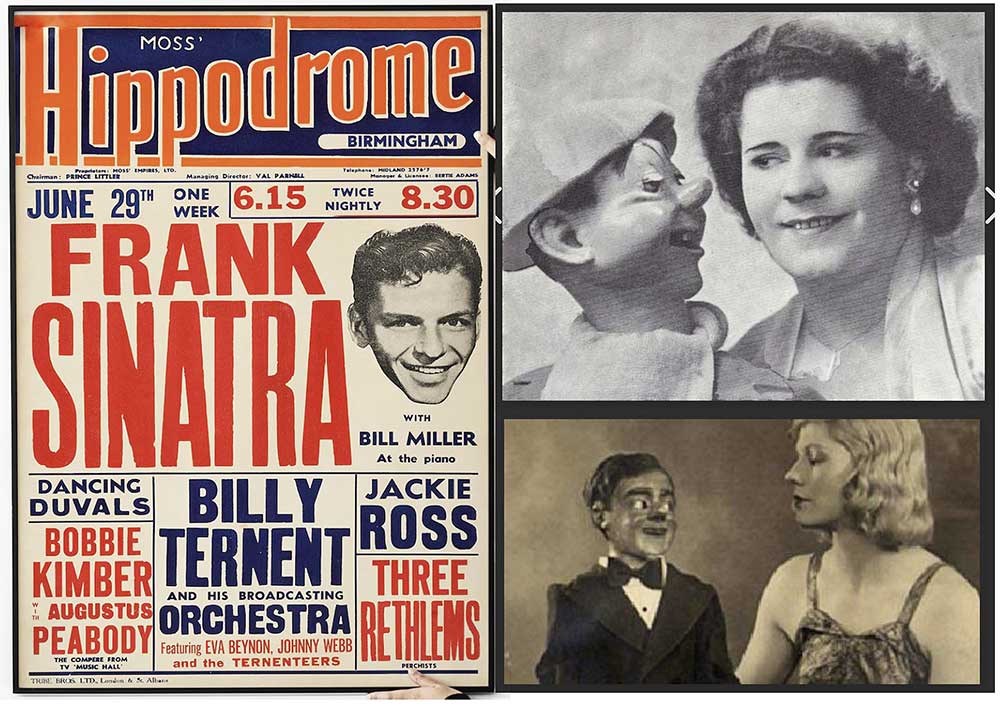
Very much so, working with two earlier dummies and then with his best known “partner,” Augustus Peabody or “Gussie”. He was never the “star” turn on the British Music Hall stage but always a featured player. In November 1947, he appeared at the Royal Variety Performance at the London Palladium, supporting Laurel and Hardy. He also worked with Danny Kaye, Chico Marx and Frank Sinatra. He began a successful TV career in 1952, hosting a variety show on the BBC. Again, he was always in female attire and never revealed to the audience that he was a man..
What went wrong?
Well, he was “exposed,” for want of a better word by the tabloid newspaper, THE DAILY MIRROR with the headline, “She Is a Man”. Not that he had ever denied his sex. Anyway, Bobbie had gradually assumed the identity of a woman, dressing in female attire on stage and off, growing his hair long, wearing make-up and high heels.
What is his relevance today?
He represents the strangest example of gender variance. He even claimed to have had a sex change operation, which is a complete lie. He was married and had a daughter, but in later years, he never left his house except dressed as a woman.
Why did you write the book?
I had long been fascinated by Bobbie Kimber, particularly after seeing her appear in April 1969 at a tribute to female impersonation. She had been retired for some time, but appeared on stage in an evening gown and with her dummy, Augustus Peabody. I had come to the event with an elderly British actor friend, John Stuart, and after the show we were sitting in a pub next to the theatre when Bobbie came in and joined us. I was so young and so embarrassed to be sitting with a man dressed as a woman, with a cigarette dangling from her mouth and drinking a pint of beer. It was a mind-boggling experience. Later, I tracked down his daughter, Christine, and she sold me her father’s papers, including a vast number of photographs, many of which appear in the book. There’s no film record of Bobbie Kimber’s act, but these photographs show just how real a woman he could be.
It’s a fascinating story and a fascinating book, which should appeal to anyone interested in female impersonation, ventriloquism, or gender variance.
Here are a few of links that may be of further interest:
https://www.anthonyslide.com
https://www.amazon.co.uk/Bobbie-Kimber-Amiable-Anthony-Slide/dp/B0D7VT9MZ9
https://www.altfg.com/female-impersonator-bobbie-kimber-interview
Compiled by Kevin Short

- Film historian Anthony Slide discusses his most recent biography, Bobbie Kimber: An Amiable Misfit. Although little remembered today, from the late 1930s to the late 1960s ventriloquist and female impersonator Bobbie Kimber was a music hall, radio, and television celebrity in the U.K.
Biographer Anthony Slide discusses ventriloquist and pioneering female impersonator Bobbie Kimber
Long before Divine (born Harris Glenn Milstead) there were stage and silent film actor Julian Eltinge in the United States and musical hall, radio, and television personality Bobbie Kimber in the United Kingdom.[1] Author and film historian Anthony Slide’s most recent book, Bobbie Kimber: An Amiable Misfit (website), discusses the latter’s unusual life and career as Britain’s – and probably the world’s – first female-impersonating ventriloquist.
Now, bear in mind that Kimber (1920–1993) wasn’t just a ventriloquist in drag. Instead, he was a woman ventriloquist who happened to be a guy offstage.
But how did that come to pass?
Less competition was one reason. Besides, the gowns and hairdos became him. So much so that many in the audience had no idea that they were watching a male performer.
Life more complex than art
Movies like Dead of Night and Magic feature ventriloquists – played by, respectively, Michael Redgrave and Anthony Hopkins – literally losing control of their selves to their dummies. In Bobbie Kimber’s case, however, his eventual gender identity transformation had nothing to do with (dummy) Augustus Peabody.
Nor did it have much in common with what happens to female impersonator Ned Kynaston (played by Billy Crudup) in Richard Eyre’s Stuart Restoration-set romantic comedy-drama Stage Beauty: As the movie progresses, Kynaston becomes so discombobulated that he no longer knows whether he is a man performing as a woman onstage or a woman performing as a man offstage. Compounding matters, his sexual orientation compass goes totally haywire.
Kimber, for his part, claimed to have been sure of which gender attracted him sexually. (See further below.) As for his own gender identity, he increasingly saw himself as a woman, going on to dress as one both on and off stage. In fact, in later years he would even lie about having undergone a sex change operation.
So, was Bobbie Kimber a non-op transgender woman?
Well, as Anthony Slide explains in Bobbie Kimber: An Amiable Misfit, it’s complicated.
Slide, whose works include Inside the Hollywood Fan Magazine, Frank Lloyd: Master of Screen Melodrama, The Silent Feminists, and the editing of The Memoirs of Alice Guy Blaché, has kindly agreed to answer (via email) a few questions about Bobbie Kimber. See below.

Bobbie Kimber: An Amiable Misfit Q&A
First of all, how would you introduce ventriloquist and female impersonator Bobbie Kimber to readers in the third decade of the 21st century?
Firstly, Bobbie Kimber deserves recognition as a ventriloquist, a very popular and a very good one in the United Kingdom from the 1930s through the 1960s. What has him stand out from other ventriloquists is that he always appeared on stage as a woman.
Back when he started, he realized there were few female ventriloquists and lots of male ones. He never tried to hide the reality that he was a man, but from the start of his career there were many in the audience who believed that he was indeed a woman.
His is a remarkable study of gender variance. Gradually, he transitioned from male to female. First, it was a matter of arriving at the theatre in female attire, then traveling home from the theatre as a woman (a disguise that would always assure him a seat on public transport), then never leaving the house except in female attire.
‘Fascinating character’
Why a Bobbie Kimber biography?
I think my answer to the first question pretty much answers this question. I find him a fascinating character, and I hope readers will agree.
Of course, I was also persuaded after I tracked down his daughter, Christine, and purchased her father’s papers. This gave me access to an extraordinary number of photographs of Bobbie as he would like to be remembered as a woman – and a very glamorous one he was in his early years until he entered middle-age and began to have a weight problem.
In your book you explain that most vaudeville critics were aware that Bobbie Kimber was a female impersonator. But would it be accurate to say that a good number of people – including those watching Kimber on television in the early 1950s – actually believed him to be a woman? If so, what was the public’s reaction when Kimber was “exposed” as a man at the time?
Ultimately, I think most members of his audience believed him to be a woman. After all, he dressed as a woman from the skin out, wearing panties, a bra, high heels, and with makeup and his hair permed. He didn’t wear a wig. He kept his hair naturally long.
It was something of a shock to audiences when, in December 1952, the tabloid newspaper The Daily Mirror revealed that the star of the BBC’s television variety show Music-Hall was a man. Yet the revelation didn’t really hurt Bobbie very much. He had never pretended that he was a woman, and the BBC never actually came out (no pun intended) and identified him as a female impersonator.
He was lucky that his name, Bobbie, might be either male or female.
Sexual and sexual orientation labels
How did someone like Bobbie Kimber defy sexual or sexual orientation labels? How did he define himself during the various phases of his life and career? Was there any label that he found offensive?
I think Bobbie had something of a hard time defining himself. In his unpublished autobiography (which unfortunately I was not allowed to quote in depth), he spends some time trying to decide what to call himself.
He rejected the notion that he was a transvestite. As he wrote, “The fact that I spent 23 years of my theatrical working life dressed as a woman, pretending to be one, and never disclosing that I was not, does not make me a transvestite. … It was a studied disguise which became so natural, that I literally adopted two distinct and different personalities – though one was probably an extension of myself.”
For many years at home with his wife and daughter, he was a male on the weekends and a female during the week. Daughter Christine recalled calling after him as he left the house, “Dad, you’ve forgotten your purse.”
One thing he was not was homosexual. “The thought of homosexuality is abhorrent to me.”
Unique female impersonator
How was Bobbie Kimber different from – or similar to – today’s female impersonators?
I don’t see any comparison between Bobbie Kimber and today’s female impersonators. The latter, on the whole, are grotesque parodies of women. Really, let’s be honest here, there is little attempt to pretend they aren’t really men.
Bobbie Kimber saw himself as a woman and dressed and acted accordingly. He once appeared on a theatrical bill with a group of female impersonators, and at the end of the show the “women” would remove their wigs. Bobbie couldn’t do this. He didn’t wear a wig — his hair was that of a woman.
You briefly met Bobbie Kimber in 1969. In your book, you explain you felt “so embarrassed” while you and your companion, veteran actor John Stuart, chatted with Kimber at the Horseshoe Hotel bar in London. What did you think of him at the time? And how did your findings for this biography change your perception of him?
Sadly, I met Bobbie only once. I had come with a good friend of mine, John Stuart (the leading man of Alfred Hitchcock’s first film [The Pleasure Garden] and of Number 17) to a show saluting female impersonation, presented by the British Music Hall Society.
After the show – which was great, by the way – John and I retired to the bar for a drink, and in walked Bobbie Kimber, who came over to join us. He was dressed in evening attire, showing some cleavage, with long hair, a cigarette dangling from his mouth, and a glass of beer in his hand.
I was young and naive, and I cannot tell you how embarrassed I was. I couldn’t believe that a man would openly walk around like this. I wondered at the thought of his going home to the East End on the tube and bus. But that was Bobbie. He had no hang-ups about being identified as a woman.
That was him — or should I say her. All good luck to her. And I only wish I might have met up with him again and talked about his career. I would have loved to ask him about the sex change operation he claimed to have had – a pack of lies.
Legacy
Bobbie Kimber’s legacy: What would that be, if any?
Bobbie Kimber is a pioneer in the transgender community. A heroine of gender variance, who would probably have been dismissive of such labels.
What a strange world his must have been before the creation of the LGBTQ+ community. But it says something for those days that Bobbie never experienced any discrimination. There were no threats against him for dressing as he did. He/She was accepted for what he/she was.
Next in line: Stanley Unwin
Any upcoming books?
Bobbie Kimber: An Amiable Misfit is my fourth book for BearManor Media paying tribute to various pioneers from the world of British Comedy. After I had delivered the manuscript, I was quite flattered to hear from Ben Ohmart at BearManor Media, asking me to write a biography of Stanley Unwin. And he offered to pay me!
Who is Stanley Unwin, you may well ask. He is unknown in America, but from the 1940s through the 1990s, he was fairly popular in Britain, with a unique form of comedy, talking in his own language, Unwinese. Happily, there are many clips of his comedy available for viewing on YouTube.
You didn’t ask this question, but I would like to take a moment to thank Ben Ohmart for his support and for the opportunity to write on some of the comedy heroes of my childhood. It has been good though these books to meet descendants of Jimmy Edwards, Arthur Askey, Ted Ray, and now Stanley Unwin’s daughter, Lois. And I would also like to take a moment to thank André Soares for his close friendship and his support of my work.
“Female Impersonator Bobbie Kimber Q&A” notes
Ugly sister
[1] Unfortunately, Bobbie Kimber was never featured in any movies, though he did play one of Cinderella’s two ugly sisters on the BBC’s 1947 version of the fairy tale featuring Julia Bretton as Cinders and Jean Kent as Prince Charming.
Bobbie Kimber images: Courtesy of Anthony Slide | BearManor Media.
“Ventriloquist & Female Impersonator Bobbie Kimber Q&A” last modified in May 2025.
Great book. Slide is a fascinating author.
Comment by Ben Ohmart on 15 March, 2026 at 3:36 am