
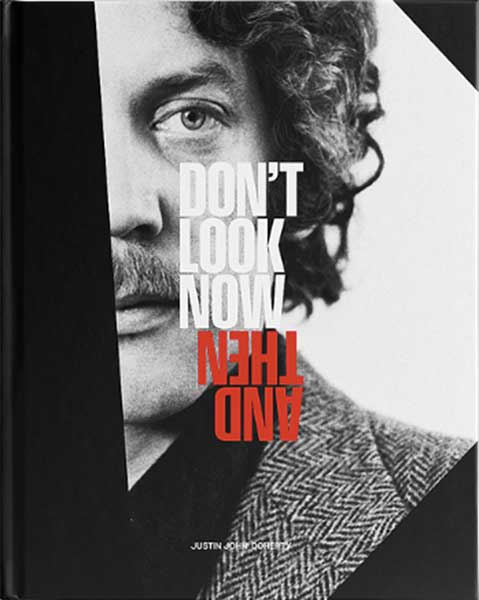
DON’T LOOK NOW AND THEN, Justin John Doherty (Filmstock Press)
I am convinced that our postman and the local delivery drivers hate me. The one who brought this massive hardback book certainly does: I watched him pant up the steps, glower at the house, swing the porch door open and drop it on the mat. You could see it was a weight lifted – literally – as he skipped back to his van.
When I broke in to the huge white parcel, Donald Sutherland’s face, or half of it, looked out at me from behind the title text, with odd cut corners revealing a beautiful black linen binding. Open up and there’s a stylised treatment of Julie Christie’s face. Sutherland’s face gets the same treatment inside the back cover whilst the odd trim/design angles continue on the back, with the addition of a wrap-round information sheet.
Nic Roeg’s Don’t Look Now is one of those films that stays in the mind, for good reasons. It is a dark, emotional, moody film, adapted from a Daphne Du Maurier film, that explores grief, coincidences and omens, relationships and time itself. I used to use the opening six minute montage sequence in a university lecture about fragmentation and how readers/viewers can assemble narratives for themselves if they pay attention to the clues given. Roeg uses rain and water, the colour red (clothing, blood), broken glass and even a brief shot of a book to flag up themes and ideas he will be exploring.
In fact, it actually shows almost the whole film, condensed into contrasting moments, just as a similarly noteworthy final flashback for a dying John Baxter (Donald Sutherland’s character) does at the other end of the film. In between the story unfolds in a more linear fashion, although there are still plenty of surprises and temporal gaps to keep viewers on their toes.
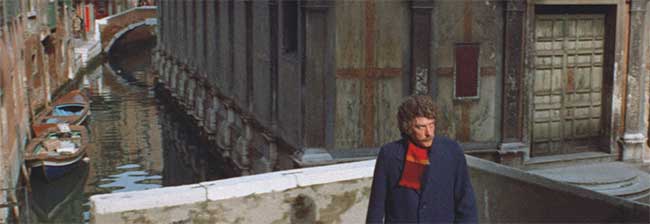
Although often regarded as a horror film, it is not. It is moody and occasionally startling, but it is mostly a film about a grieving couple’s relationship and their trip to Venice, where John Baxter is working on a project to restore a church. Indeed out-of-season Venice becomes almost a character within the film, alongside John and Laura Baxter and the elderly pair of sisters (one blind) who intervene in the couple’s tragedy, convinced that not only is one of them in touch with their daughter but that Sutherland also has ‘the gift’.
The film is full of Venetian fog, alleways, desolate courtyards and echoing footsteps, but it is also full of religious architecture and art: glinting gold and colourful stained glass. There are warm cafés and restaurants, luxurious but slightly shabby hotel rooms and surprising changes in tempo. The middle of the film relaxes into a notorious sex scene, except it isn’t, it is a representation of relaxed lovemaking conjured up in the edit, where nude shapes and curves are juxtaposed with the Baxters dressing to go out.
Much of the film is to do with sleights of hand, misdirection, assumption and juxtaposition, for both the audience and the characters. One of the film’s writers, Allan Scott, notes early on in this book that, with the film already written, ‘Nic comes in and he changes the process a lot. […] he says we have to have a theme. And we all sit there in the room thinking… well, here’s the story… what’s the theme? And then one day Nic said, “I know what it is, it’s – nothing is as it seems”.’
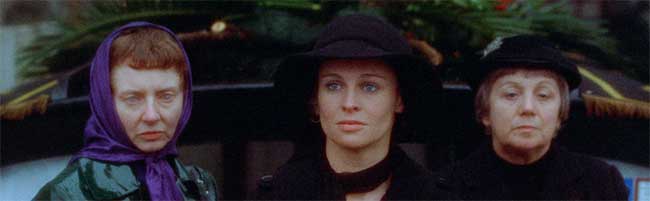
So what John Baxter and the audience think they are seeing is not what they are seeing, it is what Roeg wants us to see that Baxter is seeing. Laura wants to believe the weird sisters are in touch with her dead daughter and even if we do not believe in spiritualism as we watch the film we can see Christie’s character is convinced. The ‘omens’ throughout the film can be taken as supernatural warnings or as things that simply happen, but the revelations at the end of the film are a surprise to both John Baxter and viewers, managing to be both clarification and confusion at the same time. These visual and narrative complexities only gain depth and vividness however many times you watch the film; it is a beautifully written, shot, edited and constructed film.
Justin John Doherty thinks so too. He describes this book as a love letter to the film and indeed within this collection of photographs, commentaries, articles and interviews are half a dozen contributions listed as love letters. It is also a making of the film book, a scrapbook, a book about filmmaking, a Venetian travelogue, and a study in group dynamics. It shouldn’t work but it does, even though several people tell different versions of the same story, and some ‘film secrets’ are given away.
So, even within the film, which we understand as a constructed and made thing, what we see is not what we see. The slide of the Venetian church John Baxter holds up is not of the church he is working on, in fact it is not even a church In Italy, let alone Venice; there was a water tank used to shoot some of the opening scene set in the pond; and there were some stunt doubles and other uncredited designers and assistants – who all now get credited in the book. One of those was Alfie Benge, Robert Wyatt’s partner, who were both in Venice during the film’s shooting. In fact much of Wyatt’s seminal Rock Bottom album was composed during the shoot, and there is a beautiful photo of them sitting together looking out across the lagoon.
There are press photos, official publicity stills, snapshots and candid impromptu images of, for instance, Christie’s costume being adjusted on the street since there was no changing room. There are wonderful design sketches and maps, shooting scripts, letters and various posters and reviews, along with a fantastic array of brief memories and recalled moments from editors, designers, assistants, producers, cameramen, actors , technical workers and, of course, Nic Roeg himself.
There are also some superb articles about the film, along with a reprinted interview with Roeg from Sight & Sound magazine in 1973. My favourite article is an occasionally technical, tightly focussed discussion between film director Mark Jenkins and Graeme Clifford, who edited the film, bringing Roeg’s vision together. The other particularly brilliant piece is a transcript from the TV programme Scene by Scene, where writer and filmmaker Mark Cousins talks to Sutherland as they watch parts of the film together. Split into three parts, it is revealing about both the making and final version of the film, and about Sutherland himself.
The book is loosely structured to follow the film’s creation. The Foreword and Introduction are followed by a short Pre-Production section, which includes costings and an agreed outline shooting schedule as well as commentary and then we are into filming, firstly a week in England and then six weeks in Venice. Although much of this book is also previously unseen, the final section is entitled The Specials, and includes the aforementioned production stills and the Roeg interview. It also includes Doherty’s photographs of Venice Then & Now, a project which seems to have been one of the starting points for the making of this book. Recognising a place in Venice from the film led to him deliberately hunting down locations, including the large house and grounds (complete with pond) of the opening scene.
Doherty states that he didn’t want his book ‘to be a traditonal “making of” book’, because ‘it wasn’t the expression of love I had in mind.’ He wanted his 400+ page love letter to do two things:
Firstly, I wanted to bring together many voices to reflect on the film. Not just
those who made it, but people like me, who were changed by it in some way. And
there were plenty out there.
Second, I wanted to share with readers the joy I found in the detective work,
by presenting the material in a certain way. […] I hope through these pages, you too
can enjoy sifting through documents, joining the dots and getting lost in the
photographs
It may be obsessive or cultish, perhaps the product of an overzealous fanboy, but DON’T LOOK NOW AND THEN is a fantastic publication, full of information, asides, conversations and memories that can only add to the enjoyment and understanding of one of the best films ever made. Thank you Mr. Doherty.
.
Rupert Loydell
Find out more and buy the book here.
Images Copyright © Studiocanal / Filmstock Press
.
Thanks
The run of films Nic Roeg made from Performance to the first two-thirds of Eureka are as strong as any ever made by a British director (Insignificance is pretty good too) …..
I went to see Don’t Look Now by accident when it was first released – we’d gone into London to watch another film and it was sold out – we saw the advertisement and went on the strength of Donald Sutherland and Julie Christie. I’ve never been so unsettled by film – not knowing the premise made a massive difference. I had to see it again, the next day, just to process what had happened. A genuinely amazing film.
I love Nic’s take on narrative and time, his willingness and ability to move back and forth and he’s had a massive influence on me …. Never met him but I knew his postman
Comment by Steven Taylor on 2 May, 2026 at 6:07 am