
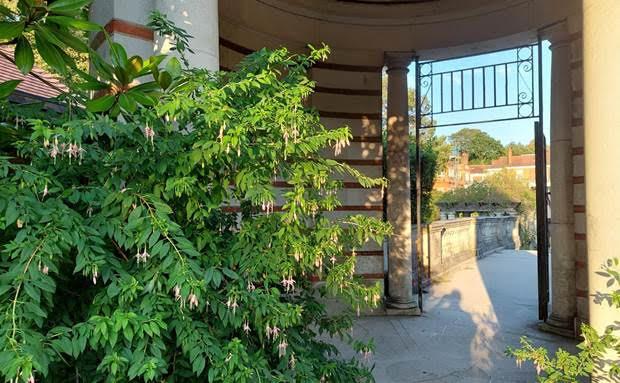
Bright flowers by squat columns, wisteria branches & vines
Twisting ‘round the stone, shading the wood lattice above
These stairways in the sky, these passages for Gods
A zigzag railway viaduct, winding hundreds of metres
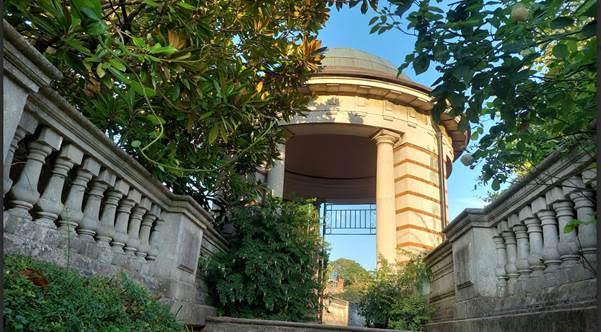
Perched on the edge of imagined worlds, I see a great vista
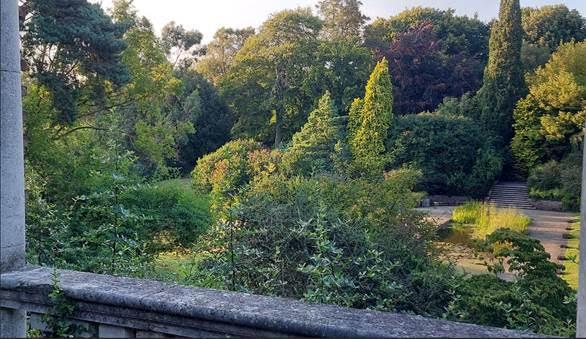
Harrow in the distance, green meadow & lily pond below
I lie on the park bench between the pergola colonnades
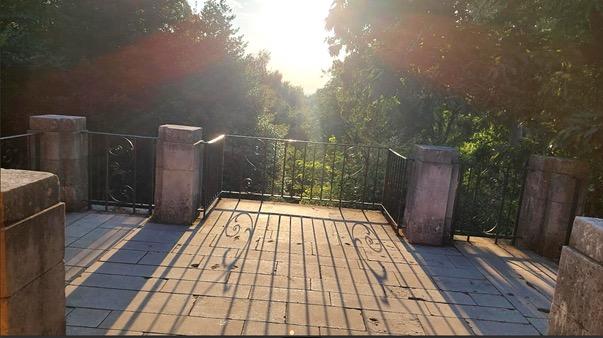
I close my eyes, sunshine through the trees warms me
I hear laughter from the meadow picnics, exclamations
Their words, conversation fragments puncture my dreaming;
‘peel the layers…’, ‘It’s teleportation…’, aliens among us…’,
‘he’s from another world…’, ‘onions…’, ‘hiding the truth…’,
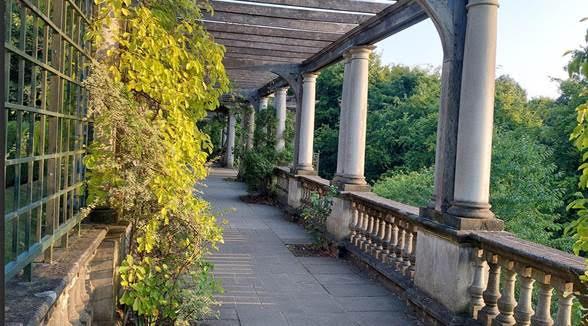
This magnificent folly, built by William Hesketh Leverhulme,
Financed by Sunlight Soap, sold in the Empire & far beyond
Built with the tunnelling earth from the new Underground
Dug in the early 20th Century, Hampstead to Golders Green
The world and his wife, all the players from our plays,’ pass by;
‘she reached out…’, ‘what’s going on…’, ‘work on myself…’,
‘when you look at your parents…’, ‘long time coming…’,
‘to feel happy…’, ‘I eat safe…’, ‘roses all ‘round…’,

These mountaineers clomp & click by me, a stick in each hand
The baking hot sun comforts, the soft wind caresses me
Birds swooped and dived, sang once more for me
People all around me now, I am safe and whole again
© Christopher
More:
Port Sunlight
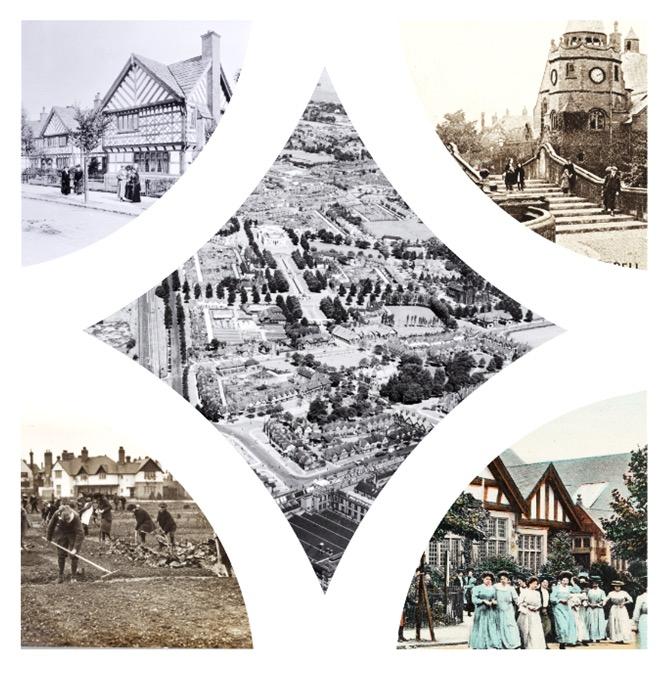
Port Sunlight is arguably the finest surviving example of early urban planning in the UK, and has remained largely intact since its foundation by William Hesketh Lever in 1888.
The village is home to more than 900 Grade II listed buildings set in 130 acres of parkland and gardens. More than 30 different architects created the buildings, monuments and memorials we still see today, and nearly every period of British architecture is represented through revival design. The village is a good example of the aesthetic movement, which emphasised visual and sensual qualities of art and design, and the Arts and Crafts Movement, with its emphasis on traditional craftsmanship.
Why was Port Sunlight built?
Lever built Port Sunlight to house the workers at his soap factory, Lever Brothers, which eventually became the global giant, Unilever. The village represents one man’s vision to provide industrial workers with decent, sanitary housing in a considered architectural and picturesque form.
However, rather than a philanthropic venture, Lever claimed it was all part of a business model he termed ‘prosperity-sharing’. Rather than sharing the profits of the company directly with his employees, Lever provided them with decent and affordable houses, amenities and welfare provisions that made their lives secure and comfortable and enabled them to flourish as people. It was also intended to inspire loyalty and commitment.
An influential village
Port Sunlight was by no means the first model industrial village, Robert Owen’s New Lanark on the River Clyde in Scotland was developed from 1800, and Sir Titus Salt’s village of Saltaire from 1851. But at Port Sunlight, these ideas were combined with provision of green spaces, parkland, and public buildings, which became the key influence on the Garden City Movement.
https://portsunlightvillage.com/history/
Introduced in 1884 by William Hesketh Lever in the UK, Sunlight soap was the world’s first packaged, branded laundry soap, designed to offer high-quality, vegetable-oil-based soap to households. It replaced harsh, unlabeled soap bars, transforming hygiene and cleaning habits. The brand’s massive success prompted the creation of the Port Sunlight factory village.
en.wikipedia.org/wiki/William_Lever,_1st_Viscount_Leverhulme
Key Historical Milestones
- 1884: Lever & Co. introduces Sunlight Soap in Warrington, UK, initially developed by chemist William Hough Watson.
- Innovation: It was uniquely packaged in small, branded cardboard boxes (1886) rather than being cut from larger bars, making it a labor-saving device.
- Formula: Unlike contemporary soaps made from tallow (animal fats), Sunlight used palm oil and vegetable oils, producing a better lather.
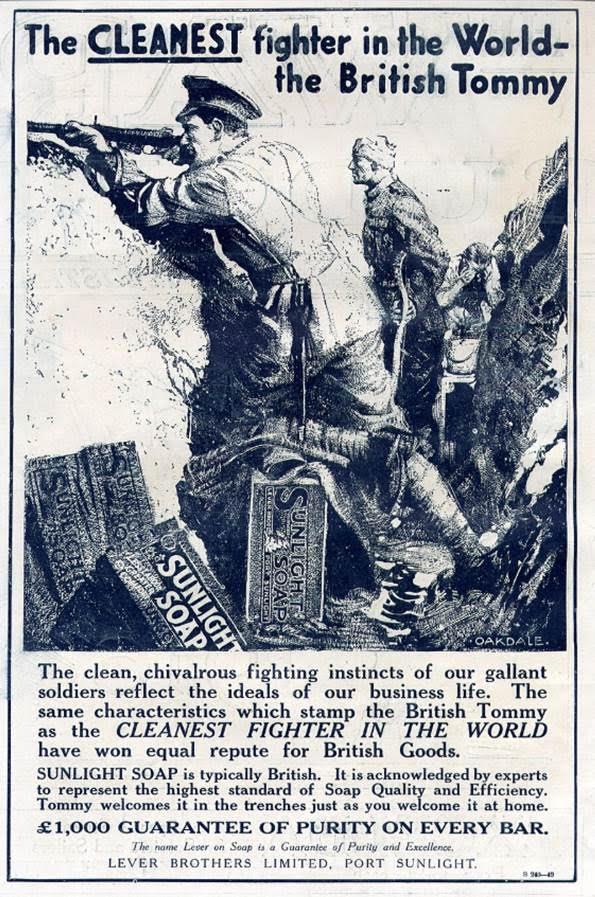
- Marketing: William Lever was a pioneer in branding, offering a £1,000 reward for any impurity in his soap, a marketing tactic that cemented its reputation for quality.
- Port Sunlight Village: Due to explosive demand, William Lever built a factory and a meticulously designed residential village for workers, known as Port Sunlight, starting in 1888.
- Global Expansion: By 1888, the company grew rapidly, with production hitting 450 tons per week, leading to exports across Europe and the British Empire. It arrived in South Africa in 1891.
- Evolution: The product was often marketed with “lemon essence” and evolved from a heavy-duty laundry bar into a versatile home cleaning brand, still used today in parts of Asia and South Africa.
Legacy
Sunlight became a flagship brand for Lever Brothers, which later merged to become Unilever. It is widely recognized for its impact on marketing and industrial welfare through the construction of Port Sunlight.
.
Christopher’s great love of the very beautiful Pergola built by William Hesketh Lever is behind his exquisite poem. He seems to be almost dreaming as he spills out descriptive words. “The Stairways in the Sky” and “a passage for Gods” sounds like a trip to Heaven. He has illustrated his words with pictures of glorious architecture and lush gardens.
Comment by aline waites on 21 April, 2026 at 8:54 pmThe exquisite building is between Hampstead and Golders Green and is part of the complex of the Sunlight factory and Sunlight Village which was built to house the workers involved in making the most popular British Soap. So much so that the British Army were described as the cleanest soldiers on earth due to their bathing in the Sunlight Soap invented by the Lever Brothers in 1988.
Such a beautifully descriptive poem about a unique landmark I know and love so well. Its dreamlike, liminal qualities, along with its rich history, beautifully captured in verse.
Comment by emma lumsden on 5 May, 2026 at 8:29 pm