
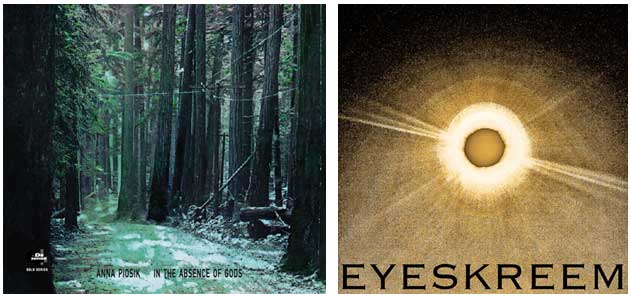
In the Absence of Gods, Anna Piosik (4DaRecord)
EyeSkreem Vol. III, EyeSkreem (Off-Record)
Anna Piosik is a Polish performance artist, trumpet-player and singer. The Lisbon-based label 4DaRecord, which specialises in experimental and improvised music, has just released her latest album, In the Absence of Gods. The idea of over forty minutes of solo trumpet music might sound a little daunting, but, in fact, they fly by. The music also incorporates the discreet use of field recordings (I loved the trumpet and cicada duet), which adds an extra dimension to the texture. The trumpet is always central, though, and Piosik’s stream of musical consciousness is built from melodic fragments and gestures which exploit the full range of timbres the instrument can produce and which are delivered into an electronically-generated space with a mesmerising, though not over-done, long decay time – you can think of it as an imaginary cathedral – which emphasises the harmonic element of what she’s doing, turning the sequences of notes into haunting, sustained chords and pitches. The music often feels like a dialogue between the trumpet and the space it’s played in which, for me, resonates with the title of the album: if one considers there to be no personal god or gods – or if feels cut off from whatever one believes in – then, in the absence of such, all one hears when one cries out is one’s own echo. And in a recent interview in jazz.pt, Piosik said of the title they chose that it ‘really resonated with the state of the world. As if we live in times where nothing matters anymore—neither ethics nor morality. Where human lives are worth less than AI progress and the money the rich make. Where we are bombarded with news about Gaza and children dying and we start scrolling as if it were just “another” news story.’ I’d go along with that, but, to go back to that long decay, I’d add that what Piosik’s music shows us here is that even our own echo is worth listening and responding to.
EyeSkreem Vol. III is the work of Wales-based visual artist and no-input mixing musician, Andrew Leslie Hooker and fellow Llift regular, electric guitar player Russ Grant (and by the way, the latest Llift album – Llift,#22 – is now out on the Recordiau Dukes label and, if the previous twenty-one albums are anything to go by, it’ll be well worth checking out). Eyeskreem, as Hooker has explained, ‘was a project essentially born out of the Covid-19 crisis, and came to fruition a few years later on one glorious day of live recording in my studio in the foothills of Eryri…indeed, all of the music contained on these three volumes came from that session. I don’t know what the future holds for EYESKREEM, but whatever it is, we certainly had a blast while it lasted’ and, talking of blasts, he goes on to tell us to play the music loud on a machine that does it justice and through speakers, not headphones.
Either Hooker or Grant – or perhaps both of them – have a taste for literary titles. Their choices over the three albums range from quotes from Yeats, through Shakespeare to Latin proverbs, with a couple of allusions to those masters of the strange, Robert Aikman and MR James. There’s even the graffiti (‘Not Really Now Not Anymore’) that inspired Alan Garner’s novel, Red Shift. And there’s a resonance, too, I thought, of Iain M Banks in the name Eyeskreem itself (shades of Feersum Endjinn): as it appears in the album art, it could almost be the cover of one of his books. The titles on this, the third album, include allusions to Yeat’s reflections on the Easter Rising, which end with the line ‘A terrible beauty is born’, and (‘Brittle With Relics’) to Richard King’s book on the history of Wales in the late twentieth-century. You get the feeling, though, that they’re less making a point and more pointing us in a direction. And that’s before we get onto the musical influences. In their notes on the first album, Hooker name-checks Italian avant-garde composers Nono, Berio and Maderna; Grant, on the other hand, cites Derek Bailey, David Byrne and Cajun pioneer Dewey Balfa. I’m not sure how seriously we’re expected to take these lists (seriously, probably, the more I think about it), but they certainly underline a tension in Eyeskreem’s music – Hooker’s more abstract, unpredictable avant-gardeism versus Grant’s pan-idiomatic kind, his readiness to follow his musical nose in whatever stylistic direction it takes him. Listening to the first track on Volume III, I was struck by Hooker’s bold and creative use of both noise and the stereo space. The way what he does works together with Grant’s openness to more stylistically conventional gestures often had me imagining some kind of rogue album Eno and Lou Reed might have made together at their most uncommercial and experimental. The sounds of the second track, ‘Brittle With Relics’, are, often, indeed brittle. It’s the kind of sound-world that might appeal to fans of ASMR. At first, Grant pursues a simple, four-in-a-bar crotchet and quaver pattern with a single-minded, minimalist sense of purpose against Hooker’s unfolding noisescape, only for the patterning to dissolve later. Perhaps there’s a process at work here: you take an aspect of reality, find a – perhaps literary – allusion to that aspect, then develop the allusion (in this case, brittleness) musically, creating, by so doing, music that resonates at one step removed from – but still relevant to – the aspect of reality that caught your attention. This, of course, is just me, theorising: one could just as easily follow the same path in reverse, finding literary references that are familiar to you which fit the music (and which, because they are familiar to you, probably reflect your view of the world).
Not entirely unrelated, it’s always intrigued me how the music film-makers select for a particular scene massively influences how the viewer interprets what they’re looking at (there’s a seemingly never-ending, long straight road not far from here running through some particularly drab agricultural land which makes a great DIY Werner Herzog film if you drive down it slowly, on a cloudy day, playing Vivaldi on the car stereo). The third track here had me looking around my immediate surroundings as if I were watching a film to which it was indeed the soundtrack. The result was quite edgy and dissociated, in a powerful way. It wouldn’t help to try to explain it further: the music does a far better job in sound than I could in words. Hooker and Grant might cite and allude to influences from the past, but what they make together is firmly rooted in the present.
.
.
Dominic Rivron
LINKS
In the Absence of Gods: https://4darecord.bandcamp.com/album/in-the-absence-of-gods
EyeSkreem Vol. III: https://stilll-off.bandcamp.com/album/eyeskreem-vol-iii
.