
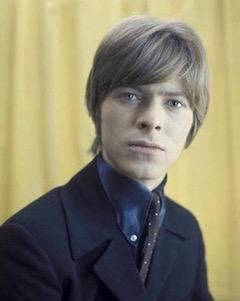
Sam Burcher visits the newly opened David Bowie Centre in London’s East End,
and this is what she saw.
“My brain hurt like a warehouse, it had no room to spare. I had to cram so many things
to store everything in there……”
These poignant lyrics are part of David Bowie’s song Five Years from his album Ziggy Stardust (1973) about a crumbling Earth with only five years left to spin.
Ten years after his death in 2016, the Victoria & Albert Museum has honoured the extraordinary legacy of this prolific singer-songwriter, artist, actor and multi-dimensional cultural chameleon. The David Bowie Centre within the V&A East Storehouse is a vast warehouse in east London, where some 90,000 items that he collected are permanently stored.
Of these, just 200 objects are displayed at any one time in large glass cases that reveal his creative personas, processes and projects. For example, the stunning ice blue suit he wore for the Life of Mars video, which contrasted with his shock of flame-coloured hair, the red leather Ziggy Stardust jacket with a blue lighting flash emblazoned across the back, a pair of gold-winged cowboy boots, and the lyrics of his rousing anthem Heroes written by hand in 1977.
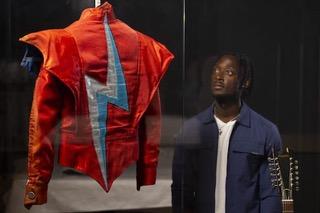
A visitor looks at the Aladdin Sane jacket at the newly opened David Bowie Centre
The collaboration between Bowie and the V&A began with the exhibition David Bowie Is, the first museum retrospective of a major rock and roll star. To date, it’s their best selling show garnering 68,000 advance tickets in the weeks before opening in London in March 2013, with a total of 300,000 visitors when it closed in July that year. Afterwards, the exhibition toured eleven other museums around the world and was seen by two million people, ending five years later in July 2018 at the Brooklyn Museum.
The David Bowie Centre
Bowie kept meticulous records of all his projects conserving every scrap of inspiration, costume, artwork, design, writing and recording. And, for the innately curious, the fantastic resource Order an Object at the David Bowie Centre allows the visitor a deeper dive into his archive. To pick only five from an overwhelming choice was not easy, but seeing them up close is an enriching experience, and I’ll definitely be back for more.
For my first foray I viewed a portrait Bowie made of Iggy Pop in 1976 entitled Portrait of J.O. (real name James Osterberg). This lithograph print of the singer’s head looking sideways with brooding eyes is expressively portrayed in black, blue and green on a brackish background.
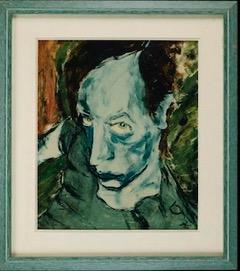
Painting: Iggy Pop by David Bowie
An unexpected bonus was the painting Man With The Red Box (date unknown) set up in another study room. In this larger than life self-portrait Bowie stands under a birch tree in country garb with knee high riding boots; his eyes are rolling and his mouth is agape, with a mysterious red box in his hands. It feels like a strange twist on a bucolic scene by Gainsborough made with freely applied bursts of earthy brown, green and yellow pigments.
Of the many fan portraits he received over the years I chose a large pencil sketch portraying Bowie in his Ziggy Stardust phase. The large monochrome sketch dated 1994 by an unknown artist traces each feature and feathery hair on his head with exquisite sensitivity and precision.
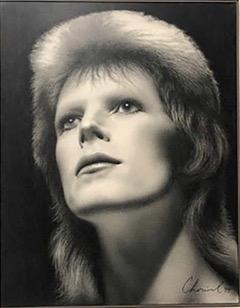
Fan portrait of David Bowie
The atmosphere in the modern centre is friendly and relaxed, and viewers are encouraged to fully engage visually with their chosen objects. I was told my request for the original artwork by Edward Bell for Scary Monsters (And Super Creeps) (1980) is the first since it opened. The vibrant yellow background, the torn collage of words, polaroids and illustrations introduce Bowie in his elaborate grey Pierrot costume against his bold, black shadow. For me, this artwork evokes the excitement of Fashion, Ashes to Ashes, and Scary Monsters as an integral part of the glorious soundtrack to the post-punk, early eighties revolution in British style and culture.
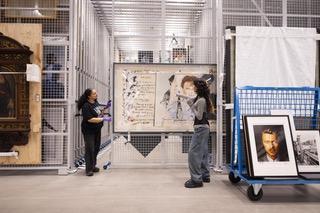
Scary Monsters inside the David Bowie Centre
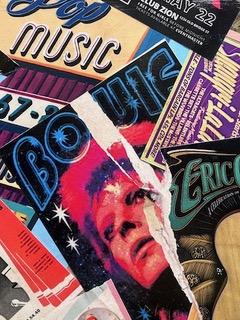
Bowie montage
Deep within the archive of iconic photos and posters is the less familiar image of Bowie in a loincloth by Anton Corbijn. His face is the picture of serenity, hands clasped to his naked chest, thumbs pressed gently together. The pose is one of vulnerable simplicity against a textured background, enhanced by a silver gelatin tint. It was taken backstage in New York before a performance of The Elephant Man (1980). On closer examination of the soft folds in the loincloth the rumours that Bowie was well hung comes to mind, which this image categorically confirms.
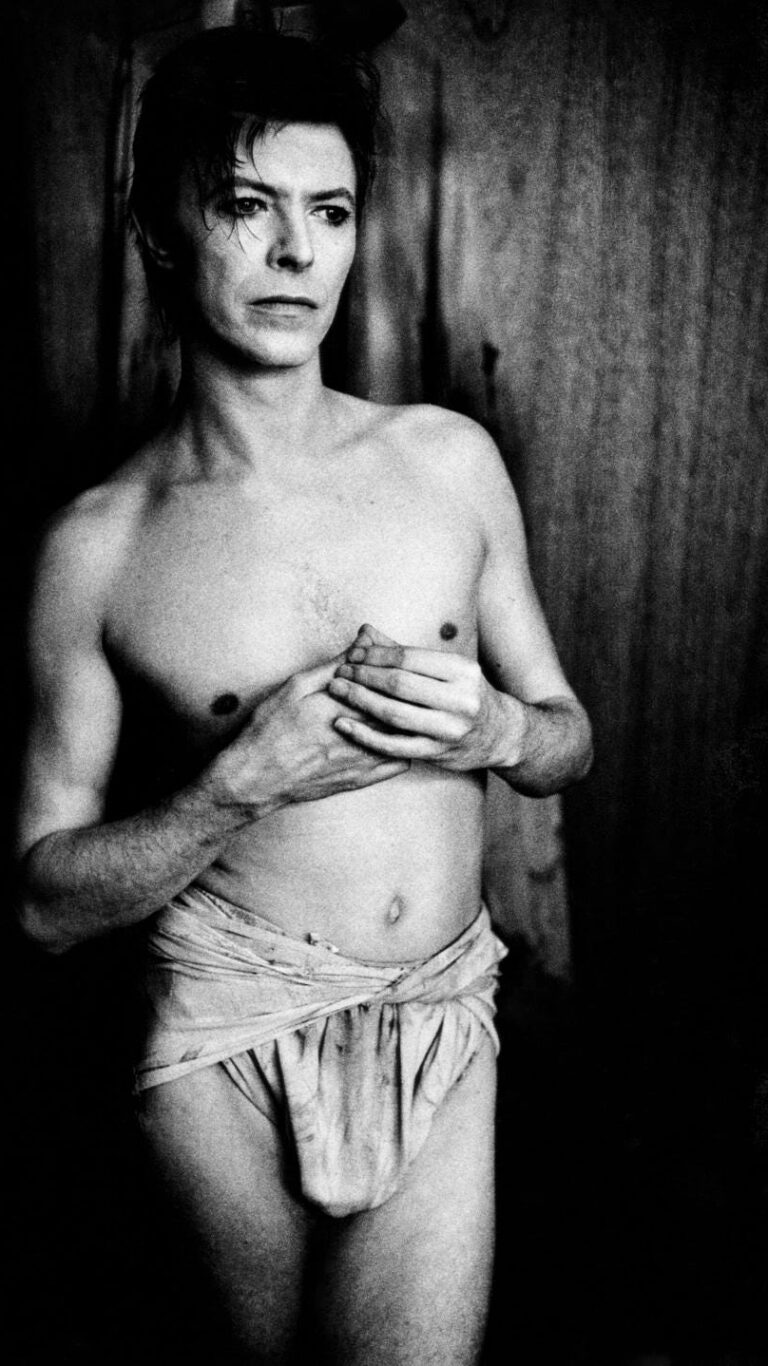
David Bowie by Anton Corbijn
I fancied strumming one of his many guitars and dithered between a red Strat and his 12 string Takamine. In the end I went for the acoustic, which he may have played on Space Oddity (1969), but definitely used on his 1990 Sound and Vision tour. It’s decorated with the signatures of the three members of Placebo, Tony Visconti, Bowie ’99, and a Free Tibet sticker. This rare and desirable instrument is kept safely in its case, and touching is strictly forbidden.
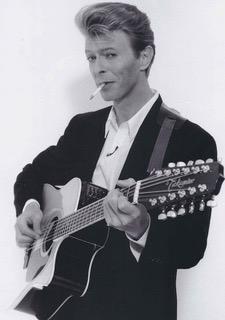
Bowie was a huge supporter of Tibet House, a US charity dedicated to preserving Tibetan culture. He performed fundraising concerts alongside Philip Glass, Moby and Tibetan monks in 2001 at Carnegie Hall, and again in 2003, notably with head honcho of The Kinks Ray Davies.
Karma Man
“I watch the ripples change their size, but never leave the stream of warm impermanence…..”
David Bowie’s long term collaboration with the producer Tony Visconti began with a quirky ditty called Karma Man (1967) and ended with Blackstar, a magnificent final album released on 8th January 2016, his 69th birthday. When he died just two days later there would be no public funeral, just a scattering of his ashes in Bali in accordance with Buddhist rituals and tradition.
Tibetan Buddhism became a spiritual thread throughout Bowie’s life after he attended the London School of Buddhism between the ages of seventeen and nineteen in the mid-1960’s. He had seriously contemplated becoming a monk during his studies under Lama Chime Rinpoche, who fortunately for the world of entertainment directed him towards becoming a musician and performer.
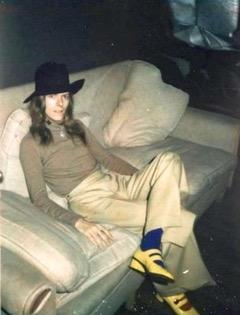
David as a hippy
Bowie experienced multiple incarnations in this one lifetime, and possibly other personas in his private life too. His courageous artistic reinventions Major Tom, Aladdin Sane, the Thin White Duke, and not forgetting Ziggy Stardust, represent a panoply of identities he birthed and killed off to inhabit yet another dazzling character. Just when things were getting conformable Bowie was done and had moved on.
But he never forgot Buddhism’s core concepts of change and impermanence which he integrated into his song Changes (1971) about his journey into adulthood. He continued to universally refer to change as “our river,” and said, “I keep coming back to that, and it means an awful lot to me.”
In 1971 he played Glastonbury Festival, appearing at 5am as the sun rose over Glastonbury Tor. He performed ten songs, many from his then forthcoming album Hunky Dory, and debuted Changes as most of the 6,000 hippies slept. When he left the stage, he said, ”I don’t do gigs any more because I got so pissed off with working, and dying a death every time… It’s really nice to have somebody appreciate me for a change.”
His triumphant return to the Pyramid stage in 2000 was attended by 100,000 people, broadcast worldwide and released as a live album in 2018. In total he performed 22 songs, including Changes, Life on Mars, Fame and Heroes, with four encores.
Hallo Space Boy
“Do you like girls or boys? It’s confusing these days, but Moondust will cover you, cover you…”
David Bowie’s launched himself as a cultural prophet and the ultimate time traveller with Space Oddity, a portal into his fascination with space. Released to coincide with the Apollo space mission in 1969 the song was used for the TV coverage of the moon landing, reaching number five in the charts. Six years later it was re-issued and hit number one.
His iconic appearance on Top of The Pops singing Starman in 1972 looking so wonderfully different in a shimmering rainbow jumpsuit and astronaut boots had captured the imagination of a whole new generation.
He was gaining a reputation as a good songwriter, which prompted Paul Anka to ask him to write the English lyrics for My Way, originally written in French. After his words had been rejected and the song recorded by Frank Sinatra, Bowie responded by writing Life On Mars (1973), once again drawing on his space theme and feelings of alienation.
By revisiting his theme again and again for inspiration he achieved his fastest selling single and second number one with Ashes to Ashes (1980), the sequel to Space Oddity. Whilst experiencing a personal and isolating crisis of my own, the hauntingly strange and emotive Loving The Alien from Tonight (1984) became a major source of comfort, along with Bowie’s sometimes maligned, but masterful cover of God Only Knows (1966), written by The Beach Boys.
Who could forget his portrayal of the sexy, but doomed alien humanoid Thomas Newton struggling to return to his home planet In The Man Who Fell To Earth (1976), inspired by the 1963 novel by Walter Tevis. Bowie wrote the songs for Lazarus, a play that revisits this character, which premiered in New York in 2016, just before he died and transferred to London shortly afterwards.
The musical takes up from where the film left off charting Newton’s descent into compulsive and obsessive behaviour. It features thirteen songs from Bowie’s back catalogue, including the perennial Changes, The Man Who Sold The World, and All The Young Dudes with several impressive interpretations by young artists. The V&A since discovered Bowie was working on The Spectator, a musical set in the 18th century when he died.
And finally, in his last emotive and epic video for Blackstar (2016) an astronaut reclines on an unknown planet under an eclipsed sun. When the helmet is opened it reveals a jewel encrusted skull inside and the death of the restless space traveller.
Bowie, Freedom & Us
Bowie’s message of there being something out there that he felt connected to helped masses of people to feel less lonely by giving them hope. Many of my contemporaries cite Bowie as their absolute inspiration for their songwriting careers, take Gary Kemp and Boy George for example. Goldie, who features in the Storehouse exhibition, cites Life on Mars as the song that connected him to his imagination as a kid in the care system.
Our hero lived for the present and the future, starting young, and wanting the most adventurous life from the age of 16. He pushed hard to get to other places, saying if you can manifest what is inside you, you will see how to coexist with the rest of society. By the time he was twenty-six he was a constant traveller from Europe to America on ocean liners, because of his phobia of flying, and had released Young Americans (1973). But, as an artist, he was unafraid of the deep end or of going out of his comfort zone. He embraced America and its positivity and made New York his permanent home in 2000.
Through his music Bowie set me on a path of freedom as I embarked on my teenage adventures. These were adventures I could not have anticipated, which are documented here: https://samburcher.com/index.php/articles/notes-on/make-me-up (Parts I and II) and https://internationaltimes.it/memoirs-of-a-blitz-kid/
I had the privilege of seeing him in concert twice, of meeting and speaking with him in person, of seeing the first V&A exhibition, attending the musical Lazarus, and viewing Sotheby’s pre-auction view of his prestigious art collection that went up for sale after his death.
It felt as if David Bowie accompanied me on my journey through his music, in moments of synchronicity, art, fashion, film, and theatre. And, I know, I’m not alone in this perception.
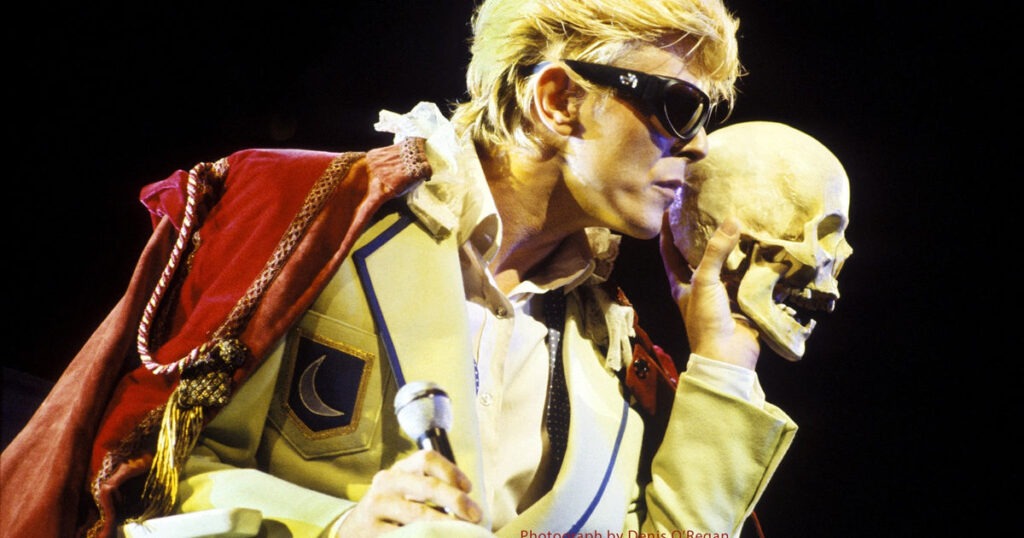
David Bowie performing Cracked Actor
Bowie’s drive for freedom and success culminated in 1983 with Let’s Dance and the sold out Serious Moonlight world tour. Although he had reached the golden pinnacle of superstardom he felt uncomfortable with whatever it was that he had created. From then on his journey would be a return to his roots, both personally and professionally.
In the end for David Bowie the power of living forever was in his music. And now, he is free, just like that bluebird.
The David Bowie Centre V&A East Storehouse, Parkes Street, Queen Elizabeth Olympic Park, Hackney Wick, London, E20 3AX
.
.