
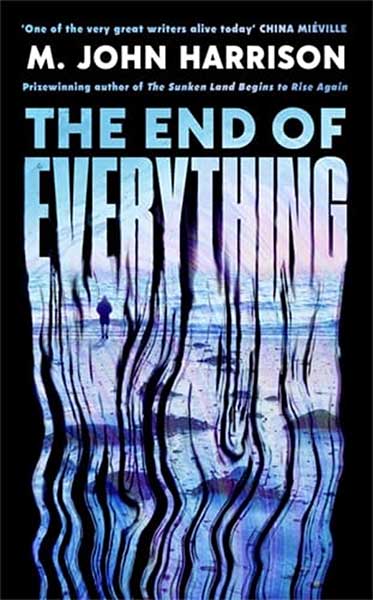
The End of Everything, M. John Harrison (Serpent’s Tail)
- ‘Sorry for your loss’ M. John Harrison is going through another resurgence of critical attention (hopefully resulting in lots of sales and readers). Firstly there were some acclaimed science fiction books, then an autobiographical non-fiction book about obsession and climbing, then a trilogy of experimental slipstream science fiction and, even more recently, an ‘anti-memoir’ and The Sunken Lands Begin to Rise, a bizarre, compulsive fiction about an invasion of damp and mould and moisture, a love/hate relationship with water, something to do with tides and drains and human fears.
The End of Everything also deals with something similar and unknown. The iGhetti (plural) may be a product of climate change or what caused it, either way there has been a reckoning with the sea: changing oceanic and riverine routes and boundaries, redrawn tidelines, and a resulting human apocalypse. Ten years later and small clusters of society are left, grappling with natural change and the failure of government and others previously responsible for a tentative order, whilst new seas and rivers are full of new creatures.
Life is hard. Towns are full of outlaws and self-serving survivors who scavenge whatever gets washed up in the hope of selling it on. But people change, move on, move away, lose themselves in memories and ideas which have no bearing on the present. Tennent and Marnie are two such people, the characters that Harrison hangs this fragmented and elliptical novel on. Tennent is a scavenger, Marnie shoots a child who keeps breaking in to her home. Everything changes again.
The story is told through close-ups and wide-angle panoramas, in generalisms and specifics. Cause and effect do not always seem related, any more than events and narrative are. Memories of others inform the story, or at least fill the pages, but are they back story, explanation or digression? Why does no-one actually know what happened? Why is what society has chosen or had to discard so prized and valued now? What is being dreamt and what is real? Why is everything so tense, so ominous, so seemingly loaded with meaning that is hard to discern as a reader, let alone a character?
I am reminded of J.G. Ballard, but this book is about mud and water not chrome and grease or concrete and cars; and I was briefly reminded of Geoff Ryman’s The Child Garden, much of which is set in a tropical swamp in a future England. But Harrison is less mannered than, though just as taut and pared-back as Ballard, and Harrison’s England is much more English than Ryman’s. This apocalypse is small-minded and petty, like the majority of the survivors, who mostly continue to farm and keep themselves to themselves, stay local, unless something like Marnie’s act of aggression interrupts it all.
The book ebbs and flows, dreams and nightmares come and go. The past is in the present, the present looks back to the past, and no-one is sure about the future. The tide rises and falls, the iGhetti seem distant and uninvolved; and by the end of the book it is unclear if they have returned to the sea or are just moving on. Either way it is uncertain what they have done or achieved, what has happened, or if they even think in those terms.
Is it the end of everything? Or even the end of anything? Is Marnie making a physical journey or a dream journey? Or is she simply remembering the paintings she made when she was an artist? Perhaps this is a story about humankind bumbling along as usual, looking for or making up somebody else to blame. Maybe it is a hallucinatory non-fiction book about the creeks, bogs and soggy fields of contemporary Kent? More likely, it is what one of Harrison’s characters calls ‘an intellectual ghost dance’, one where apocalypse ‘quickly becom[es] just another historical continuity.’ It is an addictive, obsessive and digressionary novel about the mundanity of post-apocalyptic life, lives we might be living already.
- ‘no one really understood what happened’
The End of Everything is a post-cyberpunk novel about societal collapse. A delirious mass delusion of alien invasion from the sea, seems to have been spawned by internet addiction. The aliens, cryptically called the iGhetti (= i get it) are objects adrift in human time, seemingly causing stutters in time: glitches, dislocations and repetitions or iterations over and over again.
In many ways, England seems the same as ever, with people drinking in bars, eating seafood and staring at the sea, escaping from the city for a few days. But meanwhile others live in makeshift shanty towns on the beaches, trying to sell the detritus of previous lives, perhaps a technological world that has been forgotten or wiped from memory.
Or perhaps it is about an England separated from Europe. HOW CAN YOU FORGET A CONTINENT ask the signs that Marnie obsessively makes and flashes at cars passing by on their way to the coast, without really understanding what makes her do it or why. In the second part of the book Marnie is taking a holiday, with a bequeathed alien as her driver. It is sentient, learns quickly and seems to know almost everything; again, it is perhaps a metaphor for the internet and how humans think they know everything simply by reading a website entry.
It is about learning to live. In the moment, alongside each other, thriving on misinformation and misdirection. Reliving misinformation and misdirection. Repeating misinformation and misdirection. Living to learn without any idea what learning is, just collecting and accessing ideas and information but not processing it.
Some die, some move on, some come and go, some form brief alliances, others are at war with those who are different. Memories shift and there are bad patches where the wrong things happen and nothing makes any sense. Perhaps the bad patches are areas without internet or phone connections, although the only mention of technology here is a scene where screens flicker and glow in an isolated room.
Perhaps the delusion is the result of illness? There is a passing reference to covids, plural; perhaps mental health has collapsed and no-one can cope. Perhaps this whole strange novel is taking place on flickering computer screens or immersive AI? Are there any aliens or has the human race mutated so much it has become homeless in what was previously its own habitat? Perhaps it is simply about the end of everything we take for granted and know for now, about a future we are heading towards, locked on a crash course with what we previously predicted, created and wished for, forgetting that desires and infatuations disappear as quickly as they arrive.
The End of Everything is a science fiction about the collapse of time and memory and hope. It is about an alien invasion from the sea by creatures who seem to want to ingratiate themselves with humanity, to fit in, but only understand us on the shallowest level: banter, advertising slogans, games, menus and drinks orders. Perhaps it is all we deserve, perhaps this novel is a warning to turn off our screens and look around. Or start reading.
- ‘We didn’t find what we expected!’
The End of Everything is a novel about misunderstanding, about reflections and refractions, expectations and distortions. The aliens who invade Earth are not what appears, these are simply avatars slipping through the astral plane. They are regarded as objects, something to be salvaged from the sea, by humans, whose world we are informed has already collapsed. (London’s Square Mile has become a no-go zone, although it fascinates the invaders.)
The aliens are able to slip into out world and then physically mutate into humans, mimic our movements, appearances and mannerisms, although it remains unclear what they want to achieve. Do the English survivors busy being tourists or scavengers have anything to offer those from another world?
Apparently so, for the fruit girl declares ‘what it is to be alive, the way they are. This is what it’s been about all along.’
- ‘nothing in memory ever made itself so available’
‘If nothing else, it made the past seem like a stationary train, accessible from the platform of the present, as if you could choose which carriage to enter.’
- ‘The world’s over’
‘But that doesn’t matter. Because another one will be along soon enough.’
.
Rupert Loydell
(All quotes are from the book being reviewed)
,