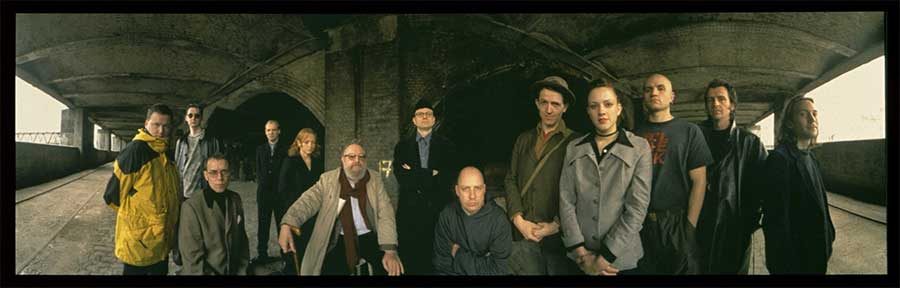
Photo: © Hugo Glendinning 1999. L-R: Stewart Home, Steve Aylett, J.J.Connolly, Nicholas Blincoe, Stella Duffy, Michael Moorcock, Steve Beard, Tim Etchells, Billy Childish, Jenny Valentish, China Miéville, Tony White, Darren Francis.
INTRODUCTION
Back in the beginning of June 2026, killing time on one of those rainy Sundays we used to get, I decided to pull off the shelf a few of my many anthologies. The ones that had the covers that grabbed you by the collar and told you in no uncertain terms: Read Me! I’m talking about Suspect Device, Acid Casuals, Sex Drugs and Rock & Roll and Intoxication, (was anyone on Planet Earth at the time?). As well as my all time favourite – ‘brit pulp’.
As I turned the pages of ‘brit pulp’ and read quite a few of the twenty two contributors’ stories, it was like bumping into an old friend after too long a separation.
So, what was so special, different and iconic about ‘brit pulp’, which was published in 1999 and edited by author Tony White?
No one could sum up what made ‘brit pulp’ a literary ‘trailblazer’ with a better description than Tony’s own words in his excellent introduction:
“‘brit pulp’ is not an attempt to define a generation of writers; after all the stories collected here span some thirty years.It should also become apparent fairly quickly that this is not a themed anthology.While readers may be forgiven for assuming that ‘pulp’ is synonymous with sex and violence and indeed authors like Stewart Home have confessed to using these devices in order to “keep the reader happy there is a lot more on offer than the ‘shagging ‘n’ fighting story.”
Setting ‘brit pulp’ aside I decided, that it would be an interesting experiment to contact as many of the authors as I could find and ask them if they would like to do an online interview with me for potential publication in the ‘magazine of resistance’ – International Times – (still going strong since the 60s, reborn in 1975 as an online publication).
At the moment I have three replies. (More in the pipeline.)
Tony White, who was both a contributor and the editor, Darren Francis – author/musician and Steve Aylett – author/filmmaker, who will be joining us next in IT in the very near future. They have already emailed fantastic answers to my questions about their life and work.
I think it’s time to just hand over to Tony and let him deliver his story in his own way and tell us about the writing/writers from that unique time in and around the 90s, that brought so many writers together and produced some of the most exciting and innovative writing in the history of contemporary literature. Not just the UK writing but international as well.
All yours Tony.
MP) Tony what was it like growing up in Farnham?
TW) Ah, we’re going in the deep end – great! Farnham is a beautiful market town, if you know it. With broad Georgian streets overlooked by a picturesque castle on a hill. I grew up in a working-class household that quickly became a single-parent household, in a semi-detached council house on a post-war estate that sprawled around gravel pits and nurseries on low hills to the south of the town and within earshot of a railway line that led in one direction to my respective paternal and maternal grandparents’ homes in Bentley and Alton (the end of the line), or about an hour’s journey in the other direction to London Waterloo. There was a long train shed, and an ancient wooden sign by the side of the track bore the command: ‘whistle’. So you’d hear the train horns blaring every half hour or so.
MP) Is/are there any cultural ingredients that would inspire an artist born there to become a success?
TW) I don’t know much about success, but certainly (beyond that easy access to London) there were cultural ingredients that might give any thoughtful and observant young person ideas: a good public library for one thing. Farnham Library on West Street – it’s still there. We didn’t have many books at home – a job-lot of Edwardian Encyclopaedia Britannicas from the Scout’s jumble sale – nor much money. My sister and I were given a John Wyndham novel each one Christmas. But there was a constant flow of library books. And at my maternal grandparents’ house there was a constantly topped-up pile of hand-me-down Readers’ Digest magazines, which I would read from cover to cover whenever we visited. So I was a big reader as a child, and a regular visitor to the library. I quickly tired of the children’s story books – Paddington, The Wombles, Doctor Dolittle – and by the time I was about ten I’d be choosing books from the general fiction section: Agatha Christie, Mervyn Peake, Gollancz scifi anthologies, Ellery Queen, and in my early teens Doris Lessing, and more Gollancz anthologies. So even more than school perhaps, the public library was a gateway and point of access to literature.
There was also a record shop, Venus Records, as well as record departments in Boots and Woolworths. And as the writer and scholar Paul Gilroy has said (these are my personal notes from a talk by Gilroy and Linton Kwesi Johnson in Oxford that I was lucky enough to attend a few years ago): ‘they weren’t just places of consuming, they were places of education. Places of a hidden almost public world where people would pass on information and make a community. They were like little churches, I would say. There’s a certain quality of reverence and spiritual nourishment which is also transacted in that relationship with sound.’
Amen to that.
So I’d browse the bins, the singles and LPs… Because record shops were like the thing AND it’s index, all in one. And my sister worked there on Saturdays for a bit, so sometimes I’d hand out flyers for them on a Saturday, which felt more like hanging out and chatting to whichever school friends I might bump into, in exchange for a record or two. It also meant that I’d get to hear about records as they came in: ‘Twat’ by John Cooper Clarke, for instance, which I bought immediately it came in. One of the guys who worked there would say, ‘Oh hey Tony, listen to this!’ This was the late seventies, and music was not just a thing in itself, but also, in its expanded hinterland of accompanying sleeve notes and the music press, in interviews with bands and recording artists, particularly ‘new wave’ bands, and reggae, a crucible for ideas as well as techniques – dub, spoken word, lo-fi cottage-industry productions – and a source of reading recommendations. It was from belated listening to Syd Barrett that I got switched on to James Joyce, Scritti Politti sang about Derrida, Laurie Anderson recommended Gravity’s Rainbow by Thomas Pynchon and John Dos Passos, while Throbbing Gristle then Psychic TV – and the avant-gardists Tuxedomoon – spread word of William S. Burroughs. Talking Heads covered Hugo Ball. Hungry for the new, I acted upon such recommendations and reinforcements.
But most importantly for me, Farnham was and is a small town with a big art school: the former West Surrey College of Art and Design, now University of the Creative Arts. Which meant that art was a fact of life; something people did for work. At one point we had regular art student lodgers in our single-parent household, which demystified things further. Here were youngish people, a decade older than me, who spent their time absorbed in learning how to create things from scratch. So maybe there was a bit of learning by example involved. They had good record collections too. But because of them I learned that there was a thing called a Foundation Course that you had to do if you wanted to go to art school. And because I was reasonably good at drawing, I wanted to go to art school.
MP) Could it be a contrary situation where Farnham creates an author/authors who are ‘exploding creatively’ and feel the need to write books like Road Rage, Satan Satan Satan or Charlieunclenorfolktango because he has to let his imagination escape the bubble and get out into the wider atmosphere/world? Could you reflect on that proposition?
TW) Épater les bourgeois? Maybe. Well, sure, there’s some lingering punk jeu d’esprit crossed with devil-may-care attitude in those first few novels. But in fact I’d escaped from any Farnham bubble long before that. And a great deal happened between my leaving Farnham aged 20 to move to Leeds in 1984, and Road Rage coming out in 1997. I had no family home as such in Farnham by that time, so I moved to Leeds and signed on while I tried to figure out what I needed to do to get a grant and get back into art school. I was by then into not just books and music but also ‘performance art’, inspired by what scant details I could glean about the more radical and dada-ist margins of twentieth century culture. Although in those pre-digital days, one had limited access to information, you’d be more likely to hear rumours about something than to have actually seen it.
MP) Do you think geographical places can be in the epicentre of experimental art – in particular literature?
Like the Jam in Woking, or John Betjeman’s Slough, Hughes in Yorkshire, Black Sabbath in Birmingham or Hardy’s ‘Wessex’. Do they really shape the artist?
What are your thoughts on Location, Location, Location???
TW) Well, maybe. I’m sometimes described as a London author, or a writer of ‘London novels’, and perhaps an ancient capital city like London, and its position at the centre of global and colonial systems of language, trade, exchange and exploitation, and of migration, with great cycles of increase and decline, and as a centre of waxing and waning cultural power, has of course made it an epicentre for a multitude of literary voices since the earliest days of the European novel, when printers and publishers were based in the streets around St Paul’s churchyard – from where Thomas Shelton’s first English-language translation of Don Quixote was published by Edward Blount in 1612. But you could also point to a smaller industrial city like Sheffield. When I finally got to art school in the mid-eighties, it was to Sheffield rather than Leeds. And there’s no disputing that Sheffield was definitely still, even then, the epicentre of a particular kind of radical, experimental and innovative electronic music. We encounter some of this in Phantom at the Feast where a young Black police officer is a big Cabs fan (the band Cabaret Voltaire). So, the answer to your question is yes. And there are now some great books by people like Martyn Ware (co-founder of the Human League and Heaven 17), Jamie Taylor, and Daniel Dylan Ray, reflecting on this. Not to mention some excellent books by members and former members of the band Pulp.
MP) Do you have any reflections looking back on what was going through your mind when you decided to write those early novels in the way you did?
TW) The early novels: Road Rage! Yes, by this time I was living in London. Amongst other things, like everyone else, I’d been reading Richard Allen’s Skinhead novels, but also Michael Moorcock’s ‘Eternal Champion’ series. I’d noticed that writers emerging in the early nineties like Stewart Home and Victor Headley were riffing off the Richard Allen novels. Nicholas Blincoe’s Acid Casuals too perhaps. I’d seen a performance artist named Roy Bayfield read from Richard Allan in his performances at the Zap Club in Brighton in the mid-eighties. But moreover Home and Headley were setting their novels in the streets of East London where I lived. I was particularly inspired by Victor Headley and how he and Dotun Adebayo had set up X-Press just around the corner from me, to publish Headley’s debut novel Yardie, and then a whole roster of new Black British writers.
After leaving art school and moving to London I’d been writing short autofictions that weren’t really going anywhere, dozens of them. I realise now they were a way of learning the craft, learning how to bring a short story home; to be able to identify and pursue its demands. I realised that beyond that, most of them were dead wood, and threw them away many years ago. But while cycling to work at the old Islington sorting office one day, I’d seen a poster on the canal towpath for a new themed fiction anthology-cum-magazine with very of-the-moment design, called Pulp Faction. And then I saw in Time Out that they were looking for contributions for a second anthology with the title/theme ‘Technopagan’. I had a story that fitted the bill, so sent it off. And it was accepted for publication.
Technopagan – including my short story ‘A Pagan Day’ – came out in the autumn of 1995. But before that, in August of that year, I was back visiting friends in Sheffield, the experimental theatre company Forced Entertainment (at the time Tim Etchells, Cathy Naden, Robin Arthur, Richard Lowdon, Terry O’Connor) who I’d got to know well while I was a student. Roy Bayfield was there too, who by then was no longer working at the Zap Club as the performance art cleaner-cum-MC, but at Wolverhampton Art Gallery. I’d gone up for a party, and all of us were slightly hungover the next day, sitting in Endcliffe Park in Sheffield, talking about those Richard Allan reissues, and this fragmented not-quite scene, perhaps a distributed tendency is more accurate, to reappropriate a certain seventies pulp style. I was thinking out loud about which subculture a contemporary Richard Allan would be writing about now; which excluded group was the most vilified? Not skinheads any longer, it seemed, but ‘crusties’ and working-class single mums. I knew people – friends, and friends of friends – in Claremont Road, the houses in Leytonstone that were due to be demolished to make way for the M11 Link Road. I’d heard rumours about Reclaim the Streets. So crusties it was. And somehow during this conversation in Endcliffe Park, Sheffield, a consensus was reached – in my mind at least – that to write a contemporary novel in the Richard Allen style, you’d base it on some contemporary subculture, do no research, write a chapter a day, and ensure there was some transcendent act of sex or violence in every chapter.
Once back in London, and within a week or so of that conversation, my young son got a pre-school nursery place from 9am to midday every weekday. I’d been responsible for childcare in the mornings, before going off to do the late shift at the Post Office in the afternoons, so suddenly there were two and a half hours a day when I could write. I could see the shape of this ‘crusty’ novel – the first few chapters anyway, so ditched the short autofictions, wrote a chapter plan, and started immediately: writing a chapter a day, no research, etc. I found that a kind of Moorcockian fantasy melded easily with a crusty road-protestor scene that I’d shifted a few miles west from Claremont Road to Well Street in Hackney, around the corner from where I lived. It felt a bit like surrealist automatic writing, using whatever was to hand in terms of locations and scenes: a juggler busking on the overground at Hackney Central, the Pub on the Park in London Fields, posters for Jah Shaka, all tumbled directly from the streets into the mix. Within a month at most, two or three weeks, I had a finished manuscript.
Getting that first novel published was another matter. I didn’t have an agent or even really know anything about getting published, so posted it to publishers listed in the Writers’ and Artists’ Yearbook and got lots of rejections. But in the meantime Technopagan was published, and there were readings and events, and a group photo (which I’ve never seen!) of most of the contributors on the steps of a Hawksmoor church in Limehouse.
There was a great books programme on the BBC at that time called Bookmark, and they broadcast a documentary in 1996 about the legacy of the Richard Allan novels, interviewing Victor Headley, Stewart Home, and publisher George Marshall up in Scotland who’d been reissuing the Richard Allan novels in 3-volume trade paperback format omnibus editions, which I’d been buying as they came out. I watched this and thought: okay, George will get this! As in understand/enjoy it. So I sent it to him. I got a letter back in a few days, saying he’d like to publish. All respect to George, he really got behind the book. A neighbour in Hackney, the photographer David McCairley had taken photos at a demonstration-cum-eviction party for a squat opposite Hackney Town Hall, and we used one of those on the cover. I remember George saying that because I was ‘a real writer’ and he had faith this would not be my first and only published novel, he made the decision to say ‘a Tony White novel’ on the cover: as if my name meant something. What a vote of confidence. What a lovely bloke.
MP) Charlieunclenorfolktango (Codex, 1999) – “bizarre, depressing and unreadable” LRB. How did reading that comment feel?
TW) It’s water under the bridge now, of course, but because of my then inexperience I didn’t deal with it very well at the time. Charlieunclenorfolktango was my third novel. The opening chapter had originally been written as a short story in response to a request by Stewart Home for a contribution to an anthology he was putting together. It was written in a fury at the conduct of the Metropolitan Police during the Stephen Lawrence murder investigation, in a kind of phonetic and mechanical approximation of a white male working-class voice: an alienated police force locked into a cycle of violence and self-justification.
In the event the story didn’t run in the anthology, but I’d found that I couldn’t switch the voice off. This stream of filth had already grown into half a novel. I was working nights at the Post Office sorting mail for much of the nineties, and I was writing Charlieuncle… in long-hand in my breaks at work. The material had its first airing – with live musical accompaniment from my friend Jamie Telford, the former Hammond Organ player for The Jam – in a basement performance art space off Brick Lane, called Hollywood Leather, run for the love of it by an artist called Christopher Hewitt. That opening chapter worked well live. It went somewhere interesting, its particular combination of narrative switchbacks and extreme profanity surprised people and made them laugh a lot. So I knew it had legs, and I’d perform that opening chapter whenever I could. This was around the time when my first novel Road Rage! was coming out on Low Life Books.
It’s worth mentioning that for a few years in the early nineties – with skills I’d picked up at art school and on the road – I’d begun programming events, performances, screenings and readings, at a gallery called The Showroom, then in Bethnal Green. I was doing that for three or four years around my Post Office job and having a young child. It was a busy time. When I stepped back from The Showroom in 1994, wanting more time to write, I did also immediately devise Piece of Paper Press as a way of publishing small lo-fi limited editions by artists and writers. Piece of Paper Press seemed to be a way to continue having the same kinds of conversations, but might be lighter and more sustainable than programming actual bricks and mortar events. Piece of Paper Press continues to this day: in the past thirty-two years I’ve published miniature books by Joanna Walsh, Courttia Newland, Michael Moorcock, Liliane Lijn, M John Harrison, Susana Medina, Alison Turnbull, Sharon Kivland, Andrea Mason, Pete Smith, and many more.
Road Rage! was launched in the summer of 1997 at a bookshop-cum-bar called Tactical then in D’Arblay Street, Soho. There was such a big crowd that the police strolled around to see what was going on. And it got lots of press – in magazines from Scootering and the Big Issue to the style press, i-D Magazine. There was much good will toward what George was doing, and people seemed to enjoy the novel.
One thing I discovered is that once you have a book out there in the world, it starts to have a life of its own. You never know who might pick it up, or who it might speak to. And through Road Rage! I met people like Steven Wells, aka Swells, the former punk poet Seething Wells, whom I realised later I’d seen performing his ‘Tetley Bitter Men’ zombie routine live one time up in Leeds. So I’d see Swells around. He was an unapologetically larger than life character, with his shaved head and grubby tracksuit bottoms, and he’d shout ‘Oi, Road Rage!’ – that was his nickname for me – and he’d seen me performing Charlieunclenorfolktango a few times, which was still unpublished, and he wanted to publish it on this putative Attack Books imprint he was trying to set up with his friend and fellow music journalist Tommy Udo. Both of them are now dead, sadly. But Attack took a while to make happen, and in the meantime Charlieuncle… (for short) got picked up by Hayley Ann the publisher at Codex, another small press based down in Hove. Codex had been set up as the publishing wing of a record company in order to publish a live CD of Kathy Acker – their list included Billy Childish, Stewart Home, Steve Aylett. They did a beautiful job of publishing it, and it was launched with a performance at a gallery called Cabinet, who’d been showing various of my visual artist contemporaries.
So when the LRB review appeared, as a still relative newcomer and/or outsider, published by tiny small presses, I was thrilled to get my first serious review (alongside Irvine Welsh no less), at least until I read it. But actually: great! I should have just measured the column-inches. And you know, you really can’t win em all. And it’s always better to be slagged off by someone who’s actually read the book in question, than by someone who boasts of not needing to read a word – I’ve had that a few times from people who should know better. Getting a bad review now I’d probably be a bit miffed for a day or two, have a bit of a moan, but of course life goes on, and you’re already working on the next thing, and it’s better to be reviewed than not.
But in spite of all that, thirty years after I started writing it, Charlieunclenorfolktango still has legs, and I still perform readings from it occasionally. The late Malcolm Bennett, author in the eighties of the Brute! comic strips and books, persuaded me to put it back in my live act – in as far as I have a ‘live act’ – and to open for him at some warm-up gigs he was planning. I’d met Mally at Swells’ memorial where I’d been on stage to give a reading of some of Swells’s fiction. Afterwards this urban gaucho ‘man-in-black’ with silver-tipped cane came over and introduced himself: Malcolm Bennett. Once he said the name, I knew who he was, because me and my friends in Sheffield had been fans of the Brute! comic strips. Mally told me that Swells had sent him the manuscript of Charlieunclenorfolktango when he was in prison. He said it had kept him going, and restored his faith in human nature! Also that he wished he’d written it. Malcolm Bennett and Swells – to have two working-class pioneers of the UK live literature underground briefly being such vocal supporters and champions of my work was a real boon. I miss them both.
MP) The Modernists (C1922) are canonised because they took a chainsaw to the written form, Joyce, Beckett, Woolf, etc.
Yet the so-called ‘slipstream’ writers can’t go in for a bit of ‘genre busting’, taking the defined genres to the literary ‘chop shop’ without being labelled ‘unreadable’, having created something perhaps not entirely original but refreshingly new.
TW) You know, I hate to say, but I’m not sure what slipstream is. I just looked it up to remind myself. I think if you asked someone to come up with a list of slipstream writers I would not be on that list. Was it a more scifi-adjacent thing? In terms of contemporaries, I do have vague memories of seeing authors like China Miéville or Steve Aylett being called ‘slipstream’, but I don’t recall my books ever being included in that. Anyway, I’m not entirely sure I agree. Didn’t Woolf call Joyce unreadable: too Irish and too working class?
And still, as crude as it was, Charlieunclenorfolktango got a fair few positive reviews as well. Time Out gave it an excellent review: a sort of ‘If you’re looking for innovation in crime fiction look no further’ type of thing. As did other listings magazines in other UK cities: Buzz in Cardiff, The List in Edinburgh and The Source in Brighton, all supported Charlieunclenorfolktango. And it’s hard to overestimate how influential the Time Out books pages were at that time, it had such a big readership.
MP) An author friend of mine suggested that ‘slipstream’ writers owed a lot ancestrally to writers like Kurt Vonnegut,Tom Robbins and Terry Southern.
Do you think this is a fair comment? Or would you identify other influences?
TW) Vonnegut, Robbins, Southern? Huh? They’re certainly not my influences – not remotely. Nowhere near. But maybe that’s because I’m not slipstream! Of course, I’ve read Slaughterhouse Five. I tried reading Tom Robbins in the early nineties when the paperback was being promoted on the back of Gus Van Sant’s film of Even Cowgirls Get the Blues, but I got bored or didn’t get along with it. Terry Southern I only know from his brief speaking appearance as a dinner guest in Howard Brookner’s 1983 William S. Burroughs documentary, and that didn’t make me want to read his books. So, no. For me the alternative triumvirate would be William S. Burroughs, Franz Kafka, and Gertrude Stein; backed up by Linton Kwesi Johnson, James Kelman, Michael Moorcock, Georges Perec, Kathy Acker, Italo Calvino, pre-Vineland Pynchon, second-hand Ed McBain paperbacks – which were everywhere, in every junk shop and charity shop. In the late eighties into early nineties I was also reading, devouring, books by William Gibson, KW Jeter, Tim Powers and James P Blaylock. And in the wake of Michael Moorcock’s majestic Mother London, I got switched on to Iain Sinclair, Peter Ackroyd, Maureen Duffy, and also a younger generation of more marginal London novelists and near-contemporaries, particularly Victor Headley and Stewart Home.
But it was Burroughs, Kafka and Stein for me. I once (only half-) joked that Gertrude Stein was my mother, creatively speaking. And actually discovering Kafka at the age of 18 got me sacked from a cleaning job I’d had for the first term or two of the Foundation Course at Farnham. The college gave me a cleaning job as a way of paying-off weekly instalments of some tiny enrolment fee, I think a contribution to workshop materials/equipment (a matter of twenty or thirty pounds) that my family couldn’t afford. But one morning I went in to work and somebody had left Metamorphosis and Other Stories on their work bench. I opened it and was immediately transfixed. For three days I spent more time reading Kafka than sweeping and mopping floors, so I lost the job. But by then I’d already paid off the workshop contribution or whatever it was. It was around that time, too, that Howard Brookner’s documentary on William S Burroughs was broadcast on BBC TV’s Arena. We watched it on video dozens of times in the art school library; they’d taped it off the TV. And through my cleaning job I found out someone had two spare tickets for both nights of Laurie Anderson’s epic performance art work United States I-IV at the Dominion Theatre. So I got to go and see both nights: amazing.
In (I think) a Time Out interview around then, Anderson recommended Gertrude Stein’s Geographical History of America, which I couldn’t find in the shops, but I did find Three Lives. Those three writers, Burroughs, Kafka, Stein, in their different ways, ways I didn’t fully understand at the time, expanded what I thought words and writing and literature could be and do.
MP) Perhaps we should stick the Nouveau Roman in the shredder along with the ‘cut ups’ of Burroughs (an early influence?) and Gysin!
 Dreammachine phone
Photo: Sarah Such
Dreammachine phone
Photo: Sarah Such
TW) I haven’t finished exploring the potential of the cut-up technique. And I love the few Marguerite Duras and Alain Robbe-Grillet novels I’ve read to date. Though I’m not a completist. I haven’t read everything even by authors I love. I put that down to being working class, not having much money in formative years, getting used to making a little go a long way. I’m still pondering the implications of things I read decades ago.
I far prefer Brion Gysin’s visual art to his fiction. I’m sorry to say that speaking personally I found his novel The Process extremely boring when it was published in paperback in the early eighties. But that obviously says more about me than the book, and I probably wasn’t ready to read it or didn’t know how. I should look again, not least because – as Iain Sinclair has pointed out – we all of us talk about ‘the process’ all the time now and the calligraphic works, his grid-based collages, the dream machines, and the cut-ups… Gysin’s lightness, and his openness to collaboration. Wow. That stuff was actually still so underground in the early eighties, even if Burroughs novels were being reissued by Picador in the UK. But Gysin’s actual Stanley knife – the Ur cut-up machine – is right now in the massive survey show at the Pompidou. He used to live right opposite the Pompidou, didn’t he? Seeing Dream Machines in the Electric Dreams show at Tate Modern a couple of years back was quite special. In the early eighties they were shown in tiny B2 Gallery in Wapping iirc. Even into the mid-90s it was simpler (if you knew where to look!) to pick up a zine from some Psychic TV fans in Brighton that contained plans and instructions for building your own dream machine, than to actually see an original. I was pleased recently to pick up a definitive edition of Gysin’s Permutations on Brooklyn-based DABA press, edited by Alec Mapes-Frances, via the late James Grauerholz. Even just a month or so ago I bought a rare second-hand copy of Burroughs and Gysin’s seminal book on collaboration The Third Mind, which I’d been wanting to re-read in print for a long time. Not least because collaborations with artists and musicians have remained a constant (if necessarily occasional) aspect of how I’ve worked as a writer, and that book may have been part of where I’d got the idea.
MP) The classic 50s/60s + Counterculture was fast becoming a series of museum exhibits by the time you would have been at school, left school and writing.
Counterculture becoming an Establishment of its own.
In the past I have interviewed writers/artists who were part of an earlier Counterculture or influenced by one. When asked if they thought a Counterculture was still a necessary part of any existing culture they unanimously viewed an alternative norm-challenging culture as an essential balance to an existing culture. Would you agree?
TW) Is a counterculture necessary? Yes, of course. Opposition and resistance to violence and hate, and to state crime. Although if you look back at footage of what once might have been thought to represent culture and counter culture, it often looked a lot like two privileged white guys who’d been to the same schools and rehearsed the same oppositions all their adult lives, both comfortable in their access to media and their relative positions. But that was an illusion produced I guess by the limited mass media of the time. You can now see that it took visionaries like James Baldwin to address the violence inherent in that privilege, and appreciate the courage that took. During my youth, the anti-nuclear movement, Feminism, anti-racism, trades unions, the Stonehenge free festival, not to mention punk and reggae music, all those things briefly put dissenting ideas from the margins into the mainstream. Is that the counterculture? Or are there many countercultures? I think we need to talk to a historian. I don’t think it’s just a question of balance, though. Balance has been misused to give false legitimisation to the far right, to science deniers, anti-vaxxers, and climate change deniers, here in the UK as elsewhere. There are myriad fronts on which destructive dominant cultures need countering right now, and where basic human rights are not only being denied but being wilfully and murderously disregarded. Lives seem dispensable to the new fascists, body counts positively de-rigeur. It’s terrifying. In the medium-term I think the survival of any culture seems uncertain, although stories, music, art are such a fundamental part of being human that I don’t think they can be erased from whatever human experience remains possible in the future.
MP) I once asked the American novelist/poet and chronicler of the Beats, Mark Terrill this question:
MP: Do you think the counterculture is still relevant today?
MT: I think that as long as there is culture there will be a counterculture. The question is, how successful can any kind of protest or rebellion be in the post-fact, post-truth world we now find ourselves in? The internet, which originally looked as though it might serve to bring people together, has done exactly the opposite, fragmenting public opinion into infinite factions with no real consensus.
So, while the motivation and reasons for protesting or rebelling are certainly there, the means by which to do so have definitely been challenged by the new digital world order.
Would you agree with Mark Terrill?
TW) I guess so. But whenever he said that about the ‘digital world order’, the same goes even more so today.
MP) There isn’t much recorded about your early school and further education.
Is there a reason for that?
TW) No reason, beyond the fact that until this interview right now, no one has been interested. You could well be the first person who’s asked.
MP) Were you a Grammar school boy, who went to University, Art school?
TW) Grammar school? No. I’m too young for that. After Pilgrim’s Way primary and St Peter’s middle schools, I went to what was then called Weydon County Secondary School in Farnham in 1976, by which time educational policy in the UK, well in England certainly, had switched away from the 11-plus etc. to the Comprehensive system. If any grammar schools still existed, they certainly weren’t in Farnham. Actually I think the sixth form college was repurposed out of the buildings of the former boys grammar school. But there was a certain anarchic element at Weydon, enabled by the fact that you could hang out in the art room at lunch times (boys, anyway: the art teacher preyed on fifth-year girls), and people would be screen-printing Red Brigade T-shirts. Also Rural Science was a subject. There was a school farm run by a hippy smallholder called ‘Mac’, where you could muck about. I actually won the prize for Rural Science in the 3rd year, possibly because I could string a few words together (the Rural Science department wasn’t a refuge for academic excellence) but I didn’t take it at O-Level. I was into drawing and painting. There was a great English teacher at Weydon at the time named Eiri Thrasher. She’d been a singer in the Welsh folk pop group Y Triban – whose work has stood the test of time. Their Welsh-language version of Kris Kristofferson’s ‘Sunday Morning Coming Down’ is very rich and strange, well worth looking out if you don’t know it. Funnily enough I bumped into her on a train maybe a decade after I’d left school, and she’d gone back to working in the music industry.
From there I went to Farnham Sixth Form College, which was probably the first time I really enjoyed school – it sounds a bit ‘Secret Diary of Adrian Mole’, but starting the A-Level Art class felt like I’d found my people! Perhaps sensing this, the art teacher Anne Weeks let me attend the Art History A-Level classes too, even though it was too late to register me for the exam. And later it was thanks to her intervention that I got a place on the Foundation Course. But after completing that, I had to take a three-year break before going on to do a Fine Art degree. Due to the vagaries of my family situation I needed to prove I’d been self-supporting for three years in order to qualify for the now legendary ‘full grant’. So after that enforced hiatus, by the time I did get to art school I was very motivated. But then, whatever initial half-formed ideas I’d had about ‘making films’ or ‘video art’, once I got the place at Sheffield, those ideas quickly fell by the wayside, as I started to realise that maybe writing the idea down was the thing. Writing it down and reading it aloud, at first. There was a kind of nascent performance art scene around the UK at that time, which you caught sight of in art magazines, in particular Performance Magazine, and I was kind of gathering up bits of prose – ragbags of anecdotes and autofictions, apprentice pieces really – and presenting those to audiences as shambolic spoken word performances in venues like The Leadmill, but also farther afield at other art schools and these grassroots collectives like Hull Time Based Arts, gigs in pubs, empty shops and artists studios, as well as more formal and higher-profile national institutions like the ICA in London. So in terms of becoming a writer of fiction, I really went the long way around, but essentially I started writing at art school – narrative fragments; juvenilia of course, long lost, thank goodness – and reading it to audiences, testing it out, then rewriting, testing again a week or so later; rinse and repeat. It was a while – a few years – before I even thought of or thought I might be writing for publication.
MP) Were you a rebellious youth? In the late 80s and in the mid-90s? Was there a rebellious period you could nail to the mast – so to speak?
TW) I think it’s rebellious to be working class and pursue a creative path, certainly in the UK. In the mid-eighties I was living on the dole in Leeds. On the margins of society perhaps, but not particularly rebellious I don’t think. By the late eighties I was at art school in Sheffield, after which I moved to London, and worked at Foyles for a while. By the early-nineties I was working for the post office and had a young family – though I was also writing, putting on events, starting Piece of Paper Press, etc.
Some readers, when they learn that parts of The Fountain in the Forest take place in the Battle of the Beanfield, ask if I was there. As if that can be the only motivation for writing about something. My answer of course is no (though I’ve now met several people who were). But I didn’t get the chops to address something as important as the Beanfield by being there, I got them by learning to be the best novelist I can be and finding a compelling way to depict all the complexities of the moment. Although, actually, I was at the last Stonehenge Free Festival in 1984, albeit very briefly. But the first glimpse you get of the festival in Fountain is from my own personal experience. And I was at the so-called Poll Tax Riot in Trafalgar Square on 31 March 1990. But I wasn’t in the middle of the square, in the melée, I was watching from the raised dais beneath the portico on the front of the National Gallery; with this struggle playing out in front of me, and all the history of power and its representation in the gallery behind me. But isn’t that kind of like the position of the novelist? Here I am in this privileged spot, this ornate gazebo, sandwiched between the historical struggle and the institutions of power, watching police vans being reversed at speed into the crowd, police horse charges, the crowd scattering, useless fusillades of sticks that have become detached from their placards… Just that now, the ornate gazebo I’m watching from isn’t the portico of the National Gallery, it’s ‘the novel’: the novel is both the privileged position and the vantage point.
MP) Emerging now as a writer primed to give the first three novels prior to Foxy-T:
“White’s first novels Road Rage (Low Life Books, 1997), Satan Satan Satan (Attack Books!, 1999), and Charlieunclenorfolktango (Codex, 1999) – ‘bizarre, depressing and unreadable’ have been located on the ‘marginal terrain of avant-pulp’.”
Reading the early novels reminded me of the experience of watching the BBC News on Acid once. I cried because somebody was digging up a dinosaur in Arizona and then there was a plant (The Corpse Plant) which flowers only once in decades and it was opening in Kew on live TV.
In the next frame a storm in the Philippines was shredding palm trees and peoples’ homes were becoming kites in the wind.
I suppose if you’ve ever taken LSD – life and similarly your early novels are a bit like a library with all the different sections swept away tangled together in a gale.
A bit like the Day in A Life “I read the news today. He blew his mind out in a car”
Do you think critics of avant pulp/slipstream are a pretty humourless bunch?
Perhaps lacking the faculty to ‘disconnect‘ their imagination from the mainstream Literature! Plug into something more challenging but in equal measure exciting.
TW) In terms of psychedelia, that’s interesting. I set out to write the Battle of the Beanfield scene in The Fountain in the Forest as a kind of psychedelic vortex, partly as a way of ramping up the tension and the visceral sensory overload. But who am I to judge anyone’s sense of humour? I don’t think anyone has the monopoly on humour, and I fear these micro genre definitions will be meaningless to most readers. Which is not to say they don’t have value.
But since you mention ‘avant-pulp’, which is a term that was applied by a very small number of critics to my early novels, yes: because of that I’ve taken a personal interest in that one. It’s ultra-niche, but if anyone other than you and I are interested, the term ‘avant-pulp’ was coined by Vurt author Jeff Noon in 1996 or so I think, in Pixel Juice or perhaps Automated Alice, to satirise US author Mark Amerika’s Avant Pop Manifesto, and the Larry McCaffery anthology After Yesterday’s Crash: The Avant Pop Anthology of 1995. (My brief DM correspondence with Jeff on the topic is lost to the vicissitudes of Twitter/X.) When my first short story was published by Pulp Faction in their Technopagan anthology in 1995 – which also had stories by Noon, Simon Lewis, Darren Francis, Steve Aylett, Sonya Madan, Hilaire – there was a quote from Hari Kunzru writing in The Wire on the cover, saying something like ‘Britain’s answer to Avant Pop’. There’s still a good interview online with Noon from 2000, by Polly Marshall (who used to run a regular spoken word gig in Brighton called ‘Do Tongues’) covering his coining of the term, and the straightforward collision of ideas it broached: I think the potential example he gives is Ulysses written by Raymond Chandler, or James Joyce writing noir. There’s some recent critical writing by Xavier Aldana Reyes about Steven Wells’ more histrionic and hyperbolic use of the term, in Reyes’s essay ‘The New Avant-pulp’ that mainly focuses on my novel Satan! Satan! Satan! (Attack, 1999), and forms a chapter in his book Body Gothic (University of Wales Press, 2014). Swells, as I understood it (and sadly he’s no longer around to ask), used ‘avant-pulp’ as a kind of indiscriminate and hyperbolic amplifier. The logic was, I think, that whatever ‘pulp’ was, ‘avant-pulp’ must be even more so: faster, punkier, louder (and Swells was very loud!), more extreme, more of everything! By contrast I saw it more literally as ‘doing what it said on the tin’: describing writing that combined avant-garde and pulp techniques – closer to Jeff Noon’s original idea. It was the critic Sukhdev Sandhu, reviewing David Peace’s GB84 in the Telegraph in 2004, who described the ‘marginal but intriguing terrain of avant-pulp’ – citing works by me, Stewart Home, and Peter Sotos (whose work I’m not familiar with) as prime examples of avant-pulp, and suggesting that Peace was doing something similar.
Satan! Satan! Satan! was named of course after the sample that opens the Butthole Surfers song ‘Sweatloaf’. Incredibly, years later – probably around 2013 – I was involved in a collaboration with Gibby Haynes of Butthole Surfers, via a mutual friend the LA-based artist Steven Hull, several of whose large-scale collaborative projects I’d taken part in previously. Steven got in touch and asked me if I could write a story at ultra-short notice that might be performed as a giant psychedelic puppet show on the beach at Santa Monica for an all-night, dusk-till-dawn media arts festival called Glow: Santa Monica. He needed it in a couple of days! Luckily I’d had an image of skimming stones with my father on Pacific Beach near San Diego when I’d seen him in around 2002, and I thought puppets of conquistadors would be cool, so I dropped the skimming stones scene into a bit of fictional Carlos Castaneda apocrypha, a psychedelic parable about Cortes and his generals travelling north up the Pacific coast to commune with the native american Chumash peoples and their shamanic pinwheel/datura culture. Simultaneously, Steven Hull asked Gibby Haynes to do the music. We never spoke or conferred on any aspect of the project – and haven’t to this day – but spookily Gibby’s music illustrates my story illustrates his music illustrates…(etc.) Following the performance at Glow: Santa Monica, the story and Haynes’s music were included (separately) on a vinyl LP of the project released on Hull’s own Nothing Moments label. But Christopher Schnieders in the LP liner notes observes that Haynes’s music ‘synchronizes remarkably with Tony White’s story.’ Interviewed by Schnieders, Haynes said that he ‘intentionally did not read the story then was shocked to find out how much the writing inspired the sounds.’ There’s a radio edit of the two put together on my site if anyone wants to hear for themselves.
MP) How do you react to an accusation that I’ve heard that more experimental genres lack emotional depth? Can it be quite shallow and that the characters are devoid of warmth, personality and humanity? Could these characteristics be a casualty of experimentation?
TW) I’m not sure such generalisations bear much scrutiny. The formidable author and novelist Kirsty Gunn says (and I’m paraphrasing wildly): By the time you’re reading this, the experiment has already been done, and it worked. But conversely you could see similar criticisms levelled at quite a lot of popular fiction. I don’t think my characters are devoid of warmth, personality or humanity: meet Foxy-T! meet Rex King! Rex is a complex character for sure, but readers get quite attached to my characters. At my book events people always ask me things like, ‘What is Foxy-T doing now?’, or tell me how much they like whichever character in Fountain or Phantom. At a book event this week someone put up their hand at the end, wanting to know how Foxy-T is doing, and was Foxy-T (the character) going to have her own sequel!
MP) Do you think the art of experimentation in writing is waning – or is perhaps lost?
Any comments on the present time?
TW) On the contrary, I think there’s more avant-garde and experimental writing being published and by more small presses than ever before, particularly by women and queer authors, both at the centre and the margins, internationally and in translation, and in the crossover areas between literature and the visual arts. From micro presses like – off the top of my head – Ma Bibliothèque, Joan, Tenement Press, Tangerine, through Peninsula Press, Prototype Books, there are too many to count, and even Fitzcarraldo who seem to have inherited a particular knack from Pete Ayrton-era Serpent’s Tail for picking up potential Nobel Prize winners in translation. For me, this new wave (if that’s what it is) of experimentation coincided with or perhaps facilitated Deborah Levy’s comeback novel Swimming Home being published in 2011 by a then only recently-founded publisher called ‘& Other Stories’. (And maybe new generations of writers in turn were emboldened by Levy.) I’d known Deborah Levy socially somewhat for a while, since programming her to read from her then latest book Swallowing Geography two nights in a row as part of a triple-bill at The Showroom in East London in 1994. (Yes, two nights in a row, in 1994! and sold out both nights!) but in the 00s and twenty-tens we were occasionally in touch or would meet up, and (as is well known) her work was in the wilderness. The sudden sea change in acceptance for Levy’s work, and its well-deserved Booker Prize shortlisting, at the very least coincided with or perhaps was simply a barometer of a very definite increase in readers’ appetites for more thoughtful and inventive novels and writings, particularly by women, by queer authors, and authors in translation. This now goes right to the centre of literary culture, with innovation being celebrated by the Goldsmith’s Prize, and evidenced by the appetite for Rachel Cusk’s later works, the work of Ali Smith, Annie Ernaux, Lucy Ellman, Claire Louise Bennett, Susan Finlay; with Lynne Tillman’s back catalogue being reissued at last in the UK by Peninsula. With Isabel Waidner, and many, many more. See also Waidner’s Liberating the Canon: An Anthology of Innovative Literature (Dostoyevsky Wannabe, 2018) for a more centrifugal idea of what and where experimental literature might be found.
MP) Do you have any thoughts on how best to placate readers who want to maintain the status quo while praising Beckett, Alain Robbe Grillet, Burroughs, Borges, JG Ballard and Kurt Vonnegut? (Read you name-checking Burroughs and Alain Robbe Grillet – Detective stories admired in a previous interview.)
TW) In a complex and continually unfolding universe of reading and politics and commerce and desire, what I’m trying to do is to surprise and delight the reader, amongst other things. If they can find me, that is. Which is not a given. All I can do, every time, is try to write the best novel I can. I don’t think it’s my job to placate anybody. Maintain the status quo in what sense? The novelist and former critic Steve Beard wrote of my first novel Road Rage! that it offered (I just had to check) ‘a vision of London that is romantic, revolutionary and conservative all at the same time.’ I’m still not sure I completely know what he meant by small-c conservative there – that it was relatively conventionally told, with a beginning, a middle and an end, perhaps? – but the net result was that my debut novel was ‘Book of the Month’ in the still then very hip i-D Magazine, which was pretty cool.
MP) A friend of mine recently stopped reading a book by Tom Robbins because he said: “there was too fucking much going on…” He said he would probably feel the same way about some of the avant pulp/slipstream. His favourite book is Moby Dick Have you got any advice for him on reading?
TW) I misread your question for a moment there. I thought your friend said there was too much fucking going on in the Tom Robbins. Anyway, I don’t know about Robbins, as I’ve said. But if your friend’s favourite book is the wondrous Moby Dick, it sounds like he’s doing just fine without any advice from me.
MP) This is all before you wrote Foxy-T, which Toby Litt was sharp enough to observe that it was “his favourite British novel from the past ten years”.
Toby went on to praise the book as “tender, funny, and one of the best London novels you’ll ever get to read”. Great guy Toby.
The London based cultural/racial mix in this incident was Brick Lane. Being a Sarf Londoner I only went up that way in the 70s to do battle with the NF in Brick Lane, enjoy a curry or visit Rough Trade. Now I would give it a miss, not really my scene anymore.
Tony looking back, how do you feel about some of the critical responses to Foxy-T?
TW) Well the critical response to Foxy-T was a slow-build, to be honest. On publication there were a few short reviews, most of which said, hmm not much happens here, and were rather disparaging about the novel’s approach to language in particular. Time Out was an exception, with one of the few detailed and in-depth reviews, and also Toby Litt in the (Glasgow) Herald on Sunday. And I got interviewed for Open Book on Radio 4, where an ensuing studio discussion (that I wasn’t part of) showed that Foxy-T had definitely polarised opinions.
To briefly rewind, I started writing Foxy-T in late 1999. A new job at Arts Council England came with a big old second-hand PC laptop, just as my old Apple Mac was giving up the ghost. So I started writing the novel on that new machine almost immediately, helped by the fact that this new/old laptop wasn’t crashing or freezing every few minutes. The novel was written in and about the part of Whitechapel and Shadwell where I was living, and in the language I was hearing all around me at the time: a new lingua franca. Several years later in 2008 that language would be named as Multicultural London English (MLE). Back in 1999 it didn’t have a name, but it was or seemed to be major cultural event that was unfolding and evolving at scale across London through a myriad of molecular utterances and exchanges – I used to say that it was like the weather, by which I meant environmental as much as cultural, it was enveloping and ever-present. To pretend this linguistic evolution wasn’t happening, or to write the novel in any other way, would have seemed sacrilege. At the time, I was very influenced by Linton Kwesi Johnson’s important work with what (interviewed in 1979 for Franco Rosso’s documentary Dread, Beat and Blood) he calls ‘Jamaican Creole’, and by James Kelman’s approach to writing language as it sounds, in particular minority languages and local vernaculars, rather than depicting excluded voices within standard and/or colonial English, where they might have to be riddled with apostrophes: pinned to the page like dead butterflies in a case. It seemed to me that to write Foxy-T in the Queen’s English, with only the dialogue written in a more vernacular style, would risk stigmatising both speakers and dialect, which I felt needed to be heard in full effect; ultimately it needed to be the medium in which the story was told. I listened hard.
With Foxy-T I also wanted to reject what I saw as new orthodoxies in writing about the East End. So-called ‘lad culture’ still predominated, and the gravitational pull of the Kray Twins. This was the era of ‘Mockney’ and Guy Ritchie’s Lock, Stock and Two Smoking Barrels. Yet in an area of London that’s been defined, for centuries, by migration, where the stratification of successive migrations was still visible, I felt that it would be more interesting to focus on what was happening on the surface now, at street level. As Victor Headley had done with Yardie. I would describe this to anyone who’d listen as ‘mapping the economies of Cannon Street Road in fiction’ – my understanding of the word ‘economy’ extending merely to systems of value, meaning and exchange. And the most obvious of those? This new lingua franca that was emerging, which clearly marked a rupture with linguistic identity politics that had obtained for the previous fifty years, in as much as this new language was a hybrid that borrowed from everywhere – Black British, Cockney, Bengali, as well as European and Mediterranean languages – but wasn’t the exclusive expression or property of any of those particular ethnic groups or communities. I used to illustrate this by observing (quite truthfully) that you could get on a bus in Whitechapel and hear someone speaking behind you but no longer be able to tell their ethnicity by the way they spoke. I thought this moment of rupture needed to be marked, and the only means at my disposal to do so was in a work of fiction. It was written on spec, I didn’t have a publisher or even any idea if someone would publish it.
I also wanted to set Foxy-T in an internet shop. One of the catalysts for writing the novel was when a minicab company on Cannon Street Road closed down. The East End of London was in a state of flux, and you really could not predict if Megna Cars would be replaced by a sweatshop, an internet shop (I hoped) or a high-end contemporary art gallery. In the meantime, I projected my story onto these empty premises; the shop and the flat upstairs. And populated it with two young women, each of whom was possessed of a bit of gumption, a sense of their own agency.
In terms of setting, it’s strange to reflect that when my first short story had been published in that Technopagan anthology in 1995, one of the events was held in Cyberia – the world’s first internet café, which had opened in Fitzrovia the previous year, before moving to Golden Square in Soho. By the time I’d started writing Foxy-T in November 1999 there were ‘internet shops’ (i.e. premises filled with networked PCs hooked up to the web and rentable by the hour, mostly dispensing with the ‘café’ element) in the transient areas of maybe almost every large town or city in the world. This was a new kind of social space, which I felt created the opportunity for new kinds of social and dramatic relations, so I couldn’t believe no one had yet set a novel in one of these places.
Then, a couple of months after publication, I was reading the Guardian on the bus, on Upper Street, Islington, and turned the page and there was a big Michael Moorcock review with the headline ‘Benglish for Beginners’. It took a while to clock what I was seeing: Moorcock situating Foxy-T in the lineage of great London novels, and bringing his critical insight and authority to the task. Most of the critical writing about Foxy-T – though I mean there’s not a great deal written about Foxy-T, perhaps a dozen or so reviews in total? plus one PhD that I know of, on Multicultural London English in literature and music, and a chapter in a grammar text book! – but much of that coverage post-dated the Moorcock review, and by several years.
MP) It seems to me that you had loyal supporters in the readers wanting some new writing and critics who recognised that need for a change.
It must have felt good to have Michael Moorcock on your side?
TW) Perhaps a small number of supporters – and who could ask for more than that! I can’t speak for what anyone else was wanting/needing to read, but that Moorcock review was immense, and hugely reinforcing or affirming: no critic at the time could speak with more authority on the London novel.
With the advent of social media several years later, I also had readers contacting me from around the world saying how much they’d enjoyed it, that it was one of their favourite books of all time, that it was a popular read in this or that British Council library, etc. This kind of feedback is obviously very special to me. In 2013 there was an event at Whitechapel Idea Store on the tenth anniversary of publication, with a speech by the then local MP Rushanara Ali – who said nice things about the novel and about her parents’ linguistic expectations, and about female characters with gumption. That was a great thrill. Not just that it was the local MP, but because the libraries in the area had been where local people had come across the book. There weren’t many bookshops in the East End of London at that time, not like now. Indeed it was through a copy being in the public library in Watney Market, E1, that a young local journalist named Hussein Ismail discovered the book and interviewed me for a short-lived Brick Lane-based style magazine called The LIP, who said ‘This is the real sound of the East End, and it deserves to be recognised,’ which meant a lot. Right now Foxy-T is out of print, sad to say, but it continues to pick up readers and fans, so I’m hopeful that one day it might be reissued.
MP) Could you say a bit about your relationship with Michael? He’s considered a sort of Counterculture National Treasure. Do you have a Michael Moorcock story to share?
TW) It’s a small world, the world of books, and I’d met Michael Moorcock once or twice. In maybe 1997 or ’98 I’d wanted to invite him to contribute to my brit-pulp! anthology, but had no way of contacting him. So I did what was acceptable then (and perhaps still is), I phoned the editorial department of whoever was publishing him, and asked who his literary agent was – I then wrote c/o his agent. I probably sent him a copy of Road Rage! A couple of weeks later I had a phone call from Mike in Texas. He was going to be in the UK because his father had just died, and would I come and have a chat-up in Tufnell Park where he’d be staying; tell him more. It was a short but productive chat and he agreed to do something for the anthology. Mike said that Iain Sinclair had vouched for me: “Good bloke. Good work.” Cheers, Iain. So that – and a conversation – was good enough for Mike. But it was also an unusual meeting in that as we chatted and drank our mugs of weak, microwaved tea, Mike was having to sort through big piles of his father’s papers and artefacts: I seem to remember an antique Bakelite cigarette case that had been a gift to some ancestor from the Ministry of Transport, which sounds like I must have imagined it, like something from a steampunk novel. Anyway, once back in the States he modestly faxed through a couple of short stories for consideration. He also made it possible for me to publish the last very poignant written words of The Trouble With Harry author, Jack Trevor Story. When it turned out that Mike was going to be in the UK again around the time of publication, I hustled and arranged for a photoshoot in the abandoned Bishopsgate Goodsyard with photographer Hugo Glendinning and as many brit-pulp! contributors as were available on the day. By pure fluke I’d blagged access to the Goodsyard from the property developers after bumping into a suit in a hard-hat as he left the site and locked the gate. We were filmed in situ and interviewed by the author Syd Moore for a late-night Channel 4 books programme she then presented, called Pulped. Glendinning’s photos of the scene were immortalised by Iain Sinclair in a piece for the LRB, in which he cast Moorcock as a kind of literary Fagin, and used his gang of acolytes.
A funny story? Okay, so around that time I was talking to the great Anna Haycraft (the author Alice Thomas Ellis) at a book launch, and mentioned Michael Moorcock. Haycraft smiled mischievously and said, ‘You know, we used to call him “More and more and more…”’
MP) Did it feel like Ezra Pound and Sylvia Beach championing James Joyce, Harold Hobson with Pinter and Jonathan Coe with BS Johnson? You had Toby Litt and Michael Moorcock on your side.
TW) Toby Litt is a contemporary, we both started getting published in the mid/late 1990s, and I’d see him around at things, and yes Toby’s support for Foxy-T meant and means a great deal and was not given lightly. He is a very thoughtful and brilliant writer and novelist, as well as a truly insightful critic and teacher. But with Michael Moorcock making a stand for Foxy-T, here was an influential author with a huge body of work and influence – not just in terms of his own books, but with New Worlds magazine – whose work I’d long admired and been influenced by, but most of all one of the leading authorities on the London novel, placing Foxy-T directly into that lineage, with an eloquent, long and authoritative review. A review moreover that was subsequently republished in his collected non-fiction: what an honour.
You mention Jonathan Coe and BS Johnson, of course Coe’s was a posthumous championing of Johnson’s work. But it reminds me that I saw him speaking recently, Jonathan Coe, at Royal Holloway University of London, where I’m the RLF Fellow. (The RLF place writers in universities where our role for two days a week is to give free and confidential writing advice to students or staff.) He was talking about the film director and screenwriter Billy Wilder and describing him as fearless, or perhaps quoting someone else who’d described Wilder as ‘fearless’. And later, probably on the train home, that idea continued to resonate, and I was wondering whether a novelist needs to be fearless. But thinking about it, I think perhaps it’s the novel that needs to be fearless, not the novelist.
MP) Some of us grew up with the RAR soundtrack to our City. Especially reggae and Punk/Post Punk.
Did you have another soundtrack in your head? Tracks that play on a loop in your imagination? Anything you would like to share?
TW) There’s quite a lot of music in Phantom at the Feast, from the Clash arriving in Leeds on their busking tour of May 1985, and a ‘Peel Session’ by the Irish band Microdisney first broadcast in August 1986. Those two bands and a handful of songs resonate through the novel. (The critic James Riley suggested that the Clash busking tour in Phantom marks the end of a certain kind of radical communality.) And much more, from reggae sound system clashes to the band Cabaret Voltaire to Pulp to the drum-n-bass of Krome and Time, not least because one of the senior police officers in the novel, DCI Clifford Heath, is a former soul boy and ‘mutant disco’ DJ from Sheffield – he’s a bit of a record collector and very patriotic about the music of the Sheffield scene. When he’s seconded to something like Special Branch in the early days of the Miners’ Strike in 1984 he rigs up a powerful in-car hifi in his PSU (Police Support Unit) Ford Transit, and for him the Strike presents opportunities for personal and professional advancement. But those two things in particular, the terminal line-up of The Clash playing ‘Straight to Hell’ and ‘I Fought the Law’ as part of an impromptu acoustic busking set in the garden of the Royal Park pub in Leeds in May 1985, and a couple of the Microdisney songs from that Peel Session, ‘Soul Boy’ and ‘And He Descended into Hell’ – the seeds of the novel are in those moments. Doesn’t Stendahl talk (in his book On Love) about the crystallisation of imaginary qualities around an object of desire. To me that concept seems a perceptive and useful metaphor in thinking about the role of the unconscious in the writing of novels – there’s a definitely a kind of crystallisation around that Microdisney ‘Peel Session’ deep in the heart of this novel.
MP) Tony, how would you describe the significance of the anthologies you were involved in? ‘brit pulp’ was a huge influence on emerging writers such as myself. A generation who found it liberating. I am hoping to finish a Trilogy of interviews with two other writers who appeared in the ‘brit pulp’ anthology: Steve Ayelett and Darren Francis (and your good-self – contributor and editor).
For me it will be able to identify not just a possible overlap but also show the originality of the authors finding a mutual home between the covers of the brit pulp anthology.
How do you feel about that idea as a project? At least wish me luck. And was this group of writers already discovering/defining a new style of writing and the anthology just brought them together?
TW) Good luck. Always, good luck! I’m truly delighted that brit-pulp! found you, or you found and enjoyed it. And I’m sure that both Steve Aylett and Darren Francis will have interesting and unique things to say. I think all of the contributors would, even if for most of them I’d imagine brit-pulp! would be just one among many short story anthologies they’d contributed to back in the day. For me at the time brit-pulp! seemed like an idea that was begging to happen. Looked at a certain way, these emerging and/or semi-underground writers all had things in common. And I wanted to bring them together with a representative handful of at least of the genre greats of a generation earlier: Moorcock as discussed, but also some (at the time) out of print Ted Lewis, Jack Trevor Story, and Richard Allen via a collation of all of his ‘author’s notes’. I’ve just remembered that I also tried to get Christopher Wood to contribute, who (as ‘Timothy Lea’) wrote the Confessions series of novels, but the terse message came back that he wanted nothing to do with it! It is important to note that the contemporary authors had all without exception already found their voices, and very strong identities: Steve Aylett, Nicholas Blincoe, Billy Childish, Stella Duffy, Victor Headley, Stewart Home, Catherine Johnson, Simon Lewis, China Miéville, JJ Connolly, Tim Etchells, and more. No one needed any help from me. All in their own ways were writing and publishing really interesting, distinctive, and unusual fiction. Actually, at that point China and JJ hadn’t yet had novels out, though both were close. To me the anthology was a snap-shot of a moment in time, but which tried to capture something of the unique energy of all these writers. It wasn’t intended to say something definitive about, much less name, a contemporary generation; just to make certain connections and to put some great short stories out there. I mean, for authors, short stories are a tradeable commodity: there’s a kind of circulation of stories among writers, and you try to be open to opportunities and invitations as and when they arise; to say ‘Yes’ to things. I was proud to be able to bring people together for that project, and to create opportunities on the back of it for most of us to actually meet, both at the launch at what was then the Vibe Bar on Brick Lane, and at the photo and TV shoot. Those are rare opportunities. And as of about ten years ago, brit-pulp! was reissued in an ebook at least, which I’m very happy about.
MP) When I asked a bookseller friend why we don’t get so many new anthologies anymore he suggested that we had Granta! Granta is excellent – don’t get me wrong – ‘but it sadly has an identity crisis’ according to my friend. Like a posh person who wandered into the wrong part of town? But I suppose if ‘new experimental writing’ has run aground then no more anthologies? Have you any comments on this situation?
TW) It’s not a situation I’m aware of. Experimental writing hasn’t run aground – there’s more of it than ever, and I don’t think ‘experiment’ and the short story anthology are mutually dependent. Wisdom in publishing often seems to be that anthologies, short stories generally, don’t really sell. And Granta published some great novels too, of course. There are still anthologies, maybe they are a bit more underground. Also genre-based anthologies are in fine fettle: certainly in crime fiction. (I’m on the judging panel this year for the Crime Writers’ Association Short Story Dagger, so I’m getting to see more of these than usual.)
In the more literary/underground sphere, Michael Curran’s brilliant Tangerine Press publishes two or three phenomenal chapbook anthologies a year. But perhaps the market for short stories has also been transformed by the online world. There are an incredible number of online journals that publish short stories of all kinds, which are more than taking up the slack. For an example, look at the brilliant work of the author David Hayden. You’d need to follow him on social media, as I’m not sure this information would be available any other way. He’s had a couple of short story collections published, but he’s also had dozens of short stories published by small presses and online journals, and he usually posts whenever a new one comes out. I published one of his stories, a beautiful and very short story called ‘Good Pizza’, as a limited edition on Piece of Paper Press a couple of years ago. I’ll see if I have a spare for you, Malcolm.
MP) You were involved in the New Puritans writing movement? (Along with others including Nicholas Blincoe and Matt Thorne editing)
I remember asking Toby Litt about this in an interview:
MP) If you’d read the Beats before, do you think they influenced the way you wrote? The writer and critic C. J. Stone claimed Burroughs taught him to pare down his sentences, a bit like the New Puritans later did with a simpler writing form.
TL) I went through a Beat phase in poetry, along with a Dylan phase, when I was in my teens. And the very first novel I tried to write had some influence. But by the time I came back to it, I was more influenced by Modernist writers – James Joyce, Beckett. And then comic writers like Evelyn Waugh and Douglas Coupland.
I think I was suggesting a connection with the Beat Movement (misguided maybe looking back). I recollect that it was just before metaphorically speaking the landlord called ‘last orders ‘and threw out my hypothesis.
Would you have agreed with the landlord on the issue of the Beats?
TW) I didn’t and still don’t think of it as a ‘movement’ at all, and certainly in no way analogous to ‘the beats’. I contributed a short story to an anthology called All Hail the New Puritans. No disrespect intended, but it wasn’t a movement, more like a game I agreed to play for as long as it took to write a short story – let’s say a couple of days. The resulting anthology was a successful provocation on the part of the editors Nicholas Blincoe and Matt Thorne, to apply Dogme style film theory to the short story, and create a talking point. This they did. Oulipo teaches us that constraints are liberating. The manifesto had an interesting point in it that I’ve returned to now and again in teaching: about disrupting genre expectations. Other than that it was a useful set of constraints that generated an interesting bunch of stories, and which succeeded in getting people talking about the short story form for a while. And that’s it – in a good way! Nicholas Blincoe and Matt Thorne are friends of mine now, and I seem to remember they’d invited me because they knew I’d used a simple set of rules in writing my first novel, and I guess they thought I’d do something interesting. In fact, for me, two short stories came out of that experiment. The other – ‘Afternoon Play’ – I gave to 3am Magazine for an anthology they did in the early 00s called The Edgier Waters.
MP) Was it around this time that you developed an interest in the Balkans and Slavonic art & culture? With the publication of Croatian Nights with Borivoj Radakovi? and Matt Thorne?
Later on in 2006 you gave us Another Fool in The Balkans – in the Footsteps of Rebecca West.
Followed later by your being Writer in Residence at the UCL School of Slavonic and East European Studies. Do you have any particular reason for following this direction? Is there any family or personal connection?
TW) In the early nineties my live art commissioning programme at The Showroom in East London included some established artists, and others who were then much less well known. Among the latter was a Serbian artist named Gordana Stanisic (at that time actually still technically a Yugoslavian artist) who in a memorable durational work of art, walked the distance between London and Belgrade over the course of a month. All without leaving the gallery: clocking up the miles on a gym machine, a treadmill. We became good friends. And I was also friends – through my partner at the time – and saw quite a lot of the now-Oscar-winning Polish director Pawel Pawlikowski and his family. Pawlikowski had been doing some important filming in Sarajevo for Bookmark on BBC Television – again, that brilliant series of literary documentaries. Important in that he filmed war cabinet meetings of Radovan Karadzic, General Ratko Mladic and their commanders during their siege of the city; filmed celebrity tourists queuing up in the mountains to take turns sniping, firing high-powered rifles at the city below. Important mainly of course in that this footage ended up being used as evidence against them by the ICTY – the International Criminal Tribunal for the Former Yugoslavia.
Fast forward a few years, and during the post-war reconstruction period, following Franjo Tudjman’s death in Croatia (1999), and the ousting of Slobodan Milosevic in Serbia (2000), an author and translator named Borivoj Radakovic got in touch from Croatian capital Zagreb, where he and other authors include Edo Popovic, Zoran Feric, from Belgrade Vladimir Arsenijevic, and others were reasserting a spirit of cultural exchange across the now ex-Yugoslav countries of the Western Balkans in a series of festivals that went under the banner of FAK – Festival Alternativ Knjizevnost (Festival of Alternative Literature). They invited a number of UK authors whose work had been of interest to the domestic scene there – zoning in on things like All Hail the New Puritans and brit-pulp! – the pulpier, punkier end of the literary spectrum chimed with a need for opposition, irreverence, dissent. So yes, this is another benefit of being in anthologies: they travel. I was lucky enough to be invited to speak in Zagreb, but also in Belgrade, capital of what was then briefly Serbia and Montenegro, in 2001. It was a memorable visit, travelling on railway lines that had only just been re-opened between Croatia and Serbia. Long train journeys spent reciting – from memory, with Radakovic – the works of John Cooper Clarke… I wrote about that in an extended travelogue for the Idler entitled ‘Beograd Mon Amour’. The piece got a great response, and out of that grew the book Another Fool in the Balkans – which was an opportunity to look at the work of a previous British traveller in the region, Rebecca West, and to present interviews with many of the contemporary dissenting voices of artists and writers who’d opposed the nationalistic and/or genocidal regimes during the 1990s, but were now able to speak out. Another Fool in the Balkans is long out of print now, but I see from my PLR statements (Public Lending Right) that the book continues to have a life in library loans around the UK. And it certainly picked up some interesting readers and responses. Shortly after his retirement from the internationally-appointed position of High Representative for Bosnia and Herzegovina, the former UK Liberal Democrat party leader Paddy Ashdown used the best part of a page in the books section of the Times to denounce both me and the book as part of an arrogantly wrong-headed review: apparently there wasn’t the requisite amount of cheese or folk-dancing in Another Fool, nor wolves, nor bears, nor murderous peasants: how dare I! Actually, his review was almost slanderous if it weren’t so laughable. (I’ve lost the clipping, but a Bosnian journalist responded immediately: ‘Look what Ashdown thinks of us!’ he wrote. ‘No wonder he achieved nothing when he was here.’) But you know, swings and roundabouts. The author Geoff Dyer telephoned me around that time to tell me that the great John Berger had just telephoned him to ask: ‘Have you read this excellent little book called Another Fool in the Balkans?’ – incredible!
Croatian Nights was co-edited with Borivoj Radakovic and UK author and New Puritans editor Matt Thorne. That anthology was an attempt to take a snapshot of the literary networks created by FAK, and was simultaneously published with translations from the Croatian and Serbian into English by Serpent’s Tail in the UK, and with translations from the English into Croatian by VBZ.
I have visited the region quite a few times, most recently to a new literary festival named Festival Poligon in Mostar, in Bosnia and Herzegovina, which I enjoyed very much; and then to undertake a residency in the Croatian city of Split, as part of the Marko Marulic Residency Programme for Writers and Translators. Split is such a beautiful city. The old city, which is built into the ruins of Roman Emperor Diocletian’s palace, really is one of the wonders if not of the ancient world then certainly of late antiquity. It was during that residency in June 2018 that I began work on Phantom at the Feast.
MP) 2012 Dicky Star and the Garden Rule. Missorts Volume 2.
(I enjoyed reading Richard Marshall’s review in 3am magazine.)
The work you did with Jane and Louise Wilson?
Would you describe this period in your life and work as a period of intense experimentation?
It seems like you had discarded all the boundaries and wanted to see how far you could push the envelope in terms of experimenting? Especially the use of Oulipo restraint. (Perhaps you could work in a short explanation there.)
“White’s novella, Dicky Star and the Garden Rule (Forma, 2012), was commissioned to accompany a series of works by the artists Jane and Louise Wilson reflecting upon the 25th anniversary of the Chernobyl disaster. Set in Leeds it was written using an Oulipo-style constraint, in this case a ‘mandated vocabulary,’ with each daily chapter told using all of the answers to the Guardian Quick Crossword from that day in 1986”
TW) You’re right to focus on this period, and in particular the novella Dicky Star and the Garden Rule (Forma, 2012). Following publication of Foxy-T in 2003–4, Croatian Nights in 2005, and Another Fool in the Balkans in 2006, there was a decade’s worth of projects that were mostly ‘off-Broadway’ if you know what I mean, in terms of mainstream publishing, and which involved small presses and/or collaborations of one kind or another. I collaborated with the artists Blast Theory (who are real pioneers in the crossover between performance and interactive technologies) with artists including Jane and Louise Wilson, Steven Hull in LA, the musicians Simon Edwards, Richard Norris, as well as institutions such as Channel 4, the Science Museum, King’s College London, with the former public art agency Situations, and Bristol City Council among others. These were often quite big long-term and large-scale projects – browse my website for Missorts, ivy4evr, Zombies Ate My Library. Or perhaps resulted in short stories or other performances: ‘Albertopolis Disparu’, ‘A Porky Prime Cut’, ‘The Holborn Cenotaph’, ‘Apocryphal Fragment from the Lives of the Conquistadors’. I also worked with the composer Martyn Harry and opera director John Fulljames, which was fascinating though a dead end operatically, but the material we developed led directly to the novel Shackleton’s Man Goes South, which the Science Museum (where I had been writer in residence in 2008) then published in 2013. I used to tell friends that working with the Science Museum was like collaborating with a small town.
It wasn’t so much that I’d decided to be experimental for a few years, more like I had to earn a living and these projects and collaborations were opportunities a) to earn money, and b) to do innovative things, to collaborate with and learn from others, often using new technologies to go where readers are. And I learned a lot.
Often these projects happened quite organically, usually because someone had read and enjoyed Foxy-T, seen some previous collaboration of mine, or been intrigued by my publishing activities with Piece of Paper Press: some combination of those things would be leading people to my work. It would take too long to talk about all of these projects, so focusing in on Dicky Star and the Garden Rule as it’s the most relevant to Phantom, but for example, just to note that collaborating with Blast Theory on ivy4evr which was an interactive drama for mobile phones for Channel 4: having to create narrative transformations within the constraints of a 140-character text message… I learned so much from that experience, both in terms of narrative complexity, but also in keeping moving and keeping the reader’s attention, taking them on a journey as far as they wanted to go.
So yes, it was an incredibly rich period, which laid the ground for what I’m doing now. Returning to your question, Dicky Star and the Garden Rule was a really fortuitous piece of commissioning, and it was the prototype for the techniques that would be used to write both The Fountain in the Forest and Phantom at the Feast.
I had been trying for a long time – since writing Charlieunclenorfolktango – to find a way-in to writing about the immediate aftermath of the Miners’ Strike of 1984-85 – but I didn’t have a way in, nor perhaps the chops. So instead, in all major works – by which I mean novels and novellas, rather than short stories – from Charlieunclenorfolktango onwards, I planted a flag, a marker, for my own benefit, just to remind myself of the larger project. Each of those works – Charlieuncle, Foxy-T, Dicky Star and the Garden Rule, Shackleton’s Man Goes South, Missorts Volume 2 – all contain some small homage to David Hare’s 1985 feature film Wetherby. For example, in Charlieuncle… they drive past some kids who’ve set a pile of mattresses on fire; in Foxy-T she reflects that Zafar never knowed how to impress a woman is it; in Shackleton’s Man Goes South some squaddies hide money in their shoes before entering an illegal gambling den they’ll never leave; in Missorts Volume 2 a teacher seeks shelter from the rain in a Chinese Restaurant, etc. These were homages to one of my favourite films of all time, a film that was released the week, maybe the day the miners returned to work. But they were placeholders, there to remind me that I still needed to find a way to adequately address that period in fiction, the immediate aftermath of the Miners’ Strike, the ninety days between the strike and the Battle of the Beanfield.
So when I was invited to write a piece of fiction to mark the anniversary of the Chernobyl disaster of 1986, I thought wow that’s as close as I’m going to get right now to 1985. It was a chance to send an exploratory probe back in time: like Voyager 1, getting as close to Jupiter as I could.
I was researching in the British Library newspaper collection reading rooms – which were then out in Colindale, North London – scrolling through Guardian newspapers of the mid-1980s, looking out for relevant news stories. But my attention kept getting snagged on the back pages: the Steve Bell cartoons, which I half-recognised, and the Quick Crosswords. I remembered that I used to do the Guardian Quick Crossword every day in the mid-eighties. Needing a break after a few hours of reading, I thought to myself: wouldn’t it be fun to redo one of these crosswords that I first completed twenty-five or thirty years ago (this was in 2011!). So I printed off the screen, and went and got a cup of vending machine coffee. I’d thought it would be fun, but I hadn’t been prepared for this Proustian rush of memories and associations, in part invoked by the muscle memory of how you used to have to fold the newspaper so the crossword was uppermost, but also from the solutions themselves. I realised that the solutions were a kind of accidental time-capsule, not intentionally, but all the more evocative for that. The very fact that these were contingent marginalia, a product of the setter’s process, made them even more telling. It felt like when scientists drill down into the Antarctic icecap and bring up a core sample of ice from hundreds of thousands of years ago and from it precise data about the prehistoric atmosphere can be calculated. The crossword solutions were a core sample, unchanged by time, and wholly redolent of their period, both in terms of historical figures named and general preoccupations, but also near-archaic matters of English usage – e.g. extinct hyphenations. They were in short a historical seam to be mined.
Of course, I’d been interested in Oulipo for many years. The Ouvroire de Littérature Potentielle, an avant-garde writers’ group that devised constraints which might be used in the production of potential works of literature. The most famous example of their work is probably Georges Perec’s novel La Disparition, which was written without using the letter E. Sitting there in the British Library, I remembered that Perec himself was also a crossword setter for the Parisian news fortnightly La Point. Another constraint is the ‘mandated vocabulary’ a lexical constraint where a particular set of predetermined words must be used in the creation of a new text. I also remembered that in his novel The Castle of Crossed Destinies, Perec’s fellow Oulipian Italo Calvino had used Tarot as a constraint, writing a novel from the accidental visual sequence created by a spread of Tarot cards; and that he described this Tarot grid as a kind of visual crossword. I also thought about how the artists Jane and Louise Wilson appropriated Stanley Kubrick’s method of putting a ‘metre-rule’ or ‘yard stick’ in every photograph for scale. I realised that if I used the crossword solutions as an Oulipian – or ‘small-o’, oulipian, since I’m not a member – ‘mandated vocabulary’, it would give access to a strange kind of historical accuracy. If each chapter in turn was written using all the solutions to successive crosswords from the period, it would also give a metre and a measure to the prose. Names, places, ideas expressed in the crossword solutions: these would be the raw material of the story.
But would it work at the scale of a novel?
So I tested the idea by using it to write a novella about the Chernobyl disaster, which was published as the accompanying publication to a touring exhibition by Jane and Louise Wilson. Along with a short film by Jane and Louise called ‘The Toxic Camera’ for which I’d written the script.
MP) Do you at this point see your life and writing having passed in stages?
TW) What, like Picasso’s ‘Blue Period’ or something? Yes, perhaps you could look at the chronology in that way. Although I see the writing – like the reading – as more of a constant, a continuum, albeit one that is cyclical – a novel generally taking a couple of years to write, flurries of activity around a short story, the different groups of people you get to work with at different publishers, and become fellow travellers with for a while, etc. These are the standard ebbs and flows of a writing life. And alongside that I’m also aware of stages of life in terms of parenthood and place, and how the nature of daily life can be dictated by the ongoing stages of a child’s and a young person’s life. The various jobs I’ve had too – Post Office, Arts Council, teaching – these do delineate far more distinct stages: a decade here, a decade there. The nature and demands, and the ups and downs of the task in hand whatever that is shaping your days and nights. (And your dreams: about once a year I have a really detailed dream in which for some particular reason or dream-logic I’m back working at the Post Office.) Also different jobs have taken me to new parts of London for long periods of time – places I might not otherwise have had a chance to get to know at all. Isn’t that one of the accidental pleasures of work?
MP) Tony, I was really enjoying listening to you talking to Lee Brackstone about the then new novel The Fountain In the Forest. That was in 2018 and I just now happen to be reading the very same book.
What are my main thoughts now?
I feel that a lot of what you have written has now reached a perfect climax.
A defining point. As if scaling a height you have reached a peak and can now look down with a sense of joy and satisfaction at what passed before in all you’ve written over the years.
Having been able to distil, bring together all the previous experiments and adventures in style and content to bear in a complex but not difficult to read detective story. It is so beautifully written and absolutely riveting to absorb that I, like many, can’t wait for the next book Phantom of the Feast to come out on June 19.
I’m sure it will be as amazing as its predecessor. You must be very excited.
Are we looking at a long running series here Tony? Film/TV maybe?
TW) On a peak in Darien! Well I really appreciate you saying these positive things about The Fountain in the Forest, Malcolm. I’m so pleased – to say the least – that you enjoyed it. Especially as you’re coming to it in full knowledge of my development as a writer. Though I think it’s more about looking and moving forward than looking back, but having more tools at your disposal. I’m a better writer now than I was, that’s for sure. It’s an ongoing process. ‘My tools are sharper than ever’, as I once heard the (very sharp!) author M John Harrison say of his own continued technical improvement. Thank you so much. I hope you enjoy Phantom at the Feast too.
I’m very excited, you’re right. Like Fountain, the new one mixes police procedural and the whodunnit with social history (particularly relating to the Miners’ Strike of 1984-85 and its immediate aftermath) and literary games and puzzles, with once again the solutions to the Guardian Quick Crosswords from 1985 being used as mandated vocabulary, and as historical and cultural source material. Film and TV? No, in short. My focus has to be on the writing and the aspects of the work that I have control over. And after a really hectic start to the year with production workflow, proofreading, etc. right now I’m absorbed with the flurry of activity around publication and promotion which is a great privilege I know, and for which I’m very grateful – this interview included! I know that some authors hate the public aspect of the writing life, but I really like it. Although, of course, the publicity demands placed upon me are relatively limited. And I enjoy doing readings. For me that’s an intrinsic facet of the work – perhaps that’s because back in Sheffield days, reading or performing something was my way in to writing. It was how I discovered I could write. And, you’re right, publication is always a very exciting and joyous moment, but publication also changes the nature of the thing that one has put one’s heart and soul into for however many years. The work becomes fixed as certainly as a photographic print when it’s shifted from the ‘developer’ to the ‘fixative’, and yet it is also transformed by the act of publication into something else entirely. For me a book doesn’t really exist until it’s published and meets its readers. I mean the manuscript is real of course, and a work of art in its own right, that’s why we take so much trouble over copy-editing and all the rest, but a novel is also a score – like a musical score – for others to create and experience, and once it’s out in the world that context and function also comes into play, and it’s the readers’ immersion and engagement, their psychology, their experience(s) and expectations, and the creation of the story in their minds that ultimately constitutes ‘the novel’. So publication is a great moment in all of these ways.
The author, editor and publisher Charles Boyle once said very sagely to me (actually this was on the eve of publication of Foxy-T, which he’d worked on for Faber) that the eve of publication was a unique moment, and one that as an author you should learn to recognise and enjoy for what it is: a brief, still moment of great potential, when anything might happen. So I always try to remember that now, and to recognise the familiar contours of that expansive moment, amidst all the stress and the million things to do. After that, the book becomes something for other people and forces – readers, the industry, lit-eds, luck, time – to create. And also, strangely, there’s a moment when you think: oh, it’s just another book. Beyond that? Who knows, but onwards!
MP) I think we know what the immediate future brings and I hope people reading this will follow up on my recommendations for both books.
A question I usually ask is: if I walked in now what music would you be listening to?
TW) Thank you for recommending Fountain and Phantom – much appreciated. I hope people reading this will want to read Phantom at the Feast. And by the way Fountain and Phantom are a series, but they’re standalone: you don’t have to read them in a particular order. If you read Phantom first you’ll find one or two ‘Easter eggs’ in Fountain, and vice versa.
OK what music would I be listening to? Right now, I’m writing this in the midst of another inevitable heatwave across the UK, so I’m listening to the stuttering rhythmic squeak of the oscillating mechanism on a pedestal fan. And my last Bandcamp purchase wasn’t music, in fact it was A Night to Remember: UK Soundsystem Flyers 1972–1994, published by The End books; that’s reggae soundsystem flyers. And it does, I’ve just checked, including Saxon versus Maverick in Leeds 1985. Which I was at, and which features in Phantom at the Feast. There’s been a bit of a move in recent years, which I applaud, for publication of collections of radical historical ephemera: Leeds Postcards, posters from the Camden Print Workshop, rave flyers, etc. Four Corners Books led the way in this field. So this morning as I write this, I couldn’t help it, I’ve been listening to the recording of that famous soundsystem clash: Saxon versus Maverick in Leeds. Famous because the audio was sampled a decade later for the Krome and Time drum-n-bass record ‘License’. Besides that, I reloaded all the music on my phone a couple of weeks ago so that I could just plug-n-play some sounds over the PA at Matt’s Gallery during the launch of Phantom at the Feast. So if I pressed ‘play’ now, my current listening, on ‘shuffle’, would still be that same book-launch muzak: The Fall Complete Peel Sessions and all the Trojan reggae box sets. Plus ca change.
MP) Have you a message/comment for Steve Ayelett and Darren Francis as I embark on the three interviews?
TW) Just what I’d always say: ‘Hi, how’s it going?’ and, ‘What are you working on at the moment? What’s coming up?’ But I’d also be able to tell both Darren and Steve, quite truthfully, that this year I’ve recommended each of their writings (respectively) to students at the University of Essex (Francis) and at Birkbeck, University of London (Aylett). And I’d ask them both to keep me posted.
MP) Thank you for your time, collaboration and abundance of information.
TW) Thank you, Malcolm. It’s been a pleasure.
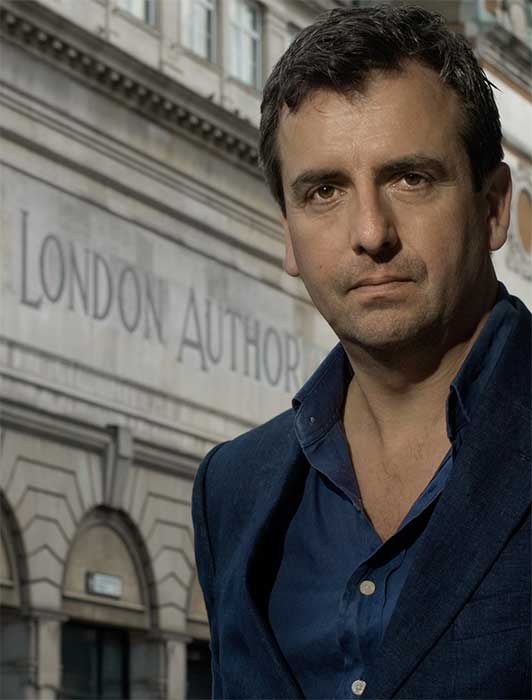
© Chris Dorley-Brown 2012
Phantom at the Feast was published by No Exit Press on June 19th 2026.
.

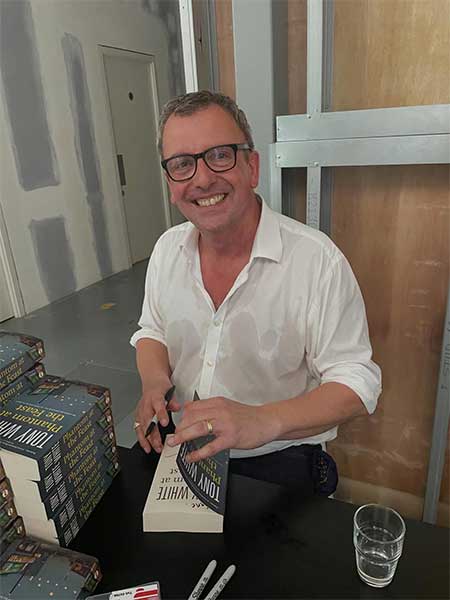
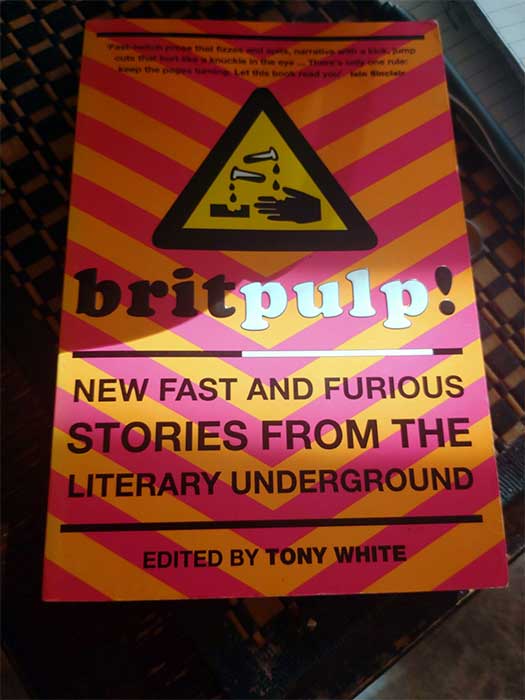
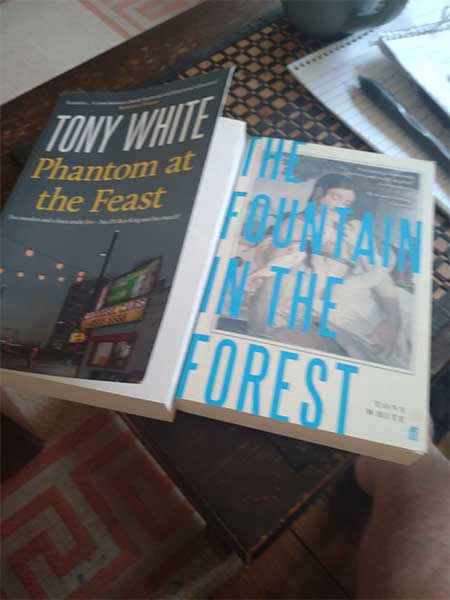
Great interview.
Comment by Rupert on 1 August, 2026 at 10:39 amThank you for your comment Rupert.
Comment by Malcolm Paul on 1 August, 2026 at 8:03 pmMuch appreciated.
Tony did all the work 😊👍🏻
All the Best
Malcolm.
Thank you, Rupert — glad to hear. (And thanks to Malcolm and Nick for making it happen.) 🫡🙏✊
Comment by Tony White on 3 August, 2026 at 7:12 am