
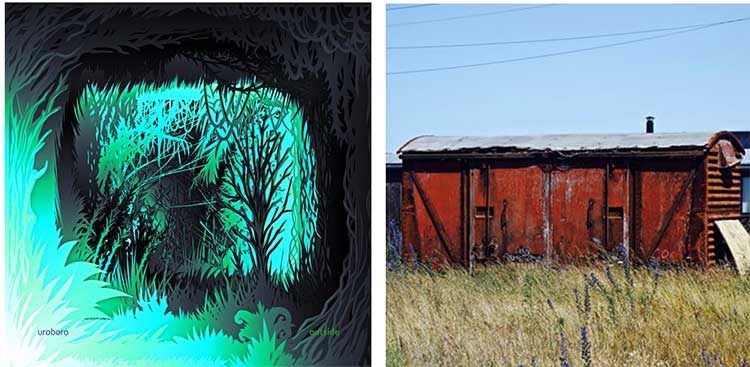
Outside 213CD – 2026, uroboro (Discus Music)
Too Much To Dream, Larry Can Laugh, (Larry Can Laugh)
Like their previous album, the bass speaks, the latest offering on Discus from Uroboro, outside, features the poetry of their leader and sax player, Keith Jafrate – and, this time, not only Jafrate himself, but also the twentieth century Scottish poet W.S. Graham. A setting of Graham’s poem, ‘Imagine a Forest’, the longest track on the album, occupies a central place on it.
The music for ‘Imagine a Forest’, is based on a riff which recalled to me the opening of ‘Night’, a song from Schoenberg’s Pierrot Lunaire, in which ‘sinister back moths / blot out the shining sun.’ There is a bit of that here: the character W.S.Graham invokes is finding his way through a forest at nightfall (‘his own Ettrick’ – a forest in the Scottish Borders region). He encounters a dying knight who, although he cannot speak, is, Graham suggests, dying for a cause. He then goes home, where he’ll ‘not fight hard enough’ and die in a place no less dark than the wood, but where no wandering stranger will find him. The Graham poem is framed by settings of three Jafrate poems, the first an invocation of winter, the second a paean to spring. The third, ‘the sky is always open’, insists that we must ‘dream ferociously.’ I wouldn’t argue with that.
It sounds like there’s a lot of pretty dark stuff going on here. However, apart from the first track, which is based on the Jafrate poem ‘winter dusk spell’, and the Graham setting itself, the music is more concerned with light than with darkness. Listening to it, I found myself imagining a dance. Usually, it follows the same pattern: in the beginning the dancers are stood close together, the choreographer/composer defining the moves then, as they circle around the centre, all the time moving outwards and creating more space between them, they develop the dance they’ve been shown, each in their individual way. No-one is showcased, nothing is overstated: there is always a sense of group music-making and even when an instrument comes to the fore, as John Pope’s bass does at the end of ‘a spell to unknot buds’, the playing is in no way self-conscious: it’s almost as if a sound-engineer had simply muted the other musicians. The third track, ‘gog and magog’ is a good example of what I mean by all this and the title is perhaps a pointer to the ritual, almost pagan atmosphere this approach can create.
It’s a great approach and the more I listen to this album, the more I get from it. It’s got me going back to the poetry of W.S.Graham, too, which is no bad thing.
Too Much To Dream is the recently-released second album by Larry Can Laugh, the Kent-based duo that comprises accordionist Michael Garcia and keyboard/electronics player Tony Flynn. Listening to them play together I always get the feeling I’m witnessing two artists attempting to forge a vernacular between them with which they can make meaningful music. Each brings something different to the conversation: Flynn, his eclecticism, Garcia, a preoccupation with the tension between freedom and structure. The result is innovative and hard to pin down: in their laconic album note they describe it as ‘down-home electro-folk’, which amused me, reminding me as it did of Throbbing Gristle titling their – very different – iconic industrial album 20 Jazz Funk Greats. Their description of their previous album, Bricolage, was a little more literal, if still tongue-in-cheek: a mix of ‘acoustic and electronic sources in an eclectic and exotic amalgam of improv-modular-jazz-ambientronica’. The fact is, it’s hard to label what they do, the reason being that their musical language is perhaps best described, as I said, as a search for a musical language: they strive to create musical gestures the way a Samuel Beckett character might strive to enunciate a word or phrase and when they find what they want, they run with it. There is a suggestion of all this in the titles of the tracks: each consists of an undefinable pair of syllables, one of which, ‘TAN’, is common to them all, running through the track list as a repeating element might run through a piece of music.
In Too Much To Dream, as in a dream, you’re never quite sure what’ll happen next: there are momentary, fleeting glimpses of worlds one might associate with the accordion; pulsing, Ligeti-like clusters; abstract electronic noise; conventional chords and melodic fragments. I particularly liked PHO-TAN, with its striking use of electronics and percussion alongside the accordion, ANA-TAN with its overtones of Harry Partch and the dark lyricism of TAN-SO with its rising series of falling semitones. A great listen.
.
.
Dominic Rivron
LINKS
outside: https://discusmusic.bandcamp.com/album/outside-213cd-2026
Too Much To Dream: https://larrycanlaugh1.bandcamp.com/album/too-much-to-dream
.