
Surrealism and Magic Realism have both had infuential Latin American expressions. The Caribbean islands and Mexico City were all ‘places of convergence and relay for Surrealism’ (including the work of Frida Kahlo and Leonora Carrington), while Magic Realism was a term originally used in relation to the fantastical elements of European Romanticism and the religious aspects of novels by Fyodor Dostoevesky before becoming a descriptor for the Neue Sachlichkeit paintings of 1920’s Germany and then the strapline for the novels of South American writers, starting with Jorge Luis Borges.
The paintings of Hulda Guzmán find their own significant space within this web of influences and prior expressions. It is perhaps appropriate that Please awake – asked Nature kindly, her exhibition at Turner Contemporary, overlaps with the opening of a major new Frida Kahlo exhibition at Tate Modern (with a section documenting Kahlo’s legacy, of which Guzmán is part) and Leonora Carrington: The Symptomatic Surreal at Freud Museum London, as her work demonstrates the continuing relevance and vibrancy of these styles in contemporary culture.
Guzmán lives and works in Samaná and Santo Domingo, Dominican Republic, and, as Tobias Ostrander has explained, her images ‘are primarily autobiographical, inspired by personal experiences’ and looking to honour ‘her everyday life, as it is lived with family, lovers, and friends’. The biodiverse environment of the artist’s home in the rainforest mountains of Samaná deeply shapes her visual language. Her richly layered landscapes and interiors echo the lush abundance of her surroundings while engaging with questions of identity, belonging and the urgent realities of climate change.
Drawing on folk art, Caribbean vernacular traditions, and art history, her paintings open portals into vibrant, dreamlike worlds where the artist, her family, animals and mythical beings exist in close dialogue with nature. A surreal sensibility permeates Guzmán’s work and is heightened by her vivid, technicolour palette. Shifting scales, perspectives, and painterly treatments coexist within each canvas and these visual instabilities introduce a sense of magical realism, inviting viewers to encounter reality as layered and open to interpretation. Guzmán says of these qualities: ‘I am interested in exploring mystery as an integral part of our existence. When nothing is certain, anything is possible.’
In avatara, a human figure stands bolt-upright with raised arms while being embraced by a night scene that enfolds the figure within a blue-drenched earth and sky. ‘An unexpected organic form emerges from the moving grass’, as Amanda Carneiro describes, ‘evoking both an ethereal presence and an extension of the landscape itself, as if the ground were exuding this organic form and revealing another layer of existence’. A more than material beauty is found in the depth of Guzmán’s colours while the figure, standing in a gesture of praise, is invited to connect with nature in a landscape that is ‘in a continuous process of interdependence’ and is therefore ‘a territory of co-creation’ where ‘coexistence is navigated’.
As the exhibition title indicates, Guzmán’s paintings insist we see the natural world not as a backdrop, but as a living force to which we are inextricably bound. She has said: ‘Please awake – asked Nature kindly is an invitation to listen more closely to the underlying presence within the subtle shifts of light and time that shape both landscape and self.’ The relevance of such work should be immediately apparent. As Clarrie Wallis, Director of Turner Contemporary, notes Guzmán is reimagining landscape ‘at a time when our relationship with the natural world feels increasingly urgent’.
In the painting Please awake – asked Nature kindly, we view ‘a strange and beautiful night sky’ from behind the naked artist and her orange cat. Our view is shared with theirs. Ostrander writes of a view ‘filled with two glowing stars, a comet, and a large black-and-white UFO-like cloud, or some similarly magical celestial formation’. As with many of her works, Guzmán is exploring humanity’s relationship to the natural world and acknowledging the Caribbean’s beauty alongside its environmental vulnerability.
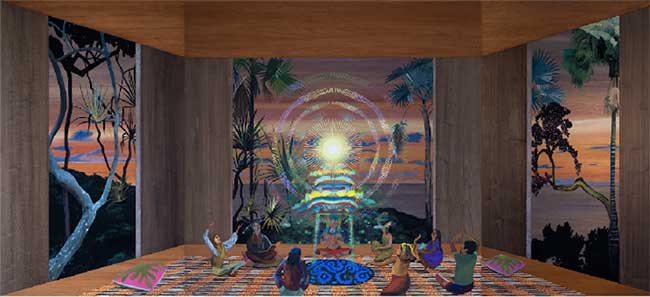
Her expressive handling of paint and colour conveys a palpable sense of vitality and magic—qualities that, in an age of climate anxiety, remind us to slow down and reflect. Yes is, perhaps, the ultimate expression of this need. An inside and outside image where the interior world of a home is interpenetrated by the natural world immediately outside, this painting shows a group seated in a circle on the floor undertaking a practice such as meditation or yoga and responding to the glittering, shimmering aureole effect of the sun’s rays through the windows of the home. Their affirmative responses of welcome and wonder show us the response to nature that Guzmán knows is needed if the effects of climate change are to be managed and contained enabling us to remain in a positive relationship with nature, rather than the destructive relationship that currently characterises much of what we are and how we live.
.
Jonathan Evens
Hulda Guzman: Please awake – asked Nature kindly, 23 May – 13 September 2026, Turner Contemporary.
PICTURE CREDITS
Article: Hulda Guzmán avatara, 2023 Acrylic gouache on linen 101.6 x 101.6 cm Private Collection, UK © Hulda Guzmán. Courtesy of the artist and Alexander Berggruen, NY. Photo: Dario Lasagni.
Inidex page: Hulda Guzmán Yes, 2025 Acrylic gouache, watercolour ink and wood veneer on cedar plywood 121.9 x 274.3 cm Augusto and Vanessa Reyes Courtesy of the artist and Alexander Berggruen, NY © Hulda Guzmán. Photo: Peyi Guzmán.
.