
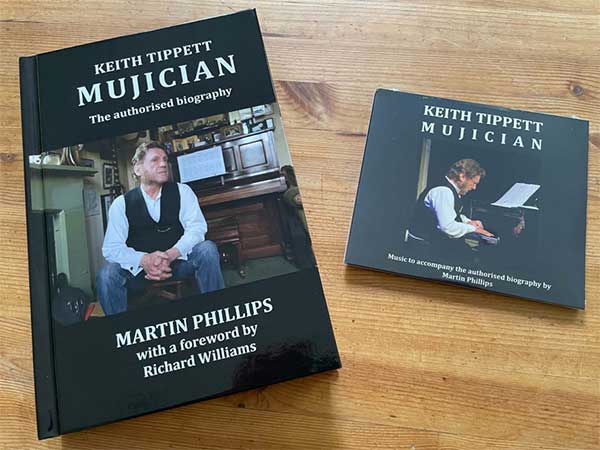
Keith Tippett: Mujician. The authorised biography, Martin Phillips (Jazz in Britain)
Many older readers of International Times may know of pianist and composer Keith Tippett through King Crimson albums such as In The Wake of Poseidon, Lizard and Islands. They might also have seen him on King Crimson’s only appearance on Top of the Pops, miming along to ‘Cat Food’ with the rest of the band. Those albums were certainly one of my introductions to Tippet, but it was also a time when I was going to gigs at the London Musicians Collective’s scruffy headquarters in Camden. There, in a previously disused British Rail property with no toilets and only an outside iron fire escape for entry, The LMC (and it’s neighbouring London Film Collective) promoted – or allowed – musicians, non-musicians, performers and improvisers to play what they waned to play, usually to small, shivering audiences.
Sometimes, after an hour of what I used to call pinky-plonky guitar or a sonic exploration of rusty found metal laid out on a blanket, I would retreat to the pub over the road and wait for my far more dedicated friend, who often taped all these gigs, amassing a huge personal archive. If I sound negative, I shouldn’t, as I was privileged to see the likes of Lol Coxhill, Roger Turner, Maggie Nichols, David Toop, Elton Dean, Mark Charig, Steve Beresford and Derek Bailey there, as well as various punk bands and tentative musical groupings. And Keith Tippett.
Sometimes solo, sometimes playing with a small group of musicians, Tippett could either be lyrically diffuse or at times a thunderous rumbling storm. He seemed to be able to play with anyone and everyone, a still unusual attribute. (Lol Coxhill is the only other player who springs to mind. He was as comfortable playing improv, 1930s music hall songs or working with the likes of the Damned and Kevin Ayers.) I much preferred the less intense music Tippett played, or when he tipped into a form of free jazz-rock, perhaps borne out of his 1970s mainstream albums. I also enjoyed seeing him duet with the much under-rated Stan Tracey at The Bull’s Head in Barnes.
On the back of You Are Here… I Am There and 1971’s Dedicated to You but You Weren’t Listening (Vertigo, 1971), Tippett formed the massive big band Centipede, toured them and recorded an album for RCA. It is a Centipede gig at the Lanchester Poly in Coventry that was Martin Phillips’ introduction to Keith Tippett. I can only imagine the effect of this tumultous, noisy and varying music on Phillips, who was probably expecting something else in the way of ‘jazz rock’. He mentions ‘edgy dissonance’, ‘a sustained drone’, ‘incantation’ and ‘cacophonous free jazz’. There are, it seems, ‘too many notes to take it all in’ but he states ‘that first encounter […] had an incendiary impact. It led me away from rock music to Archie Shepp, Pharoah Sanders, Cecil Taylor, Ornette Coleman, Mingus, Coltrane, and many others’.
Phillips later got to know Tippett personally and his ongoing fandom and friendship shines out of this biography. Phillips is an adept storyteller, one who can quickly bring the reader up to speed if necessary and offer succinct back stories and summaries of less engaging details. If I have a problem with the book it’s 1. because I am not as big a fan of Tippett as Phillips and 2. I wish the book was more about the music than the musician. It is very much a biography not an exploration of the music.
Maybe that’s the point however? The music is available to us, fairly easily thanks to CD reissues and online file-sharing but what we can’t get from that, or can only guess at, is how warm-hearted and dedicated Tippett was. To his family, to his friends, to those he played with, and to the music itself. Tippett thought the music deserved the best available, and would demand decent pianos in tune (which often meant tuning twice on the day of a concert) and dedication from band members and fellow musicians. He was also generous with his time, working with (and sometimes founding) local jazz clubs, offering tuition to the likes of the Devon Youth Jazz Orchestra, and renowned as a strict but encouraging tutor at the Dartington Summer School.
Tippett remained an inquisitive and accomplished musician until his death in 2020, working with numerous ensembles, individuals and solo. His wife Julie Tippett (née Driscoll) accompanied his musical exploratory journey, leaving pop success with Brian Augerand the Trinity along with her beautiful solo music (check out the Sunset Glow album) behind her to move to free singing and vocal improvisation. He established several working groups such as Mujician and Couple in Spirit, played (irregularly) with a number of regular musicians such as Paul Dunmall, Louis Moholo, Elton Dean’s bands and Harry Miller, and continued to surprise those paying attention, popping up on albums by Working Week, Toyah and David Sylvian.
Although he has a large discography, and appeared at numerous major jazz festivals and on mainstream radio, Tippett is not a household name. But he should be. Phillips’ entertaining, well researched and informative story should help, as should the double CD of previously unreleased music: a 1984 solo recital in an Exeter pub and a 1976 recording from London’s 100 Club of Keith Tippett’s Ark, an eleven piece big band. They are very different and both wonderful, as is my memory of Tippett’s piano in that damp, cold LMC room.
.
Rupert Loydell
Buy the book and CD at Jazz in Britain here.
Jazz in Britain have also released In Concerts by Mujician, a triple live album. Order here.
.