
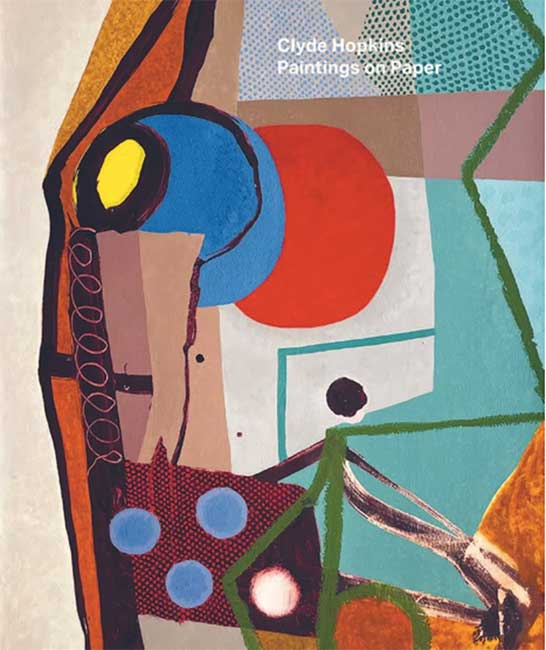
Clyde Hopkins: Painting on Paper (Blackbird Books)
Like Matt Lippiatt, one of the contributors to this volume, I can struggle to ‘place’ Clyde Hopkins’ paintings in relation to art history and popular culture. Lippiatt uses American cartoons from the 1960s as a reference point, and also the interesting phrase ‘hot mess’, whose various connotations and possible meanings he carefully unpicks and explores.
Although I have known of Clyde Hopkins’ paintings for several years (unlike Lippiatt, who came across an Instagram image in 2018), he has always been a rather peripheral and unknown artist to me. When I first saw his work I borrowed a small catalogue of paintings from the library and found little of interest at the time, and have only occasionally come across his name since then.
This new book clearly shows what I have been missing. Hopkins’ work gradually moves from an exploratory, often splashy and gestural, abstraction towards more formal and subtle compositions, which contrast stippled and ‘busy’ areas with both flat colour and looser drawn lines, stripes and splashes.
In a conversation about the work included in this book, David Sweet and David Ryan discuss the juxtaposition of different types of mark-making, as well as ideas of fluidity, violence, dialogue and ‘insolence’. Their conversation includes references to graffiti, the idea of black paint being used as an armature or scaffolding within the paintings, and how Hopkins’ work might be thought of as allusive rather than imitative, an idea which Roland Barthes used to discuss Cy Twombly’s art. There’s also a brief discussion about how drawing and painting on paper could be considered as a form of writing, simply because paper has been used for, and even in the age of computers is still associated with, that activity.
The final essay in this book is also the most academic in nature but Joan Key’s writing is lucid and intriguing, making good use of quotations to back up her arguments and own ideas about Hopkins’ work. I particularly liked phrases such as ‘fluid development’ and ‘the integrity of accidental inclusions’. She suggests that the paintings rely on ‘an experience of lived immediacy’ and clearly evidence their own making and exploration, and that the artist wanted viewers to encounter not ‘a resolving of uncertainties’ but their ‘enduring complexity’.
Deleuze, Key notes, invented the word ‘perplication’, a term Key now applies to Hopkins’ work, ‘to suggest a use of logic without certain outcomes, something other than rational working towards resolution’. She also notes that ‘Deleuze compares it with related terms: the fracture of “complication”, and the “implication” of connectivity or seriality within a sequence.’
So, effects such as ‘accidental blots, thrown paint, areas of patterning, black linear graffiti, finely networking marks’ are used to lead ‘the eye through chains of associated forms.’ Key goes on discuss how these associations help hold initially disparate sections together within a painting, and also uses the metaphor of a river’s ebb and flow, how it exists in many differing states.
Hopkins’ work is not, of course, a linear sequence, nor was he prone to working in series, but there is a gradual sense of movement towards clarity and tentative resolution. Key states how surprised she was, when visiting an exhibition of Hopkins’ earlier paintings, by ‘the consistency that resonated across disparate works’, something she attributes to ‘a humour, derived from empirical observation of the results of painterly decision-making, informed a critical sensibility consistent throughout his practice.’
We are, perhaps back to the cartoon worlds of Yogi Bear, Top Cat and Wacky Races, as referenced by Lippiatt, yet this is not to denigrate Hopkins’ art. His witty and painterly explorations produced an exuberant body of work that makes use of vivid colour and dynamic gestures, carefully unbalanced composition and unruly forms. Lippiatt, continuing with his down-to-earth and possibly nostalgic reference points, recalls how ‘Browsing Hopkins’ late pictures for the first time was moreish, like the liquorice allsorts they occasionally resemble.’
I couldn’t agree more, although I might push the simile further and suggest they are more akin to squashed liquorice allsorts. Either way the work is delicious, and this beautifully produced 128 page book offers a wide range of colour reproductions and essays discussing the work from a number of intriguing viewpoints. As Fred Flinstone would say, Yabba Dabba Doo!’
.
Rupert Loydell
.