
I travelled to Sicily several times between 2009 and 2016. Each time I was compelled to write not just about its remarkable scenery and history, but about my observations, thoughts and feelings. By Sam Burcher.
Palermo

Palermo is wild and rocking on a Thursday night and imbued with the sound of the 1960’s. The Beatles, The Doors, and Bob Dylan’s harmonica blares out, interspersed with hypnotic Arabic music. I feel alive and surprised to be alive walking on the wide cobbles of the medieval alleyways shining with wear.
Young Sicilians crowding the narrow streets part ways ever so slightly until I ramp up my aura, only then do they make a little more room for the old souls passing through. But it’s relaxed, all out in the open, out on the streets. It’s a dreamscape populated by motorcycle boys and girls who drink and smoke to get by.
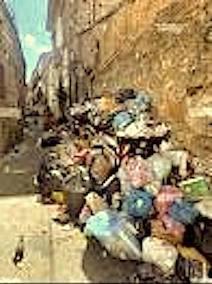
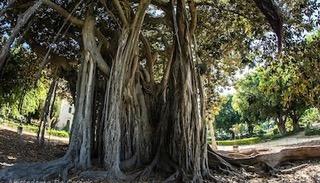
Stinking rubbish is piling up in the labyrinthine passages. Like many old cities Palermo operates on a base, low vibration.The ephemeral thought that it might be a place to drop acid and be subsumed quickly passes. And, in Garibaldi’s Garden, in Parco d’Orleons with the sad caged birds, and in scorched grass squares magnificent Banyans purify the senses.
In a pizza parlour on a street full of pizza parlours, feeling slightly tipsy and addicted to sugar, I ask the cafe owner for a gelato. I wait patiently as she communicates with unknown hand gestures. She’s busy making good money and smokes far too much, but her health is protected for now.
My first floor lodgings are rudimentary. Tiny blue tiles dotted about the kitchenette with two cooking rings and a coffee pot brighten the room. The mattress is flea bitten and the host’s abstract paintings and loose weavings are for sale on cob walls. From the balcony I see her laughing and chatting on her way to the bank. The bathroom window looks onto the wonky balconies of buildings underpinned with wooden pegs reminiscent of those holding up the Ponte Vecchio, only smaller.
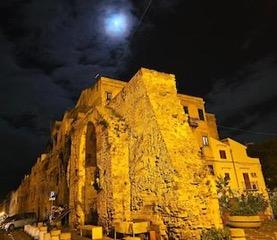
Later in bed the wooden shutters are making complex patterns on the ceiling. Palermo is a place of shadows. There is a glorious decrepitude here. In parts it’s not unlike Rome, where municipal development has not spoiled the intrinsic beauty of the city. Cultures and identities are preserved mostly because the government can’t afford to develop, and widespread corruption means the money goes elsewhere.
The sounds of the night eventually simmer down. At dawn, the incessant car horns start blaring again: long streams of honks and short bursts of beeps at various frequencies. This unnatural horn chorus prevents any return to sleep. In between the honks is the rumble of a city that has lost its mind; simultaneously exciting, maddening and disturbing. A strident language of parps supplants normal conversation as the slaves to their cars communicate via horns.
Despite the cacophony it’s womblike and protected in my shuttered room and I arise to record the noise pollution. I consider the ease of my journey so far, the levels of anxiety have dropped and people are nice to me. At last the blast of car horns is lulling, moving further away, like a storm.
Agrigento

Beneath my boat the waves were silvery-white, the dust of a billion stars fallen into the ocean. The port of Palermo welcomed me with a face full of beauty and a lingering stink filled the air with blasphemous fumes. I pull on my trolley avoiding dog shit, while angels direct the traffic. This city is a stew.
And I move on to Agrigento from platform number 5. A fight breaks out on the concourse in front of the transient witnesses. The moment passes, the stink continues. I look at the nice people; the girl with glasses, the couple with child, the well dressed strangers off down the line.
Stunted ficus and pampas grows between the tracks out of Palermo Centrale. The train moves inland to where the earth rises and undulates. There is fire in the mountains where the sun illuminates the cabbage fields and parched river beds. Ploughed fields are ochre and ringed with pale green trees in alkaline soil. Hedgerows straddle the palomino hills marking each scorched mound with a green cross. The sun disappears and wildfires break out close to the tracks. A full moon rises overhead. I contemplate the moon, it contemplates me spelling its name over and over in my head to the motion of the train. The moon moves me on. Only days ago I was a solar priestess, my forehead branded by the sun rays bouncing off the Aeolian sea.
The boat to Palermo couldn’t outrun the sun, no matter how fast it went. The sun lit a trail which ran constant with the journey. But the train to Agrigento easily outruns the moon. It waves farewell and falls out of the race, then catches up and falls behind again. The station is deserted when I arrive, apart from the patient dad showing his son the train just arrived.
My trolley wheels slide over cool Art Deco tiles. I step into the warm, dark unknown.
I am dragging my bag up the steeply cobbled passageways of Agrigento. The place is a medieval hilltop city teeming with different religious denominations, a cleric lurks on every corner. Misread signs and the bag is getting heavier on the climb. I feel burdened like Christ on my journey to the top of the mount.
Locals on the dark and unfamiliar streets know better. They sit in relaxed little groups calling out to passers-by. ‘Want sex?’ a voice hisses from a balcony above, perhaps in response to the sound of trolley wheels. Finally, the Via Duomo, the highest road in Agrigento where the air is better. Once a pope slept here and now the bed is part of the Catholic Museum, his sheets are unchanged.
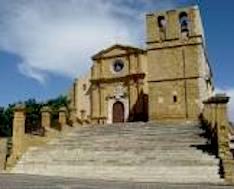
A man sitting on the steps of the nearby Cathedral looks on smugly when I get no answer to the bell at the B&B Liola. Perhaps, as I learn later, he’s the one poisoning the cats who have gathered under the full moon to feast on the overflowing bins. It’s disconcerting because it’s late and the strained reflection in the mirrored front door is mine. Finally, the door opens and the room is a yellow temple, a golden tomb.
.