
In Britain today, we face a number of profound challenges, amongst them the very real and immediate threats of climate change and the fear that extremism and violence imperil our democracy. The striking thing (which may feel either reassuring or depressing) is that none of these dangers are especially new. Activists have been warning us about the impacts of pollution and environmental degradation since the late 1960s; we’ve been grappling with the meaning of Britishness for just as long.
In fact, the pages of International Times were a forum for these debates from the paper’s inception during the late 1960s. In my recently published study – Hazy Cosmic Jive – The New Age & the Underground Press (1966-76) – I examine the role played by IT – alongside other underground journals such as Oz, Gandalf’s Garden and Friends/ Frendz- in providing a forum for such discussions and, thereby, spreading awareness of the issues.
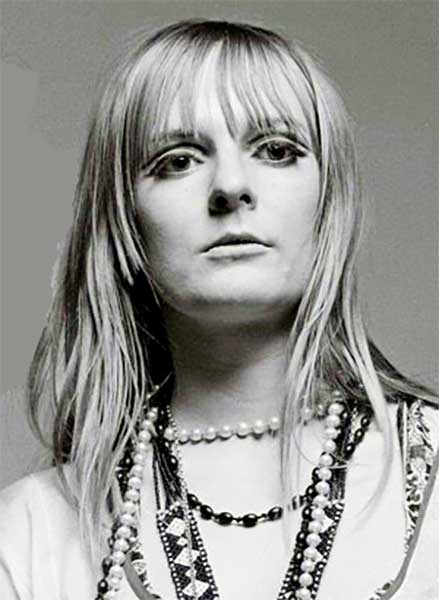
In this article, I want to pay particular tribute to one member of IT’s staff, Joy Farren. Joy fulfilled various roles at the paper, undertaking administrative as well as editorial duties. When, though, in December 1971, she got caught up in the obscenity prosecution of the comic zine Nasty Tales (published by the same company that produced IT) she protested that, as company secretary, she was just “an innocent dupe.” I think Joy seriously downplayed the key roles she performed. She became, in fact, one of the leading contributors to the paper on ‘new age’ and alternative subjects. Her articles covered a wide spectrum including vampires, faeries, William Blake, druids, King Arthur, Robin Hood and many other aspects of British tradition and mythology.
Most notably, in a March 1971 article entitled ‘The Enchanted Isle,’ Joy injected a personal note, describing her own feelings for Britain. Her emotions were not, she stressed, about patriotism, the flag or the empire – nonetheless:
“there is a mysterious quality I cannot pin down into words; there is a magic that, regardless of truth, reality or belief, holds my heart and soul for Britain. As G. K. Chesterton says quite simply, there is something personal about England… This haunted island is my home, however far I travel… It is to Britain that I shall return. My soul is here, my past is here, my future is formed here. I am linked to this island by deep-set spiritual bonds that I cannot break.”
When I first read these words, I found them very immediate and very inspiring because they expressed so well what I wanted to say. Britain is, for me too, not about nationalism, concepts of race, wars, monarchs or conquests, but instead it’s about the landscape and the island’s cultures and stories – something less tangible and less easily put into writing, something that isn’t readily reduced to jingoistic symbols nor to the sort of simplified history that’s represented by clichés such as the ‘Dunkirk spirit’ (arguably, a sort of modern mythology, but far more contentious than those about Merlin or Friar Tuck).
Reading her article, I knew that, at the time Joy Farren wrote, things looked bleak: Enoch Powell was leading a resurgence in racist politics, David Bowie talked about the need for a dictator, and performed his notorious Nazi salute at Waterloo station, whilst retired generals were planning for a coup. We survived all of that, as did the vision of Britain I shared with Joy – it remains for me a country of literature, art and music, of legends and mystery and romance. That’s what I’m attached to, not bits of cloth, a Turkish saint, and the mistaken notion that ‘Great’ Britain was meant to describe anything other than surface area.
As for Joy Farren, she was plainly more than the duped secretary. She became IT’s resident ‘new age’ expert, able to produce intelligent and interesting summaries of a diversity of unusual topics – and let’s not forget, she didn’t have Wikipedia to copy and paste; there was solid reading behind everything she wrote, as well as her own clear vision of what it stood for.
Joy’s work gave a particular tone or voice to early ‘70s International Times. Not every reader liked that, of course: one wrote to Oz in May 1972 complaining about her “continuous avalanche of mystical occult crap,” but Joy’s contributions were symptomatic of a wider output (from Oz just as much as IT) that offered readers a broader perspective of ideas- eastern religions, yoga, I Ching, tarot, magic, astrology and a range of ‘alternative’ theories about such matters as UFOs, ley lines, pyramids and the lost continents of Atlantis and Mu. Some of this material, it must be admitted, tended toward conspiracy theory and was written in terms that would seem entirely at home in various corners of the internet today (‘all scientists are keeping the truth from us; you need to do your own investigations’). Most of these ideas gained extra impetus and relevance from a more encompassing belief- that the Age of Aquarius was imminent and that this would precipitate major changes across the world- not just physically (the resurfacing of sunken lands) but to our thinking and the structures of society. Joy Farren made her own contribution to this mindset, writing one article about international prophecies of global disturbance and transformation.
The impending dawn of the Aquarian Age – and the urgent need for the upheavals it would bring – was a conviction, or expectation, that underpinned the mindset of many of the young generation who composed the ‘alternative society.’ The steadily accumulating evidence that modern human society was damaging the planet, and that industrialisation and consumerism were unsustainable, fuelled this apocalyptic mood. Western civilisation, which set all-knowing humans at the apex of chain of exploitation, was widely seen as faulty; many argued that we needed to learn from other cultures. When various hippie communes called themselves ‘tribes,’ they were sending a message that other, older societies might very well know better than we do how to relate to the world.
Of course, the anticipation of the arrival of the Age of Aquarius faded as the 1970s continued, but the complex of ideas linked to idea were absorbed into our thinking and persist even today. With the critique of consumer-capitalism possibly more urgent and existential than ever, perhaps it’s time to read those old IT articles by Joy Farren again.
.
John Kruse
Hazy Cosmic Jive- The New Age & the Underground Press (1966-76) is available as an e-book and paperback though Amazon.
Photo: Mick and Joy Farren by Clive Arrowsmith, originally from Queen magazine, 1969.
.