
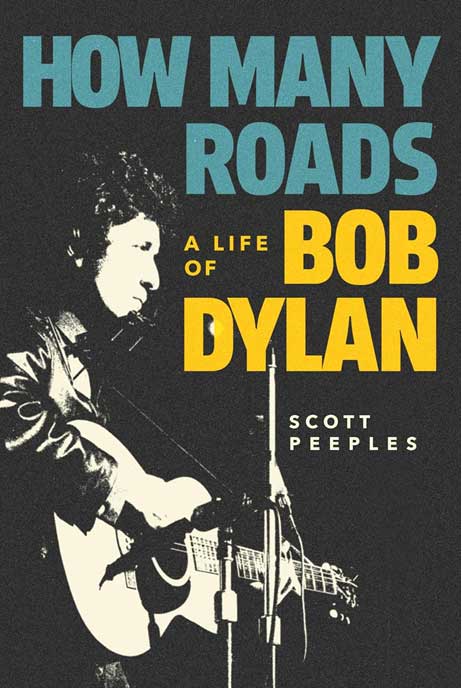
How Many Roads – A Life of Bob Dylan, Scott Peeples (£20.00, 365pp., Reaktion Books.)
The Bob Dylan book industry continues unabated, having now reached the point where those professors and critics Dylan mentioned are now weighing in, month by month, with their academic tomes. Scott Peeples is a Professor of English in South Carolina and teaches a course on Dylan, where the seeds of this book originated. One might expect, therefore, something distinctively academic, but here he has produced a pretty user-friendly, one-stop account of Dylan’s life and career – it’s just difficult to know why you would want this when you could buy more authoritative deep-dives from the likes of Greil Marcus or Clinton Heylin.
For those new to the labyrinthine twists and turns of Dylan’s career, Peeples covers all the main stops on the journey: the Greenwich Village years, ‘Judas’, Highway 61, Blood on the Tracks, the Christian years, the Never-Ending Tour, Rough and Rowdy Ways. All covered effectively, reminding the casual reader of just how many strange byways and attempts to torpedo his own career characterise the inscrutable one behind the shades. The main problem is that, after the incredible pace of Dylan’s first five years as a recording artist, there are just as many failures as triumphs.
Peeples isn’t afraid to tackle some of these. He wonders, for instance, why The Basement Tapes were originally released in a bastardised form in 1975, with new overdubs and tracks by The Band not strictly intrinsic to the project. He makes the case for relative failures such as the 1970 Self-Portrait, arguing that context allows it to be viewed more favourably today, after the release of Another Self-Portrait in 2013, as part of The Bootleg Series. Some of his other opinions are more arguable: for instance, he finds Under the Red Sky, Dylan’s 1990 mish-mash, to have ‘more character’ than most of his 1980s albums. Hmmm.
One of the most divisive periods in Dylan’s life was the ‘born-again’ Christian period of 1979-84, during which he issued Slow Train Coming, Saved, Shot of Love, and then Infidels, to gradually diminishing effect as far as his wider public were concerned. Peeples rightly isolates the studio performances as being a problem on some of these songs, noting that the much later Bootleg Series collection, Trouble No More (2017) revealed the power with which Dylan’s band played them in a live context, causing a major reassessment amongst long-time Dylan followers. A similar reassessment took place almost immediately with Infidels once it became widely known that Dylan had perversely left the best songs off it.
The fluctuating fortunes of Dylan’s later career could be perhaps seen as a symptom of something Peeples takes as his main thesis: that since the mid-1960s, Dylan has obsessively chased his own freedom as an artist, regardless of anything else. This almost convinces, but not quite: it doesn’t, for instance, square with how he has been blown to and fro by fashion, seeking trendy producers and big-name guest stars to illuminate or sink his work. Occasionally, this really pays off, as with the two albums made with Daniel Lanois, 1989’s Oh Mercy and Time Out of Mind from 1997; more often, it results in indifferent, over-produced product, often cobbled together, such as Down in the Groove (1988). Aficionados have long learnt to roll with the punches, and to argue that it’s just a by-product of Dylan following his muse seems a tenuous argument for the defence.
Dylan’s main output this century falls into two categories: a fairly consistent trickle of blues-based albums, self-produced but somehow underwhelming, and the ongoing Never-Ending Tour, wherein the sets change minimally, but the voice remains pretty much a shadow of what it was even as recently as the late 1990s. Dylan continues to ban phones and photographers; fans smuggle out audio tracks that prove his voice has deteriorated considerably, but at least he’s still there onstage, pumping the songs out, night after night, backed by a polished, sympathetic group of sidemen. Peeples deals with the last twenty years fairly efficiently, and Rough and Rowdy Ways, his most recent studio set, is described as having ‘a distinct air of finality about it’. Dylan could yet produce more radically impressive new work, as he did with Blood on the Tracks and ‘Blind Willie McTell’, but it may be asking a lot of an 85-year old performer who’s constantly on the road. It’s a fair bet that he’ll never move with the speed, poise and acuity that characterise his first five years as a recording artist. Ironically, these are the years when Dylan’s career was mostly helmed by Albert Grossman, his manager, and the songs poured out of him. The freedom that Peeples explores first lured Dylan in 1967, when he retreated from the spotlight after his motorcycle accident. The immediate result was a lacklustre series of albums while his public clamoured for the return of the “old” Dylan. This begins to look like a recurring pattern: every ‘return to form’ is pretty quickly followed by disappointment; every dynamic onstage appearance is followed by grim, predictable tours with unsuitable bands. In other words, every Rolling Thunder Tour eventually leads to Live at the Budokan. On record, for every ‘Things Have Changed’, there’s a Christmas in the Heart.
Utilising the ongoing evidence of The Bootleg Series, Dylan’s long-suffering fans have created a subtle counter-narrative, where the song choices and artistic decisions of the CBS archivists are actually far more potent than Dylan’s own decisions, which often seem a mixture of disinterest and a shrug. Like many of Dylan’s biographers and chroniclers, Peeples can do little with this strange version of freedom, but if you’re after a one-volume survey of the man’s career, then I guess this one’s as good as any other. Just don’t go looking for revelations or new insights: for those, you may have to go elsewhere.
.
M. C. Caseley
.