
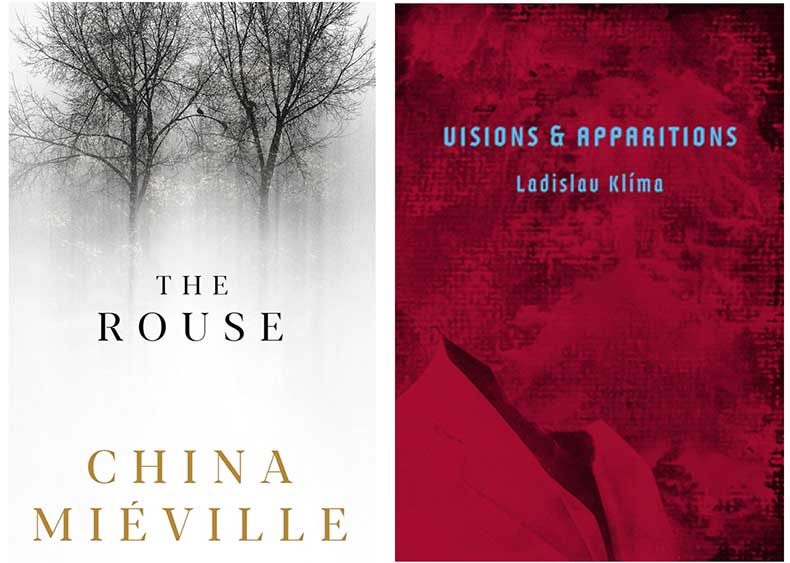
The Rouse, China Miéville (Picador)
Visions & Apparitions, Ladislau Klíma (Twisted Spoon Press)
The Rouse is being published as a huge hardback book; so big that the paperback proof I was sent to review is in two 600+ pages volumes. It is, trumpets the press release, the result of 20 years work.
This is not, however, some dreadful fantasy epic, nor it is a return to Miéville’s earlier science fiction series set in Bas Lag. It is more akin to his better novels, which are based on concepts: space travel using trains and wormholes; aliens who have no sense of or language for the singular; a city inhabited by citizens of two different countries, who share the same geographical/urban space but are trained to ignore each other. The Rouse is about life force, soul or spirit energy; about militarism, occult science and power.
It is an overwhelming book, one that works – if you persist in reading – by engulfing you in its conspiracies, rituals and arcane knowledge. It is like staring at a huge abstract expressionist painting which absolutely fills your vision, so that in that moment nothing else exists. Yet in the end the book has to work around the unknown which is its subject matter, a secular version of negative theology, which tries to define God through what cannot be known. It also reminded me of Frank Herbert’s Destination Void (which clumsily tried to discuss ideas of AI and consciousness within a hard sci-fi story) in the way that its occult rituals and pseudo-science are not always believable, despite the knowing mentions of authors such as Charles Williams and the subtle sprinkling of allusionary phrases, hidden references, characters and book titles throughout the text.
It is a book about unexplained military deaths, a book about off-the-record activities, secret societies and a hidden military research unit, a kind of psychic commando group who seem to spend half their time in a hidden bunker doing dodgy experiments and half their time travelling round the world to battle with foreign baddies, malevolent ghosts or spirit armies.
The book has a huge cast but the main protagonists are Maur and Stallo, the former the mother of a dead soldier, the latter a sergeant in the Unit. They both follow networks, rumours and hunches, sometimes together, often apart, to try and make sense of what is going on. It is all hints and possibilities, objects of power and memory, hauntings, Unit officers and scientists at loggerheads with each other (and the chaplain), journeys and pilgrimages that lead nowhere, circle back on themselves or simply fizzle out.
Gallo basically goes rogue, or is allowed a very long leash by his superiors, attempting to become a kind of psychic superhero but he is too wounded, abusive and egotistical to become a simple cipher or cartoon character. He is a damaged and complex hero or anti-hero, who sometimes has a spirit sidekick, spends years creating his own safe rooms, stashes of money and a network of informers and contacts which he can later put to good use. Maur, however, has to learn the hard way about survival, about being alone and independent, ear to the ground, tuned in to the ether (or the other). Her skills are very different ones to Stallo’s and at times these complement or negate each other.
Having finished reading my response was What on earth was that about? In fact What on earth was that? Although the fight/sex/confrontation/Unit scenes are brilliantly executed, with many of the characters and much of the dialogue superbly written, the majority of this book happens outside any plot or narrative. Outside of the book really. Whilst Miéville is not alone in producing books that do this (M John Harrison’s recent work springs to mind), I do think he could have taken a cue from Charles Williams’, who although not formally a great novelist, described his occult and theological fascinations and ideas in everyday language. Miéville does not, and if – I haven’t checked, but it seems a distinct possibility – his terminology and rituals are the result of extensive research, they are still bewildering and complex.
This is a novel of obfuscation and obsession. I like diffuse and complex novels but this book desperately needed an editor, for length and for clarity. It feels like Miéville has been indulged now that he is a successful, best-selling author. Somewhere within these 1244 pages is the ghost of a story waiting to get out.
Ladislau Klíma’s Visions & Apparitions, a ‘Selected Tales of the Uncanny’, is a very different book. These are slightly mannered – whether from the late 19th/early 20th century originals or as a result of translation, or both – stories that dictate how we are to respond. It explains everything and rather than scaring the reader, tells us we should be scared of what is or isn’t happening. The best part of the book for me are the three collages by Alexander Booth, and I’d have liked to have seen more of them..
.
Rupert Loydell
.