
or
TOMORROW SOMETIMES NEVER COMES…
by ANDREW DARLINGTON
To borrow John Lydon’s jibe at the very last Sex Pistols show, ‘Ever get the feeling you’ve been cheated…?’ And yes, I sometimes feel that way. I feel like I’ve been cheated out of what should have been.
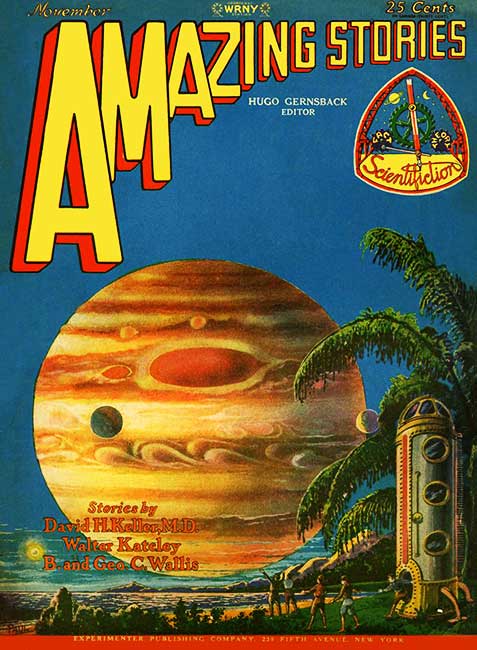
In November 1928, an eleven-year-old Arthur C Clarke, still wearing short trousers, caught his first glimpse of Amazing Stories magazine (vol.3 no.8) with space-travellers emerging from a cylindrical spaceship onto the tropical shores of one of Jupiter’s moons, pointing upwards to where the immense turbulent disc of the gas-giant dominates the sky. The visionary artist was Frank R Paul, illustrating ‘The Moon Men’, a story by Frank Brueckel Jr. There are a couple of intriguing indications in this cover. The astronauts on a jolly jaunt tumble through space without spacesuits. They stand on that improbable beach in shirtsleeves and shorts. They have no breathing apparatus. The future was never going to be this way. Surely no-one seriously believed that it would be, even in 1928?
But it was the beginning. The young Arthur C Clarke was there at its first launch.
There had always been fantastic voyages of exploration, as humans spread out across the face of the world, there were new lands to discover, new mysterious islands. They even called the Americas the New World, a blank canvas to flesh out with ideas, to map and colonise, a frontier to push further. Even into the twentieth-century there were writers inventing hidden lands, Arthur Conan Doyle found his Lost World on a South American plateau, King Kong was located on Skull Island, Tarzan had a habit of stumbling across forgotten civilisations in the African rainforests, there was even the utopian Shangri-La in a hidden Himalayan valley (in James Hilton’s 1933 novel, and Frank Capra’s 1937 movie). In the closely-related fantasy genre there was the microverse of Ray Cummings’ 1923 ‘The Girl In The Golden Atom’, there was Clark Ashton’s Smith’s ‘The City Of The Singing Flame’ accessed through a dimensional portal, and vast subterranean realms such as Abraham Merritt’s 1919 ‘The Moon Pool’ – as Brian Aldiss perceptively pointed out, writers crafted secret realms from every drop of water, fabricated from the shift of every shadow.
But as the last corners of the world were systematically mapped, filmed from orbit and interconnected through electronic media it became increasingly difficult to convincingly imagine new terrestrial terrae incognitae. So, logically, it was necessary to nudge the frontier of imagination out beyond the atmosphere, into space. HG Wells uses the gravity-opaque Cavorite to make his mismatched Englishmen ‘The First Men In The Moon’ (1901), where they discover that the warmth of the lunar day releases breathable pockets of air, and there are insectoid Selenites who dwell beneath the surface. Stories involving a lunar atmosphere continue into the midpoint of the century… although progressively with less conviction. And when that failed, the Moon has a conveniently as-yet-unseen dark side, on which there could still conceivably be fertile valleys. A slender chance, for sure, but just enough to be tenuously credible. The moon continued as a venue for alien lifeforms in comic-strips even longer.
What John Wyndham termed ‘The Outward Urge’ was rewritten into the American manifest destiny. When Gene Roddenberry was originally pitching his ‘Star Trek’ concept to the networks he described it as a ‘wagon train to the stars’, with space itself as the final frontier. Drawing on the idea of the pioneers who opened up the north American continent – ‘Go West, Young Man!’ as the New York Tribune urged. But when they reached the Pacific rim, and there was nowhere further to go, the logical continuity route must be up. Upwards and outwards. Humans have always been a migratory species. That is the urge that took humans around the world. But now there was nowhere left to migrate to, everywhere was already peopled, except to other worlds, new earths out there waiting in space. It was not only logical, it was inevitable. It was human evolutionary destiny. There was an entire solar system of worlds beyond the moon, ripe for exploration.
Young Arthur C Clarke joined the ambitiously named British Interplanetary Society. Founded by activist and agitator Philip E Cleator in 1933, at a time when airplanes hadn’t even exceeded the speed of sound. Later, when the V-1 and V-2 flying bombs rained death on London, young Arthur recognised them as rockets, forerunners of the powered ships that would carry people into space. Members of the BIS thought of themselves as conscious advocates of space travel, when the rest of the world mocked the very idea as frivolous ‘Flash Gordon’ stuff. They were serious. They had seen tomorrow, they felt they could reach out and touch it. Maybe, in their enthusiasm, they oversold their idea?
While the Beat Generation writers hitchhike their way east to west and back across the north American continent restlessly hunting new horizons, the century was assuming new shapes around them. Momentum was gathering. Accelerations were accelerating.
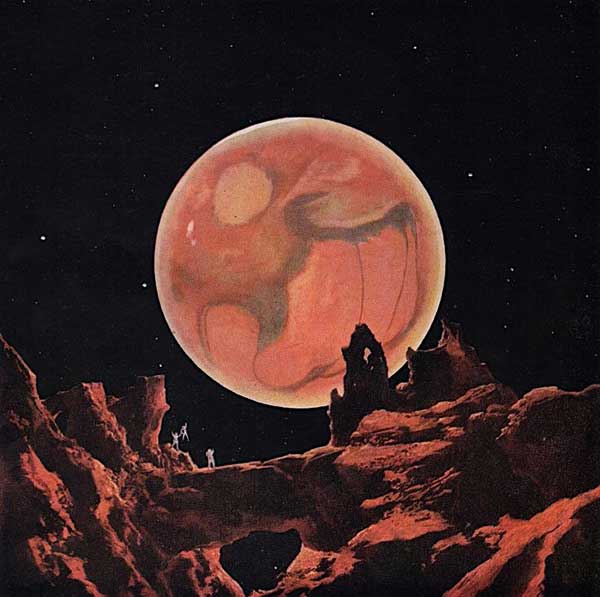
Science Fiction was the first genre that identified humans as Earthlings, rather than Russians, French, Chinese or Italians. We were citizens of the world, above and beyond some more limited perceptions. The trashier school of SF magazines expanded the concept with a Solar Federation of Saturnians, Neptunians and even Plutonians. The asteroids were mined and exploited. The moons of the gas giants were cold, of course they were, but wearing a thick parka provides adequate insulation, if not quite as pictured by Frank R Paul on the November 1928 cover of Amazing Stories. It’s worth remembering that at this time, the most powerful ground-based telescopes only showed blurred images of other worlds. The textbooks in the library speak of Martian ‘canals’ – a mistranslation of Italian astronomer Giovanni Schiaparelli’s ‘channels’, while those same books note the seasonal changes of plant-life around the polar regions of the Red Planet. This was science. The surface of Venus was eternally obscured by cloud. Everyone knows that clouds on Earth are composed of water vapour, hence Venus must be an oceanic rainforest world. This was a logical deduction.
Mercury, the closest world to the sun, was thought to be tidally locked by gravitation, so that its axial rotation matched its orbital period. In the same way that Earth’s moon always presents the same face towards its primary, so Mercury was believed to have a super-heated hemisphere eternally facing the sun, and a frozen side facing away into space. But between the two extremes there’s a habitable twilight zone suitable for a human colony.
A consensus solar system emerged by a palimpsest process, built up layer upon layer through a succession of writers and stories. Mars was the new Egypt, a world of deserts and dead sea-bottoms crossed by dry canals that linked the remnants of extinct cities from civilisations that flourished in an antiquity that coexisted with Earth’s Jurassic era. While Venus was a steamy hothouse world of rampant jungle that just might harbour monstrous dinosaurian creatures.
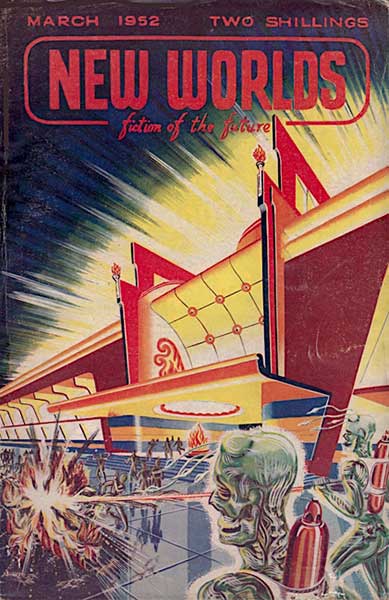
This was fiction. Of course it was fiction. But it was based in speculation around what was assumed to be extrapolation from genuine science. No-one believed that it was actually going to be that way. But through repetition there was a gradual incremental impression that it was going to be something vaguely resembling that. The nearer worlds of the solar system were tough and hazardous prospects, but with determination, with valour, they would be conquered, colonised and tamed. The more distant moons and asteroids would be exploited for their resources and raw materials. This was not only the future, this was our inevitable tomorrow. Expansion into the worlds of space was human destiny. Writing in New Worlds no.14 (March 1952) Francis Arnold makes claims for the SF genre that it has ‘a unique high quality of its own, even an idealism, and a purpose. Their ambition – we might even call it an aspiration – was to forward that purpose.’ They were not just fantasists, they were advocates of the future.
As we accelerated through the century, it was happening all around us. After the bitter austerity of the post-war years, the standard of living was gradually rising, with a greater availability of consumer goods, TVs, fridges, vacuum cleaners, record players… the family car. While cruel legislation was being liberalised, the abolition of the death penalty, the legalisation of homosexuality, the beginnings of anti-racism with protests against segregation in the American southern states, and apartheid in South Africa. There was the Welfare State, caring for its citizens on a non-discriminatory basis. An influx of new freedoms, with a general opening up to new ideas and innovations. HG Wells had foreseen the World State, the gradual coming together of nations into trade blocks and federations, the United Nations after the collapse of the League of Nations. Surely, Britain joining the European Union was further evidence of this evolution? The architect of the V-2 missiles, Wernher von Braun, was directing the NASA space-shots, propelled by Cold War rivalries, and in direct competition with the USSR space programme.
With the arrival of the counterculture, there were what seemed to be three related freedoms; Woman’s Liberation, Gay Liberation and Black Power. Added to that, were renewed flowerings of interest in Green issues, previously considered the lone preoccupation of cranks and weirdos. I could never fully work out how windmills could be introduced to generate power… yet, decades later, they – and solar farms, are everywhere. Black Muslims marching with guns in the USA shifted the centre ground, shocking legislators into realising that the modest campaigners for greater racial integration were more reasonable than they’d previously considered, and maybe negotiations with their community leaders is no bad thing. And while the bra-burning aspects of Woman’s Lib made for good headlines and comedy punchlines, the more genuine concerns for greater equality were being made, if painfully slowly. And the ‘Stonewall Riots’ made it clear that the Gay community was prepared to stand up for its rights, and no longer hide away in a closeted assumed anonymity. This was part of a wave of liberalisation turning the world dayglo.
It was no coincidence that the Woodstock Festival happened within a month of Neil Armstrong taking that first step onto the Moon (20 July, and 15-to-18 August 1969). So where did it all go wrong? Why do I feel like I’ve been cheated? Of course, it didn’t go wrong. Every rising generation knows implicitly that it is going to change the world, and leave it a better place than their parents and grandparents did. And every rising generation consistently fails. It fucks up. Yet we are still here, albeit lurching from crisis to crisis. The modern world might be rubbish – as Blur said it, but this is also the most remarkably inclusive, accepting and tolerant place that it just about ever has been. I feel comfortable in this world in ways that I didn’t in the sad conformist straitjacket of the 1950s or early-1960s. Despite the occasional nay-sayers, the World Cup is a global event that unites the planet in a spirit of friendly sporting competition. The smartphone that I so easily take for granted is an information and entertainment hub that plugs me into the world. Beyond the Meta algorithm conundrums, the internet links front-room laptops in a way that enables friendships and conversations across hemispheres as never before, way beyond the quotidian dreams of those SF pioneers. These are days of miracle and wonder.
And while there are teetering new lunar ‘Artemis’ spaceshots posing the promise of maybe Mars as a destination later on – a nine-month trip in a cramped tin-can drinking recycled piss, to take astronauts to what SF-writer EC Tubb described to me as ‘take the Sahara, dump it down in the middle of Antarctica, and take away the atmosphere’. The increasing clarity of orbital space-based telescopes, the revelations of deep-space probes and NASA’s Mars Rover fleet have revealed a solar system both awe-inspiring and more hostile than anything the SF writers ever dreamed of. Maybe people aren’t out there walking the rings of Saturn, but robots have plummeted through the sulphuric Venusian clouds and sent back scorched images of the 880F-degrees surface. The Cassini-Huygens mission probed through Titan’s nitrogen atmosphere to show us the methane-based weather cycles of Saturn’s moon. NASA’s 2015 New Horizons spacecraft revealed hitherto unsuspected close-up surface details, the glaciers and frozen mountains of the Pluto system, demoted from planetary status precisely because the advancing blade of astronomy reveals more about the solar system’s rim worlds… and the extrasolar planets beyond. As the Voyager 1 & 2 probes cross the heliopause to become the first human-made objects to enter interstellar space.
Many space voyagers… and there are now plenty, report experiencing a shift in perception towards Earth itself. They see a fragile world. They see no national borders, no political or religious divisions. No artificial lines to separate us. They recognise that we are all Earthlings. We need that vision now more than ever.
I’m never going to live in the ‘Dan Dare’ or ‘Jet-Ace Logan’ solar system. Instead of looking for the ruins of beautiful Martian cities, we are searching in the hope of identifying fossilised micro-bugs that might possibly have existed billions of years into the past when Mars was a more temperate world. Yet there are moons of Jupiter – Europa, Ganymede and Callisto, and there are dwarf planets – such as Ceres, believed to harbour sub-crust oceans. Someone says that flying to the nearest star is like a flea on a dog in Battersea attempting to jump onto a dog in the Rio de Janeiro streets. It will never happen. Physics denies it. Captain Kirk is already dead. Arthur C Clarke lived to be ninety. He saw the moon-landings, he saw the turn of the millennium. But he died 19 March 2008.
Neil Armstrong’s footprints are still trodden into the Sea of Tranquillity dust. Yet the extravagant dreams of the British Interplanetary Society foundered. Something lost and something gained in living every day, as Joni phrased it.
‘Ever get the feeling you’ve been cheated…?’ Yes, I sometimes feel that way. I feel like I’ve been cheated out of what should have been. I’m stranded in a parallel continuum where things didn’t work out exactly as intended. But hey, I’m doing fine.
.