
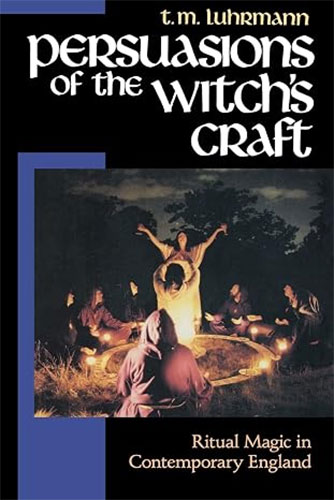
Persuasions of the Witch’s Craft, published by the Harvard University Press in 1989, is American anthropologist Tanya Luhrmann’s account of witchcraft and magical practice as ‘alternative’ religion in London during the early 1980s. By immersing herself in the secretive worlds of ceremonial magic and the Western Mysteries, she spent almost every night of fourteen months in the company of self-proclaimed magicians; engaging in rituals, making ceremonial clothing, giving tarot readings. In short, she engaged with magic head on, later analysing as academic data her own subjective experiences as a practitioner of magic. What she encountered appeared, probably unexpectedly, to bring her, as a notional rationalist, to some uncomfortable conclusions. In order to try to make sense of the many ambiguities concerning the effects on the practitioner of the act of magical practice, she developed her theory of ‘interpretational drift’.
To the lay observer notions of ‘magic’ or ‘witchcraft’ are often synonymous with the ‘occult’, the shadowy world of spells, invocations and naked rites under the moonlight; if not ‘evil’, then certainly, to a conventional mind-set, questionable or unsettling. Alternatively, the terms might refer to the beliefs and practices of ‘primitive’, pre-Enlightenment or pre-modern societies. In contemporary terms – a modernist environment – magical practice refers to the activities of those who, for a range of reasons, reject the ‘rational’ in favour of something more mercurial and elusive; expressions of a belief system that conforms to their individualistic ordering of the world – one that is rejected by those who adhere to a literalist, mechanistic world-view.
Lurhmann identifies on page 4 of the book the conundrum that is central not only to the anthropologist’s own look at late 20th century magic, but is also equally mystifying to those for whom non-mainstream belief systems are problematic: ‘why do they practise magic when, according to observers, the magic doesn’t work?’. One might reasonably ask the same question of any adherent of mainstream religion with regard to prayer, or some other devotional practice. Magic as an alternative, New Age or Aquarian religion is still, fundamentally, a religion. Why should it be expected to achieve observable results not required of the mainstream? The question serves to raise the suspicion that it carries a covert subtext: that what is being asked of the magician is not only ‘why do you do this?’, but also ‘what exactly is it that you do, and should I be alarmed by it?’
Lurhmann describes in detail the processes by which the would-be initiate magician finds a coven or practising group, principally by visiting a New Age shop or weekend Psychic Fayre. In the 1980s, a common route was to buy a magazine like Prediction, and to correspond by post with magical groups through box numbers found by scouring the personal columns of the magazine. Secrecy is paramount: the newcomer is given few clues as to how to find, and join, particular groups. One must use one’s wits. Only those who really wanted to go the full nine yards would persist. This was pre-internet time: in contemporary terms, almost pre-historic.
Lurhamnn was accepted into several groups, including the circle founded by Gerald Gardner, whom she described as ‘the man who created witchcraft in its modern form’ (p. 37). Her account reveals several of the ‘household’ names of the magical fraternities, some with more positive associations than others – Marian Green, Dion Fortune, Aleister Crowley. In keeping with the secrecy insisted upon by practitioners, she gives her respondents, and their groups, pseudonyms. Again, secrecy is crucial. It gives magical practice a special significance, and some maintain that ‘practice requires secrecy in order to be effective’ (p 251).
The book is divided into five sections. The first, Speaking with a different rhythm, identifies four main categories: witchcraft, the Western Mysteries, ad hoc ritual magic groups, and New Age neo-pagans, with the Western Mysteries seeming to hold themselves in particularly high esteem. Its adherents believe that their rituals allow them contact with non-biological entities that help guide our spiritual evolution. For one such group there were some moralistic caveats regarding membership: it insisted that ‘members must be practising Christians, and that they may not be, or have been at any time in the past, homosexuals or drug takers’ (p.60).
Rites and rituals are common to all groups. Luhrmann also discusses the literature that practitioners of magic allegedly favour, novels that reveal much about the mindset of the contemporary magician – J.R.R.Tolkien, Ursula le Guin, and Dennis Wheatley are three such mentioned. These books tend to focus on magical or fantastical realms set in ancient worlds, populated by fabulous beasts or beings endowed with extraordinary powers. The characters often declaim in clichéd language that pastiches Nordic mythology, or tries to evoke ‘old ways’. These books are often characterised as offering child-like escapism for adults, heavily romanticised and moral in tone. Luhrmann summarises their readers as ‘imaginative, self-absorbed, reasonably intellectual, spiritually inclined, and emotionally intense’ (p.100).
In the introduction to the book’s second section, Listening to the Goddess Lurhmann describes the process by which the magician, once initiated, ‘begins to find new patterns in sets of events, to see connections where previously he has only seen coincidence’ (p.115). She writes of her own struggle to extract sense or reason, largely by imaginative or intuitive means, from stuff she encounters that unsettles her. Events that might seem to the uninitiated to be merely coincidental are often invested with special significance, where they are seen to be connected in ways that are meaningful, yet are unaffected by causality. Assertions concerning the results of a particular ritual address the question as to why such processes are serially adhered to in the light of them not ‘working’. Failures are often ignored, whereas those that are to seen to have succeeded are lauded as examples of magic’s efficacy.
In this respect, it seems to be that the creative realm of the imagination is favoured over the claims to objective truth of scientism, the latter insisting as it does on tightly-controlled experiments whose results can only be considered scientific if subject to rigorous testing, informed by strictly rational criteria. The novels mentioned above all deal with the realms of the fantastic. In a literalist sense, many of the ideas they expound are unworkable or absurd. The magicians Lurhmann met were intelligent people. A computer analyst, for instance, or a university lecturer, would be well acquainted with the need for assertions concerning the way the world works, according to the fundamental laws of cause and effect, to be logically supportable. Yet, if magic increases the emotional satisfaction of the practitioner, or expands the realm of their imagination, then perhaps the rituals enacted can be said to have ‘worked’. The error in thinking is, for Lurhmann, in claiming that rituals are effective in ways defined by scientism. She says that magicians often suggest that quantum mechanics offers a clue to magic’s power. Discoveries of the apparently chaotic nature of the sub-atomic realm, particularly experiments that show that the behaviour of particles can be directly affected by the act of observation, are offered as supportive grounds for the notion that mind can affect matter. Luhrmann’s response is apt. It is not that experimental physics ‘proves’ that the mechanistic laws of cause and effect are inadequate in understanding the true nature of the way the universe behaves, and that thus all is open to conjecture – it is that we lack as yet a complete understanding of the apparent randomness of the sub-atomic realm.
In the book’s third section, Lurhmann seems to be getting to the heart of at least one aspect of magical practice that makes a kind of objective sense. In Summoning the powers she ascribes basic therapeutic value to the practices of meditation and visualisation: ‘The remarkable feature of this training is that it works’ (p.181). As she says, neither of these techniques is unique to magic. Meditation is taught in evening classes held up and down the country in church or village halls by people who would hesitate to describe themselves as magicians. Lurhmann suggests that such techniques may be adopted to give the practitioner access to areas of inner lives that are intimidating, and to provide a forum in which to explore feelings, to mediate ‘unknowable uncertainties’ such as death. Certain aspects of magical practice, she suggests, provide ‘the symbolic forum through which those personal feelings can be confronted, identified and to some extent understood’ (p.261).
But still, there is the problem for the magician of scepticism from the world outside the groups and circles; scepticism that could manifest itself in damaging prejudice. In the closing sections of the book, Justifying to the sceptics and Belief and action, Lurhmann describes ways in which practitioners come to terms with their own unease about their experiences of magic. Strategies employed deal with differing perspectives, from the view that magic reveals more about the objective world than science; or that there are two worlds – one subject to rational analysis, the other not. A relativist argument posits truth as ultimately unknowable; and a metaphorical view recognises that magical theories are probably false, but that the practice is engaged in for its therapeutic value.
Intriguingly, Lurhmann says of her own experiences that remarkable things happened to her during her time as a participant researcher; that she felt empowered by certain rituals, and that events occurred that seemed to be strangely synchronous, if interpreted in a way that was new to her – a way that might not have impressed itself on her had she not been so immersed in the world of magic. She attributed this way of gaining a new perspective on events as an instance of ‘interpretational drift’, where unfamiliar associations and correspondences gradually became apparent to the practitioner of ritual magic. The drift was towards interpretations that might baffle the non-practitioner, but which satisfied a need to emphasise imaginative or creative processes in apprehending the way events in the world were ordered. Ultimately, there was not much, it seemed, to prevent Luhrmann from ‘believing’, save for the fact that there was little to be gained but magical power, which could act anyway, whether or not she consciously directed it. Conversely, however, she stood the serious risk of losing credibility as an academic if she were to come out as a ‘believer’. This seemed to summarise the central dilemma for many who had had contact with magic – that from such exposure they could apparently discern its effects, but were reluctant to attach to that experience the process of belief. Perhaps, ultimately, in dealing with magic, belief in the sense of maintaining that an assertion or a set of claims is objectively true is unimportant. It is the subjective experience that matters; the creative process underlying the rituals, the sense of freedom from having to justify ones activities, the therapeutic aspects of practice. For the magician, rationalism is too cold; it is the warmth of sentiment and emotional engagement that they value.
Two quotes from the book serve to give diverse but compatible views on what magic might mean for the practitioner, whether a ‘believer’, or not. The first comes from a female witch called Mick, one of Lurhmann’s respondents in the introduction to the third section of the book, Summoning the powers: ‘The goal is to bring out the hidden perception of human beings…That’s what magicians are here for’ (p.176). The second comes on page 157, from a talk given by a highly-regarded senior practitioner that brings some levity to the debate on magic’s efficacy, and perhaps speaks of the way that the world of mainstream rational analysis sees magicians, and the way that, if engaging humorously, they are able to see themselves: ‘Well, this is the story of occultism through the ages, isn’t it? It’s a question of loonies, saying the right thing.’
Keith Rodway
.