
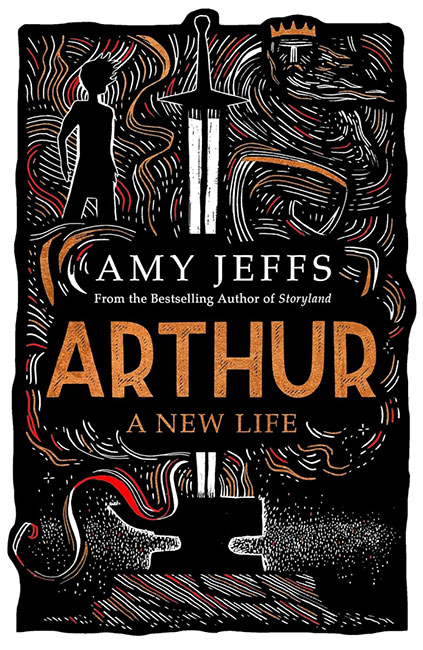
Arthur: A New Life by Amy Jeffs (riverrun, 2026)
Tales of King Arthur continue to enthral. Amy Jeffs’ retelling of Arthur’s story emerges in a similar time period to the four-volume epic in ballad form that the poet Malcolm Guite is currently undertaking in Merlin’s Isle: An Arthuriad. It has ever been thus, with troubled times in particular regularly calling out clusters of works about the once and future king.
With Arthur: A New Life, Amy Jeffs revisits her original research and the source materials used for her best-selling Storyland: A New Mythology for Britain. That debut tome established the accessible approach she has consistently taken to her source materials as she combines brief retellings of original stories with discussion of her sources and descriptions, where applicable, of her visits to original or possible sites. This is a compelling combination which never gets bogged down in too much detail and which by lightly stepping through the layers of original and contemporary materials retains the interest of the general, as opposed to the specialist, reader. This is a skill which many academics never master and Jeffs is to be congratulated for the way she intertwines story, research, and description.
Each new telling of the stories of King Arthur needs to grapple with who the author believes Arthur to have been. Jeffs, in her usual accessible manner, concisely describes the source materials that are available and her own selection from them. Her main source is the Brut Chronicle, named after Britain’s legendary founding father ‘Brutus’, a medieval pseudo-history that formed a large part of Storyland. However, she also draws on romances, saints’ legends, early Welsh poetry and fragments of archaeology.
While these sources contain some of the much-loved elements we now expect to find in stories of Arthur – Merlin, Guinevere, the sword in the stone, and the building of the round table – there is much that is different: Arthur as a larger-than-life warlord, a hero raised by fairies, a leader of the wild hunt, a monster-slayer, a defier of the Roman Emperor, and more. Jeffs has primarily focused her attention on sources and stories that didn’t feature in the Arthur tales included in Sir Thomas Malory’s 15th century Le Morte D’Arthur. As a result, tales concerning the Holy Grail and Tristan and Isolde do not feature.
Guite’s Arthur, by contrast, draws heavily on the perceptions of the Inklings, and Charles Williams in particular, that the Holy Grail strand of the Arthur stories is key to their longevity and continuing significance. While both make different selections from the available sources, those different choices speak volumes about the breadth of the source materials while it is also clear that both see the meeting of Christianity with pre-Christian Celtic pagan Britain as one of the most interesting elements of the source materials.
So, what does Jeffs’ version of the Arthur stories achieve? In the ‘Prologue’ to another of her books, Wild, she states her essential intention for all her books. She writes, ‘I hope the stories’ accessibility will encourage the greatest number of readers towards the wonders of the primary sources, while keeping those sources alive in our culture by means of creative reinterpretation.’
In the case of the Brut version of Britain’s deep past, as she writes, ‘England’s educated classes would […] have learned, lived, fought and dreamed’ these stories ‘from the mid-twelfth century until at least the sixteenth’. Those stories as a whole are not well known in our day and time, while the Brut’s stories of Arthur have been obscured by those from other sources. As a result, we can ‘significantly enrich our understanding of Britain’s cultural and political heritage by knowing about the Brut’ and this Jeffs makes accessible to us through both Storyland and Arthur.
We also learn much, through Jeffs’ commentaries on the stories, about the way that Arthur lore grew and spread. She traces fascinating Arthurian connections to Bronze Age daggers, hollow oak burials, the enterprising monks of Glastonbury Abbey, the folklore around an Ice Age lake drained by the Victorians, the Order of the Garter, a miracle at Edward the Confessor’s tomb, and Henry VIII’s restoration of Edward III’s Round Table. With this element of the book, we are not being offered a systematic literary or cultural history of the Arthurian legend, however, our whistle is well wetted by the information she shares that is of direct relevance to the stories she has told and encouragement is also given to explore further beyond the pages of this book.
One of the Arthur legends is of Arthur and his knights lying sleeping in a hidden underground cavern or hill across Britain, waiting to awake and return in the country’s hour of need. With Arthur: A New Life, Jeffs successfully and compellingly reawakens stories of Arthur that had been put to bed by the impact of Malory’s Morte D’Arthur with its courtly knights and chivalric romance. The older, wilder tales she revives succeed, as Helen Carr has noted, in bringing Arthur back ‘to ferocious life’.
.
Jonathan Evens
.