
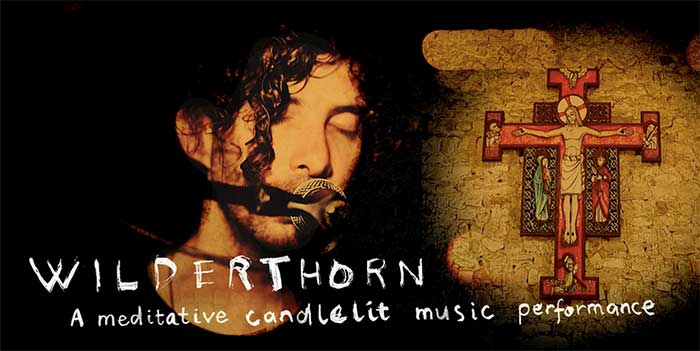
Wilderthorn: IMMERSE, St Peter on-the-Wall, Sunday 23 August 2026.
St Peter on the Wall in Bradwell-on-Sea, Essex, is one of the oldest, if not the oldest church in Britain. Founded by St Cedd, a missionary from the Holy island of Lindisfarne, it dates back to 654. Originally a larger building built on the remains of a Roman fort, what remains is a barn-like space, which was used as just that by farmers for many years, but has, since 1920, been re-consecrated as a church. See my poem ‘Bradwell’ for more on the history and atmosphere of the place.
As a singer, Jon Bilbrough (AKA Wilderthorn) has worked with award winning composer, Nitin Sawhney, members of the platinum selling rock-band, Athlete, The London Bulgarian Choir and renowned conceptual-electronic producer, Max Cooper. He is featured throughout Nitin Sawhney’s critically acclaimed album, ‘Last Days of Meaning’ along with actor John Hurt and Yolanda Quartey (Massive Attack); has toured the UK with Athlete; and opened for the likes of St Vincent, Guillemots and performed alongside Beth Rowley, Iain Archer and Foy Vance.
As Wilderthorn, he is known for gigs in disused and abandoned spaces, turning forgotten places of history and atmosphere into wild and magical experiences. These IMMERSE performances in ancient, hidden, sacred or natural spaces aim, through improvisation, to respond to the ambience, atmosphere, acoustic, sounds and senses of such spaces. Performing together with the multi-instrumentalist Sekrit and the violinist Natasha Petrović de Maio, Wilderthorn created a meditative experience of ethereal sounds and atmospheric textures amid the Chapel’s candle-lit space.
Beginning with a drone, then layering percussion, violin, vocals, and samples (including birdsong) on top, the music ebbs and flows, moving from enchanting one-to-one hymn-like moments of intimacy through to states of tribal and religious euphoria, whilst interacting with the natural sounds of a building on the outer edge of the Essex saltmarshes and one inhabited, currently, by a flock of starlings. Wilderthorn’s powerful and emotive voice is tinged with dark operatic tones and engages in ‘sufi-style’ flourishes while backed by a wave of primal rhythms, clanging and shimmering percussion, combined with haunting violin textures. His vocalising is primarily wordless, his vocals adding to and being an element within the slow-moving, meditative soundscapes. One wonders whether this approach derives at all from the singing in tongues found in charismatic church worship, albeit slowed to induce contemplation and reflection, rather than being ramped up for anthemic ecstasy.
His musical journey began in Asia, however, his earliest gigs being in Sri Lanka, Malaysia, Singapore and India. He then returned to Chennai, India, to create demo recordings with local Bollywood musicians, famous for their work with award-winning Indian composer, A.R. Rahman. Such influences are melded with those which are more western and contemporary both in Wilderthorn’s own music and that of his brother Sekrit (a qualified sound therapist), who plays instruments such as Himalayan Singing Bowls, Gongs and Percussion in ways that are therapeutic.
All music begins and ends in silence, or more accurately stillness, as silence is never absolute. On this occasion, we begin and end by hearing the song of the starlings. Their song complements the chants and shouts of Wilderthorn throughout this performance and is the more enduring sound in that they continue when his performance ends. His music consciously takes us into silence in a similar way to Van Morrison’s extended meditative works such as ‘Summertime in England’. As well as imploring us to feel the light and the silence, Morrison often extemporises in such pieces using grunts, cries and repeated words. Wilderthorn extends this approach to whole pieces in which the vocalising makes no use of recognisable words.
Two-thirds of the way through the ebb and flow of this tidal performance however, Wilderthorn sang of being in a golden hour. This was emblematic of our experience, as the beauty of the sounds created washed over us while the sun itself was setting at the west end of the building. The performance had been prefaced with a drum played outside the entrance before accompanying the musicians as they entered to begin the interior performance. As the last rhythms of percussive energies ebbed away inside the building, we were invited to join the musicians outside for a closing invocation to the sun before it fully set. Thus, we ended this golden hour immersed in the golden light of the evening sun.
Although this performance began and ended in this Christian space with prayer, its wordless, improvisatory nature connected it most closely to nature and enabled open reflection on the part of those who were immersed in the soundscape Wilderthorn shared in response to this sacred space. Although predominantly chilled and contemplative, the flow of sounds into and then out of dramatic dissonant and dynamic stretches reminds that not all aspects of the story of this place are tender and true. In responding to this place, its stories and its atmosphere, the emotive flow of sounds evoked took us to troubled places as well as those that are peaceful or resolved. It was in this openness to emotion and experience that this performance and experience found its strength and depth.
.
Jonathan Evens
Wilderthorn’s website is here.
.