
[Scene: An empty room.
In it, there is nothing. Nothing has been described as “pure zero. But this is not the nothing of negation. For not means other than, and other is merely a synonym of the ordinal numeral second. As such it implies a first; while the present pure zero is prior to every first. The nothing of negation is the nothing of death, which comes second to, or after, everything. But this pure zero is the nothing of not having been born. There is no individual thing, no compulsion, outward nor inward, no law. It is the germinal nothing, in which the whole universe is involved or foreshadowed. As such, it is absolutely undefined and unlimited possibility — boundless possibility. There is no compulsion and no law. It is boundless freedom.” And if you understood that you will love what comes next.
Even the most humdrum and low school educated theatre-goer knows that the trouble of sustaining a true void may push us to the most extreme answer to the question ‘Why is there something rather than nothing?’ – namely, ‘There must not only be something but there must not be any emptiness at all!’. You can say that again! Meanwhile, Parmenides, a blonde, maintained that it is self-defeating to say that something does not exist. The linguistic rendering of this insight is the problem of negative existentials: ‘This room does not exist’ is about this room. A statement can be about something only if that something exists. No relation without relata! Therefore, ‘This room does not exist’ cannot be true. Parmenides and his disciples elaborated conceptual difficulties with negation into an incredible metaphysical monolith.
The Parmenideans were opposed by the atomists. The atomists, who met every Thursday afternoon in the library for a few drinks and a chat, said that the world is constituted by simple, indivisible things moving in empty space. They self-consciously endorsed the void to explain empirical phenomena such as movement, compression, and absorption.
Parmenides’s disciple, Zeno of Elea, a brunette, had already amassed an amazing battery of arguments to show motion is impossible. Since these imply that compression and absorption are also impossible, Zeno rejected the data of the atomists.
Less radical opponents of vacuums, such as Aristotle, whose hair colour is irrelevant, re-explained the data within a framework of plenism: although the universe is full, objects can move because other objects get out of the way. Compression and absorption can be explained by having things pushed out of the way when other things jostle their way in. Aristotle denied that the void can explain why things move. Movement requires a mover that is pushing or pulling the object. An object in a vacuum is not in contact with anything else. If the object did move, there would be nothing to impede its motion. Therefore, any motion in a vacuum would be at an infinite speed.
Anyway, in this room there is not even a simple chair, a book of plays, or a fly buzzing around looking for a way out.
The door opens.
Enter Bill and Ben, furniture removals men.]
Bill: Is this the place?
Ben: Doesn’t look like it.
Bill: Check the address.
Ben (pulling a note from his overalls, studying it): Yeah. This is it.
Bill: This is definitely the place?
Ben: Apparently.
Bill (with heavy irony): Oh, only “apparently.”
Ben: Listen, mate. A job is a job.
CURTAIN
.
Mark Halliday & Martin Stannard
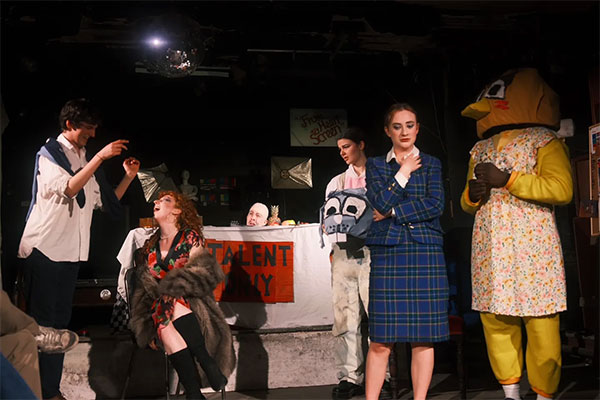
Picture From “A Vacuum at the Centre”
Photo Mili Branston
.