
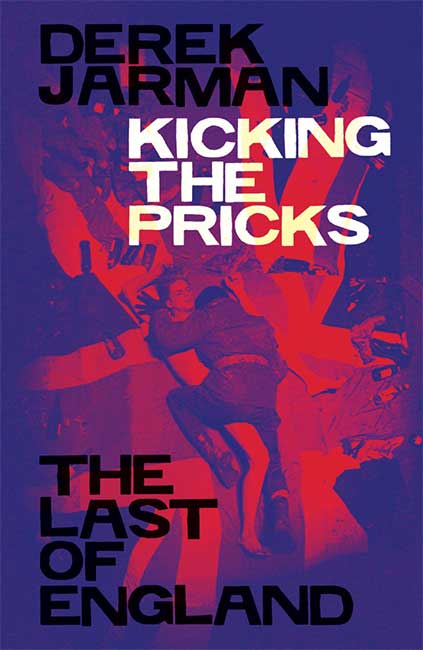
Kicking the Pricks: The Last of England, Derek Jarman (£12.99, Prototype)
Derek Jarman’s films are astonishing: the Elizabethan/Punk mash-up of Jubilee (1978); his radical adaptation of The Tempest (1979); the erotic and sensual The Angelic Conversation (1985), dreamily soundtracked by Coil, and with Judi Dench reading fourteen of Shakespeare’s sonnets; the painterly chiaroscuro and colours of Caravaggio (1986); and the painful, visually monotone Blue (1993) with its interweaving spoken narratives.
Best of all, however, is The Last of England (1987), an angry, at times despairing, elegy for English culture, and a vision of what the end result of Thatcher’s politics would be. The film is an assemblage of juxtaposed scenes from semi-improvised events mostly set in rundown housing estates or semi-derelict warehouse compounds, along with excerpts from Jarman’s grandfather’s and father’s home movies. It is at times brutal, raw, violent and emotional: desperate sex on a giant union jack; homeless and hopeless down-and-outs sat on a dock waiting for an impossible future; a starving figure trying to eat raw cauliflower; a tragic dance of mourning and grief on a pebble wasteland.
I hadn’t previously taken in that the film was initially not a success. To me, living in a run-down industrial Cheshire town at the time, scraping a living running a community printshop, selling paintings, and gigging with a ramshackle band who mixed post-punk experiment with collaborative improvisation, it seemed simply an artistic response to what was happening around us and in Liverpool, Stoke-on-Trent and Manchester, where we made trips to see live music, dance and art exhibitions. If you had read William Burroughs and contemporary poetry, and knew about Dada and collage, it wasn’t problematic to assemble meaning from the film or to view it as performance art.
Jarman was also a fine writer: of poetry, autobiography, polemic, about gardening, and meditations on colour. Prototype have already reissued his early book of poems, A Finger in the Fishes Mouth and now they are publishing a new edition of Kicking the Pricks, which was first released alongside The Last of England and with the film’s title. It too contains a mix of material: autobiographical fragments, notes about filming, sections of interview, rants, script excerpts, poems, confessions, declarations of love, ruminations on politics, sex and current events. There are also tender observations of nature and reflections on art and music.
Perhaps more than any other of his other books, the book foregrounds the contradictions and emotional turbulence of Jarman’s life. Brought up in a conservative RAF family in various airbases and then sent to public school, Jarman hated the enforced discipline and emotional suppression of his youth, yet was also nostalgic for what we might regard as a non-existent or imaginary England from the past. As he wrote Kicking the Pricks he was dealing with a positive AIDS diagnosis, the introduction of Section 28, which forbade ‘the intentional promotion of homosexuality’, and the death of many of his friends and acquaintances in the gay counterculture.
Jarman at times resorted to angry condemnations of heterosexuality, and banal paintings with brief slogans or words designed to shock scratched in thickly applied colour. As Channel 4 became less and less radical and stopped commissioning experimental films, and ‘The British Film Renaissance’ turned out to be anything but, merely another marketing device for a chosen few who had relocated to Hollywood, Jarman found it difficult to fund his work or gain critical support. Several sections of this book angrily deconstruct the censorship, power struggles and duplicity of the film industry at the time: ‘In all, I haven’t spent a million on all my films yet; I’m proud of that, and also filled with fury for those who deal out the cash.’
Jarman was committed to working with his actors and crew to create films as they recorded them. He embraced improvisation, unplanned moments, asides and the unexpected, enjoying what could be discovered in the edit and cutting of a film, the technical errors and problems of celluloid:
The Last of England has changed the face of my cinema. It’s grown into itself.
I know that I can stand by this film even if the critics form a firing squad. What
comes next hardly matters. I’m happy with it, and all its flaws. I love the flaws,
they are the flaws that the Japanese master potter puts into his work. The
arbitrary gesture to spoil a perfect shape. ‘I love the moments which are out
of focus. I’ve fallen in love with dust and scratches.’
In retrospect this might seem overblown; what came next did and does matter. Jarman would produce several more feature films and exhibitions of paintings before his death in early 1994 at the age of 52. He is also remembered for his Dungeness house and garden, as a gay rights activist, and as part of what is known as ‘New Queer Cinema’. None of that is enough, none of those labels offer much insight into the complexity of Jarman himself or his work.
Kicking the Pricks does, however. It helps us understand how Jarman’s sexuality underpinned all his creative work, and how he fought with the film industry and the self-opinionated, illiberal, bigotted and uninformed politicians of the day as they failed to deal with the spread of AIDS and deliberately turned their backs on the sick, poor, elderly and unemployed. It was the start of the Neoliberal intolerance, self-righteousness and greed we find ourselves dealing with today, which is why this book is more relevant than ever. It is a historical document, a rallying call, a provocation, and an act of resistance in itself, just as the film of The Last of England was and remains so.
Like the original edition, this book is full of photos, and it also includes the Preface from the 1996 edition when it was first retitled as Kicking the Pricks. In addition, there is a sequence of ‘flat sonnets’ by author Richard Scott, a previously unpublished short interview with Jarman, and a superb Afterword by Declan Wiffen, which considers the book (and Jarman’s work in general) both then and now, encouraging readers to ‘find some hope in the optimism Jarman found through his art-making’, and ending with a poignant call to arms:
Kicking the Pricks reminds us of the community at the heart of Jarman’s ability
to make art and to resist, and invites us to reassert our efforts to do the same.
.
Rupert Loydell
You can order Derek Jarman books from Prototype here.
.