
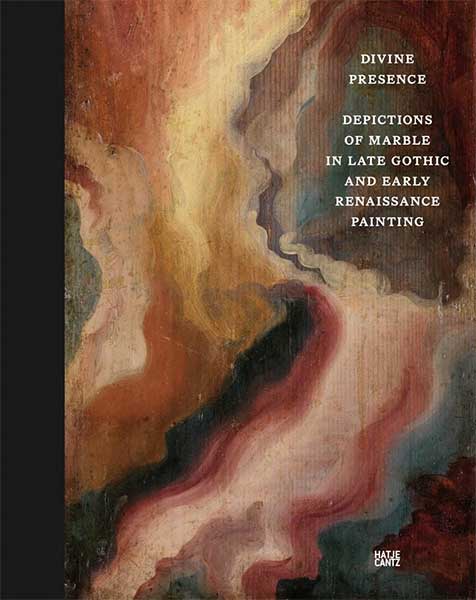
Divine Presence: Depictions of Marble in Late Gothic and Early Renaissance Painting, ed. Karl Kobitz (Hatje Kantz)
If you spend time looking at the Annunciation paintings of Fra Angelico in Cortona, Florence and San Giovanni Valdarno, as I like to do when on holiday in Italy, then you can’t help but start to notice and be puzzled by the context that the angel and Mary are placed in. What are these strange buildings they inhabit? Where did the idea of halos come from? Why do these paintings (and many others from the same period) consistently use colour in the same way? What are the lilies for? Why is there sometimes a ribbon of text issuing from the angel’s mouth? And what about all the abstract patterns where there should be solid walls or floor?
It’s not difficult to find quick answers to most of these questions (I found John Drury’s Painting the Word: Christian Pictures and their Meanings lucid and understandable) and most of our confusion is because here in the 21st Century many of us simply don’t understand the symbolism attached to objects or concepts, nor the social and religious constructs of the time. What may seem to us like a fairy story about some kind of alien encounter, a being arriving from another world to explain an unwanted pregnancy was, of course, part of a religious story that remained central to many European populations, even as ideas about science, astronomy and perspective expanded and changed.
The abstract patterns, the swirls and spatters of paint, are usually explained as being a reminder of how the world will not last, how temporary it all is in relation to God’s everlastingness and omnipotence. That, along with some symbolic decoding, can help with mentally understanding the story depicted, just as finding out about historical pigments and colours allows us to know more about the physical nature of a painting.
But, as this gorgeously produced art book evidences, there is lots more to stone and how it was thought about and painted. Andrea de Marchi’s Introduction summarises what will be expanded upon later in the book, namely how ‘Renaissance painters embraced the manmade and the imaginative’ alongside long-standing ‘awe for God’s creations, expressed through materials such as gold and precious stone.’ He continues, arguing that as well as allowing painters ‘to suggest the intangible’ the marble’s
unpredictable patterns disrupted habitual ways of looking, compelling the eye
to linger and return. In this way, marble acted as a link between the visible and
the invisible, guiding viewers toward the contemplation of ‘higher things.’
De Marchi boldly claims that only did ‘these painted stones became a means to express what could not otherwise be shown’ but ‘[a] pioneering use of paint emerged that foreshadows much later Western artistic movements and gestures such as Renoir’s broken brushstrokes, or Pollock’s action painting.’ It evidences ‘a moment when medieval traditions gave way to Renaissance innovation’ an example of ‘the fluidities of artistic and cultural development ‘.
The following chapters explore different aspects of painted stone and how marble was perceived and regarded in society at the time. There are two sections, one dealing with ‘Stone in an Enchanted World’, the other about ‘Depicting the Ineffable’. Whilst marble can now be reduced to pretty building blocks, floor tiles and geological structure, back in the 14th and 15th centuries, it had many spiritual and alchemical significances. Precious materials and colours reflected an ever-present God and there was often a literal (rather than mythical) belief in the existence of Biblical characters and stories. The veins of different colours in marble were evidence of beauty, of that God, and were often also regarded as ‘liquid light’, evidence of a supernatural presence, as well as a magical substance that could be ground down to create pigments for artists.
There were associations with water and the earth. Did marble somehow hold tides and currents within it? Had the oceans shaped it? Or was it formed in some vast underground cauldron before being pushed up into the visible world? We read that ‘Marble was widely considered a living entity—a veined, flowering thing that existed somewhere between a vegetative and fleshy state’ and that this wasn’t totally discredited until the science of Geology emerged in the 19th Century. But the authors also note that
The transformation of a humble rock into a material that appears to capture
the light, color and motion of the skies and the seas is no less miraculous for
our scientific understanding of it.
The book also explored how marble was used in churches to create illusionary religious space(s), yet also depicted by artists as a magical, weightless element that could only support the likes of angels and spirits; a way of discussing or imagining miracles, magic and unexplainable interventions or events. It also explains how stone columns were used as a symbol of ‘a bridge that crosses the chasm separating Earth from Heaven, and [in Annunciation paintings] a link that connects the ethereal creator and the human mother’.
There is more, much more, but not enough space here to précis it all. As the book comes to an end, the idea of this work prefiguring or being early examples of abstraction is discussed further, as well as the art in relation to Negative Theology, the strange idea that God can only be described in terms of what he is not, since he is unknowable. It is also evidence of a different ‘relationship between people and the natural world’, one we may have to renegotiate in the advent of global warming and extreme weather events. This may mean not only changing how we live and what we eat, farm or create, but also rediscovering a sense of wonder and duty of stewardship, because – as this book notes – ‘[t]he advancements of modern science make marble no less mystical or strange’.
.
Rupert Loydell
.