
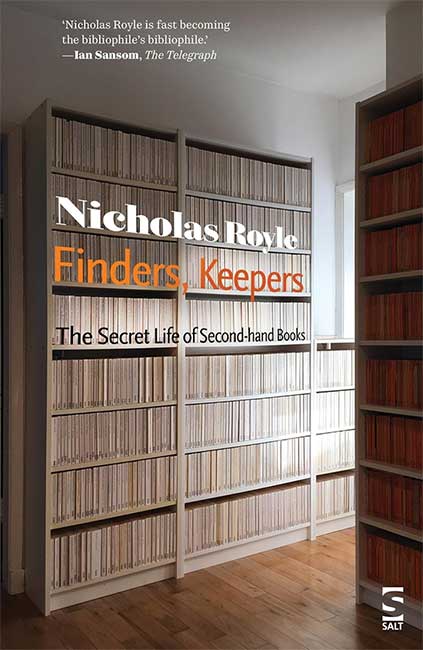
Finders Keepers, Nicholas Royle (Salt, £10.99)
Sometimes you get to the end of a book and think ‘blimey, I could have written that’, but that’s a bit like saying you could paint that great abstract piece at Tate. No you couldn’t and no I couldn’t. What I meant by that, in the middle of last night when I eventually put down the final part of Nicholas Royle’s trilogy about secondhand books, is how eloquent, readable and casually-toned the book is, how fluid and approachable the prose is.
So, no, I couldn’t have written it, but the way it reads like a good pub conversation or chat with an interesting stranger on the train, makes its whole construction and flow seem easy. There’s another reason I couldn’t have written it, though: I am not the slightest bit inclined towards Royle’s obsessions with annotations and inclusions in secondhand books. I tend not to buy books that have been written in or are ex-library books, and swiftly get rid of most if not all of any detritus that’s been abandoned in books I buy.
Royle, however, loves shopping lists, bus tickets, train tickets, business cards and any bits of paper with names, addresses or anything else on; inscriptions and dedications too. No, I don’t get it either, nor the fact that often it is these that he buys the book for, sometimes choosing to return books to their previous owners or their authors after some basic detective work.
That’s my idea of a nightmare, all the books I’ve turned out being delivered to me by a stranger, but then I read a lot and am a bit of a hoarder. Royle is as well, and I know – having met him but also from his Instagram account – that he does actually read books, too. Sometimes, however, according to Finders Keepers, he only reads odd chapters, often en route to somewhere else that has been prompted by the ‘inclusions’ he has found. That is, he re-enacts other people’s previous journeys in addition to travelling to search secondhand bookshops.
There are, it seems, few bookshops in the UK that Royle does not know and has not visited. Many are known to me, but even more are new to me. I might have to start travelling with Royle’s books in my bag or go to the bother of copying a list out. I confess that I like agreeing with him when his book declares that such-and-such a shop in Newcastle or Manchester or London is a good one, in fact I am tempted to start leaving a trail of books stuffed with used tickets and notes to see if he turns up at my door.
Probably not. Royle prefers the kindness of strangers, or the kindness some people show towards the stranger who mails them their old books back, or pushes them through their letterboxes as part of his urban perambulations. (Royle runs a small press, too – Nightjar Press, since you ask – and delivers orders on foot when he can. He calls this Royle Mail.) Royle is also one of the few people in the world who can read as they walk, apparently without accident or incident. A number of fellow perambulatory bibliophiles (I worked hard on that term) are given entries throughout the book: location, brief description of person reading, book being read, and sometimes a smartarse comment or reported (often self-) conversation. (Smartarse comment being Royle; self-conversation being the walker, not Royle.)
Where am I going with this review? I have no idea. Where is Royle going with all his obsessions, self-created tasks and projects, his secondhand books, tours and purchases? I definitely have no idea and am not convinced he does. He doesn’t seem to like most novels or poetry, is happy to read an odd chapter or two then discard a book, seems to have time to spare which he fills by taking off where found material dictates. Of course, he also finds time to write non-fiction like this new book of his, run a publishing outfit and author experimental novels too (well, he used to anyway). And for all those bookshop visits too.
I guess this is a form of autobiography that evades the obvious, cutting through the crap as it were, replacing it with other crap, found by chance. Well, not chance, because Royle goes out hunting for it. But in amongst all the strange projects, comments and journeys we get to know Royle pretty well, as well as some of the bookshops, towns and cities he frequents. The subtitle suggests that this book is about ‘The Secret Life of Second-hand Books’ (no, I have idea why there is a hyphen there) but really it is about the secret life of Nicholas Royle, who chooses to engage with what is hidden in books rather than books themselves. It’s an engaging, peculiar, original and at times hilarious read. I commend it to you.
Rupert Loydell
PS I realised after completing my first draft of this piece that I could not remember a thing about the final couple of chapters I had read in the small hours the night before, and that some re-reading was in order. I have to say I found the notion of ‘doubles’, that is books that share the same title, a bit silly. It’s like expecting people called Nicholas or Rupert to have anything in common with others with the same name.
PPS I was chatting with my mum (who also loves books, and with whom I go to London bookshops whenever I am visiting her) about insertions and bibliophilia. She doesn’t like annotations and dedications any more than I do, but she did point out my habit of amassing bookmarks when available for free. (Fortunately, she is fairly oblivious to how long I spend choosing the right bookmark from the stack beside my bed for each book I read, while I am reading it. That is I don’t leave them in the book once I have finished.)
PPS I think I am right in saying the book contains no mention of Bookmarks, the Socialist bookshop in Bloomsbury, which I have found a great source of cheap secondhand books over the last few years. However, part of me does wonder if it is Nicholas Royle who purchased the first edition of one of Denton Welch’s books from the 50p box whilst I nipped over the road to Oxfam Books. Turn your back for ten minutes…
.