
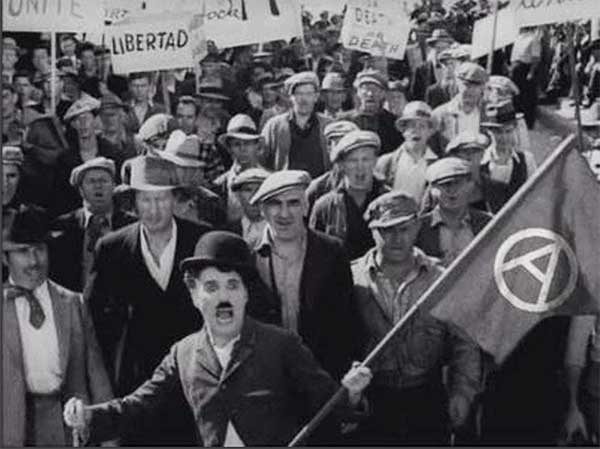
Charlie Chaplin is most often remembered as a comic genius, a figure of silent cinema whose character, the Tramp, still wanders through popular culture with a bowler hat, a cane, and a quiet dignity. Yet beneath the humour and sentiment of his films lies a deeper current of political thought that is often overlooked. Chaplin was never a theorist in the formal sense, nor did he write manifestos or align himself neatly with any ideological school. However, his work reveals a persistent sympathy with ideas that can be described, with care, as anarchistic. These ideas are not expressed through slogans or rigid doctrines, but through stories, gestures, visual jokes, and the everyday struggles of ordinary people.
When understanding this aspect of Chaplin’s thought, it is important to consider his early life in greater depth. He was born into poverty in London, and his childhood was marked by instability, hunger, illness, and periods spent in workhouses and institutions. These experiences were not simply background details, they shaped his emotional and moral outlook. Authority, as he encountered it, was rarely protective or kind. It appeared instead as distant, mechanical, or indifferent to suffering. This early exposure to harsh systems of control gave Chaplin a lifelong suspicion of institutions that claimed to act in the public interest while neglecting the individual.
This suspicion did not lead him towards bitterness alone, but towards a form of moral questioning. Chaplin did not argue directly against the existence of structure or organisation, but he repeatedly asked whether authority deserved obedience. His films suggest that authority must justify itself through compassion and fairness, rather than demand respect by default. Where it fails to do so, it becomes something to be quietly resisted.
The Tramp, Chaplin’s most famous creation, can be seen as a subtle embodiment of this resistance. He is not a revolutionary in any conventional sense. He does not organise protests, write speeches, or seek power. Instead, he survives at the edges of society, navigating rules without fully accepting them. His rebellion is small in scale but constant in nature. He avoids capture, questions expectations, and finds ways to live outside the strict boundaries imposed on him.
In films such as Modern Times, this resistance becomes more explicit. The Tramp is placed within an industrial system that reduces him to a function. The famous image of him being pulled into the machinery is not only comic but symbolic. It shows a human being literally consumed by a system designed for efficiency rather than wellbeing. The rhythm of the factory, repetitive and relentless, contrasts sharply with the spontaneity and individuality of the Tramp. Chaplin presents industrial modernity as something that demands conformity at the cost of freedom.
This critique reflects a core anarchist idea, the belief that human beings should not be dominated by rigid hierarchies or impersonal institutions. Chaplin’s films often suggest that genuine order arises not from strict control but from cooperation, empathy, and mutual understanding. This idea appears again in The Kid, where the relationship between the Tramp and the child develops outside formal structures. Their small household is fragile, yet it is based on care, loyalty, and shared effort. In contrast, the official systems that attempt to separate them are shown as cold and procedural.
Chaplin’s treatment of authority is also marked by humour, and this is one of his most effective tools. He does not confront power through direct argument, but through ridicule. Authority figures in his films are often clumsy, confused, or easily deceived. Policemen slip, officials misunderstand, and systems break down at the moment they try to assert control. This humour does more than entertain. It reduces the aura of authority, showing that it is neither as stable nor as rational as it claims to be.
This use of humour aligns with a long tradition of political satire. By laughing at power, Chaplin invites audiences to question it. He does not instruct viewers what to think, but he creates a space in which authority can be seen from a different angle. The result is a quiet but powerful form of critique that avoids confrontation while still undermining accepted norms.
At the same time, Chaplin’s work is deeply humanistic. His focus remains firmly on the individual, particularly those who are overlooked or marginalised. Hunger, loneliness, affection, and dignity are central themes in his films. These are not abstract ideas, they are shown through simple actions such as sharing food, protecting a child, or offering a moment of kindness. This emphasis reflects an anarchist tendency to prioritise human needs over institutional demands.
Chaplin’s later work expands these concerns into a broader political context. In The Great Dictator, he directly addresses the rise of authoritarian regimes. The film uses satire to expose the vanity and brutality of dictatorship. While it includes a more explicit message than his earlier films, it still avoids rigid ideological language. The final speech calls for compassion, freedom, and unity, rejecting domination and appealing to a shared sense of humanity.
What is striking is that even at his most direct, Chaplin does not offer a detailed political programme. He does not replace one system with another in a clear or structured way. Instead, he returns to a set of basic principles, kindness, cooperation, and respect for individual dignity. This approach reflects a form of anarchistic thinking that is ethical rather than theoretical. It is concerned with how people treat one another in practice, rather than how systems are designed in abstraction.
It is also important to consider Chaplin’s understanding of community. Although he is critical of authority, he does not reject social connection. His films often show small groups forming bonds that allow them to survive difficult conditions. These communities are informal, flexible, and based on mutual support. They stand in contrast to larger systems that impose rules without understanding personal circumstances. This distinction highlights Chaplin’s belief that meaningful order grows from relationships rather than enforcement.
Another key aspect of Chaplin’s thought is his portrayal of resilience. The Tramp continues despite repeated setbacks. He loses jobs, faces arrest, and experiences rejection, yet he persists. This persistence is not presented as heroic in a traditional sense, but as a quiet form of strength. It suggests that dignity can be maintained even in the absence of power or security. This idea resonates with anarchist views that emphasise individual agency and inner freedom.
Chaplin’s method of storytelling also deserves attention. Silent cinema relies heavily on visual communication, and Chaplin mastered this form. Through movement, expression, and timing, he conveys complex ideas without relying on spoken language. This gives his work a universal quality. Audiences from different backgrounds can understand his films without translation, which allows his ideas to travel widely.
The simplicity of his style is deliberate. Chaplin avoids complicated language and theoretical explanation. Instead, he presents clear situations that carry deeper meaning. This makes his work accessible while still allowing for thoughtful interpretation. It also reflects an approach to communication that values clarity and emotional connection over technical detail.
Chaplin’s public life adds another layer to this discussion. During periods of political tension, particularly in the mid twentieth century, he was viewed with suspicion by authorities. His films and public statements were sometimes seen as challenging established values. This reaction suggests that his work had a real impact, even if it did not fit neatly into recognised political categories.
In a broader sense, Chaplin’s films can be seen as a continuous exploration of freedom. Not freedom in a purely legal or political sense, but freedom as the ability to live with dignity, to form relationships, and to act with kindness. This form of freedom cannot be fully provided by institutions, nor can it be entirely taken away by them. It exists in the space between individuals, in the choices they make and the ways they relate to one another.
A further dimension of Chaplin’s anarchistic sensibility can be seen in his treatment of law and legality. In many of his films, the law is not presented as a neutral force that guarantees fairness, but as something uneven in its application. The Tramp is frequently pursued, arrested, or punished for minor acts, while larger injustices remain unaddressed. This imbalance suggests that legality and justice are not always aligned. Chaplin does not argue this point through dialogue, but through repeated situations in which the audience is encouraged to sympathise with the person who has broken the rule rather than with those who enforce it.
This perspective reflects a scepticism towards the idea that order must be maintained through punishment. In Chaplin’s world, rules often appear arbitrary, and enforcement is shown to lack sensitivity to context. The Tramp may steal food, but he does so out of hunger. He may deceive authority, but only to survive. By placing the audience in a position where they understand his motives, Chaplin subtly challenges the assumption that obedience is always morally correct.
Another important theme is the relationship between technology and control. In Modern Times, machines are not simply tools, they shape behaviour and dictate rhythm. The feeding machine, designed to eliminate lunch breaks, becomes a symbol of efficiency taken to an absurd extreme. It malfunctions, turning a supposedly rational invention into a source of chaos and discomfort. Through scenes such as this, Chaplin raises questions about whether technological progress necessarily leads to human improvement. Instead, he suggests that without ethical consideration, technology can become another means of control.
This concern connects to a broader anarchistic suspicion of systems that prioritise productivity over wellbeing. Chaplin does not reject technology outright, but he portrays it as something that must remain subordinate to human needs. When it does not, it risks reducing individuals to parts within a larger mechanism. This idea remains relevant, as debates about automation and labour continue in contemporary society.
Chaplin’s films also explore the idea of identity and individuality. The Tramp has no fixed social role. He is not defined by a profession, a stable home, or a clear position within society. This lack of definition allows him to move between different environments, from streets to factories to temporary homes. It also highlights the extent to which social identity is often imposed rather than chosen.
From an anarchistic perspective, this fluidity can be seen as a form of freedom. The Tramp is constrained by poverty, yet he is not fully contained by social expectations. He adapts, improvises, and resists categorisation. Chaplin seems to suggest that identity should not be rigidly fixed by external structures, but should remain open to change and self expression.
At the same time, this freedom comes with insecurity. The Tramp’s lack of stable identity means that he is always vulnerable to exclusion. He can be removed from spaces, denied opportunities, or treated as invisible. Chaplin does not romanticise this condition. Instead, he presents it as a complex reality in which freedom and hardship are closely connected.
The emotional tone of Chaplin’s films also contributes to their political meaning. Moments of humour are often followed by moments of sadness, and vice versa. This shifting tone prevents the audience from settling into a single perspective. It mirrors the instability of the Tramp’s life and reinforces the idea that social reality is not easily simplified. In this way, Chaplin avoids presenting a clear ideological message, choosing instead to evoke reflection through contrast.
Chaplin’s influence can also be considered in relation to broader cultural traditions. His work shares similarities with forms of storytelling that focus on the outsider or the wanderer, figures who exist on the margins and observe society from a distance. These figures often reveal truths that are not visible from within established structures. The Tramp belongs to this tradition, offering a perspective that is both critical and compassionate.
In examining Chaplin’s anarchistic tendencies, it is also useful to consider what he does not do. He does not depict organised political movements, nor does he show collective uprisings in a sustained or strategic way. His focus remains on the individual and the small group. This absence suggests that his interest lies less in large scale transformation and more in everyday acts of resistance and care.
This does not mean that his work lacks political significance. On the contrary, by focusing on ordinary experiences, Chaplin highlights the ways in which power operates in daily life. He shows how systems shape behaviour, limit choices, and create inequality. At the same time, he shows how individuals respond, sometimes by complying, sometimes by resisting, and often by finding creative ways to endure.
Chaplin’s use of space also reflects these ideas. Urban environments in his films are often crowded, unpredictable, and difficult to navigate. Streets, factories, and public institutions form a landscape in which movement is restricted and surveillance is constant. The Tramp must constantly adjust to these conditions, finding moments of freedom within constrained spaces.
This spatial dimension reinforces the sense that authority is embedded in the physical world, not only in abstract rules. It shapes where people can go, what they can do, and how they are perceived. Chaplin’s attention to these details adds depth to his critique, showing that power operates at multiple levels.
Another layer of interpretation can be found in Chaplin’s treatment of time. The pace of industrial life, particularly in Modern Times, is shown to be unnatural and exhausting. Workers are expected to keep up with machines, rather than the other way around. This reversal places human beings in a subordinate position. Chaplin contrasts this with moments of leisure and spontaneity, where time slows down and individuals regain a sense of control.
This contrast suggests that freedom is not only about physical movement, but also about the experience of time. When time is controlled by external systems, individuals lose a degree of autonomy. Chaplin’s emphasis on rhythm and timing, both in narrative and performance, reflects his awareness of this issue.
It is also worth noting that Chaplin’s films often end without complete resolution. The Tramp may walk away, continue his journey, or remain in an uncertain situation. These endings resist closure, leaving open the question of what comes next. This lack of finality aligns with an anarchistic view of society as something that is always in flux, rather than something that can be fully resolved or perfected.
It is also possible to look more closely at the emotional intelligence present in Chaplin’s work, and how this connects to his broader scepticism of authority. Authority in his films often lacks emotional awareness. It responds to situations in a rigid and predictable manner, applying rules without understanding context. In contrast, the Tramp responds with sensitivity, even when he behaves in ways that break those rules. He recognises suffering in others and reacts instinctively, offering help even when he has very little himself. This contrast suggests that moral understanding does not come from position or power, but from lived experience and empathy.
Chaplin’s repeated focus on care, particularly informal care, is significant. In several films, characters survive not because of institutional support, but because they look after one another. These relationships are not organised or regulated, they emerge naturally from shared circumstances. This idea reflects a belief that social bonds can exist independently of formal structures, and may in fact be stronger when they are not constrained by them.
There is also a recurring tension in Chaplin’s work between visibility and invisibility. The Tramp is often overlooked by those in power, treated as insignificant or ignored entirely. Yet he is highly visible to the audience, whose perspective aligns with his experience. This dual position allows Chaplin to highlight the gap between how individuals are seen by authority and how they exist in reality. It suggests that systems of power often fail to recognise the full humanity of those they govern.
In this sense, Chaplin’s films can be understood as acts of recognition. They bring attention to lives that might otherwise be dismissed or forgotten. This act of representation carries political weight, even in the absence of explicit statements. By making the marginalised central to his stories, Chaplin challenges assumptions about whose experiences matter.
Another aspect worth exploring is Chaplin’s use of repetition. Many of his comedic sequences rely on repeated actions, which gradually change in meaning. A simple gesture may begin as humorous, then become frustrating, and finally take on a more serious tone. This technique mirrors the repetitive nature of social systems, where the same patterns occur again and again. By exaggerating these patterns, Chaplin draws attention to their effects on individuals.
This repetition also creates a sense of inevitability, as though the Tramp is caught in cycles that are difficult to escape. Yet within these cycles, he continues to improvise and adapt. This balance between constraint and creativity reflects a key tension in anarchist thought, the recognition that while structures exist, individuals are not entirely defined by them.
Chaplin’s treatment of failure is equally important. The Tramp fails frequently, he loses opportunities, makes mistakes, and encounters rejection. However, these failures are not presented as final. They are part of an ongoing process. Each setback leads to another attempt, another movement forward. This approach challenges the idea that success must be measured by stability or achievement within established systems. Instead, it suggests that persistence and adaptability are forms of success in themselves.
The idea of dignity runs throughout Chaplin’s work, and it is closely linked to his anarchistic perspective. Dignity is not granted by authority, nor is it dependent on social status. The Tramp maintains a sense of self worth despite his circumstances. He dresses carefully, behaves with politeness, and carries himself with a quiet confidence. These small acts affirm his individuality in a world that often seeks to diminish it.
Chaplin’s films also engage with the concept of chance. Events often occur unexpectedly, altering the course of the Tramp’s life. He may find himself in a new situation through coincidence rather than intention. This unpredictability reflects the instability of the social world he inhabits. It also suggests that control is limited, and that life cannot be fully organised or planned.
From an anarchistic viewpoint, this emphasis on unpredictability challenges the idea that systems can fully regulate human experience. Chaplin’s narratives show that despite attempts to impose order, life remains open and uncertain. This openness allows for moments of connection and transformation that would not occur within a strictly controlled environment.
Finally, it is worth reflecting on the tone of hope that persists throughout Chaplin’s work. Despite the difficulties faced by his characters, there is a consistent sense that kindness and resilience matter. The Tramp continues to move forward, often walking into the distance with quiet determination. These endings do not resolve all problems, but they suggest that the possibility of a better experience remains.
This hope is not based on faith in institutions or systems, but on faith in human capacity. Chaplin’s films imply that even in a flawed and unequal world, individuals can create moments of meaning through their actions. This belief aligns closely with anarchistic ideas that emphasise personal responsibility, mutual aid, and the potential for change arising from everyday interactions.
Taken together, these elements form a rich and layered body of work that continues to invite interpretation. Chaplin does not offer a single, fixed message. Instead, he creates a space in which audiences can reflect on authority, freedom, and the nature of human connection. His films remain open, adaptable, and deeply human, qualities that ensure their relevance across time and context.
(This article was written for, and is dedicated to dearest CP.)
.
By Ade Rowe
.